


You’ve heard it a hundred times – security is everyone’s responsibility. But when security starts slowing things down, it’s usually engineering teams that feel the pain. Nobody wants to be the one responsible for shipping vulnerabilities into production, but at the same time, nobody wants security to be the reason releases grind to a halt.
This is the dilemma DevSecOps was supposed to solve – bringing security into the development process without breaking everything. And in theory, it works. Security gets embedded into CI/CD pipelines, and everyone lives happily ever after. But in practice? Not quite…
Some of the top issues we hear from the organizations we work with include:
- Too many findings, not enough time: Security tools are great at flagging issues – so great that they flood engineering teams with an endless backlog of alerts, many of which are redundant or low-priority. Sorting through the noise takes time that engineers don’t have.
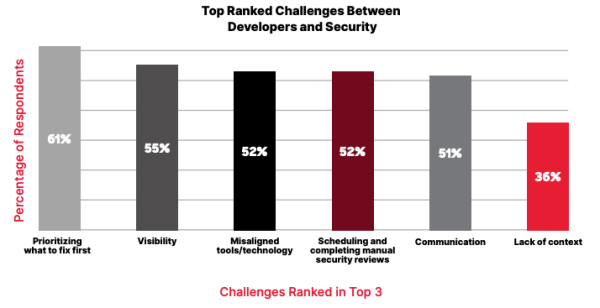
- Manual triaging is a productivity killer: When every security finding has to be manually reviewed, prioritized, and assigned, developers spend more time sifting through tickets than actually writing code. Crowdstrike’s 2024 State of Application Security Report found that 60% of DevSecOps teams cite prioritizing vulnerabilities as one of their top three application security challenges.
- Confusion over ownership leads to delays. Who owns a vulnerability? Is it the backend team? The app security team? The DevOps folks? If no one knows, it just sits there, unresolved, until it becomes an actual problem.
- Security and engineering don’t always see eye to eye. Security teams want everything fixed yesterday. Engineering teams need to balance security fixes with feature development and release deadlines. When priorities clash, security often takes a back seat. GitLab’s 2024 Global DevSecOps Report revealed that 58% of security respondents said they have a difficult time getting developers to prioritize remediation of vulnerabilities.
The result? Security bottlenecks that frustrate everyone involved. Development teams feel like security is just another roadblock, and security teams feel like they’re shouting into the void. And in the meantime, actual security risks keep piling up.
So, how do you fix this without forcing engineers to become full-time security analysts? Enter: Remediation Operations (RemOps).y leaders.
What is Remediation Operations (RemOps)?
Think of RemOps as the missing link between security and development – the thing that finally stops security issues from derailing engineering work. Instead of treating remediation as a slow, manual, someone-should-probably-fix-this kind of problem, RemOps turns it into a structured, automated process.
The problem isn’t that security exists; it’s that traditional vulnerability management is too inefficient to keep up with modern development cycles. RemOps fixes that by streamlining vulnerability management workflows, eliminating noise, automating the slowest parts of the process, and making remediation an integrated part of development. With RemOps, security no longer lags behind engineering – it moves with it.
And the best part? Developers get to focus on what they do best – building and shipping great software – without security becoming a constant source of frustration.
How RemOps Prevents Development Bottlenecks
We’ve covered why traditional vulnerability management is a headache and how RemOps changes the game. Now, let’s get into the details – how exactly does RemOps keep security from becoming a speed bump for engineering teams?
It Kills the Noise So Engineers Can Focus
The average security team generates way more findings than a development team can realistically handle. Seemplicity’s 2024 Year in Review Report revealed that, on average, organizations generate nearly 50 million findings a year.

And while some of those are critical, most of them aren’t. Security tools tend to flood teams with alerts, many of which are duplicates or low-priority issues that don’t need immediate attention. Instead of letting engineers get buried under a pile of unnecessary tickets, RemOps consolidates findings from multiple tools and automatically deduplicates redundant alerts, eliminating the clutter that slows teams down. When the same vulnerability gets flagged by multiple scanners, RemOps merges them into a single actionable task instead of overwhelming engineers with duplicate tickets. This means teams don’t have to sift through the same vulnerability flagged ten different ways – they see one ticket with all the relevant details.
And because not every vulnerability is a high-priority crisis, RemOps applies intelligent prioritization, ensuring that developers focus on the most critical issues first. Instead of treating every security finding as an emergency, it ranks vulnerabilities based on exploitability, business impact, and risk context so developers know exactly what to tackle and when.
By cutting out the noise, engineers spend less time chasing security tickets and more time doing what they were actually hired to do: building software.
It Automates the Boring, Repetitive Work
One of the biggest bottlenecks in remediation isn’t the actual fixing of vulnerabilities, it’s everything that comes before that. Manually reviewing, assigning, and tracking security issues is a productivity killer. Yet, without a structured system, security teams often waste hours just figuring out who should fix what. That’s where automation comes in.
RemOps eliminates the need for security teams to manually route vulnerabilities by automatically assigning each issue to the right person or team instantly. There’s no more guesswork, no more manual triaging, and no more wasted back-and-forth between security and development trying to figure out ownership. Even better, RemOps integrates directly into the tools that engineers already use – whether it’s Jira, Azure DevOps, or ServiceNow – so remediation tasks flow seamlessly into existing workflows. Developers don’t have to check yet another platform to track security tasks, and security teams don’t have to chase people down to make sure issues get addressed.
By removing manual effort from the equation, RemOps ensures that security issues don’t just sit in limbo, waiting for someone to deal with them. Instead, remediation happens as part of the normal development workflow, without slowing teams down.
It Makes Ownership Crystal Clear
One of the most frustrating parts of traditional vulnerability management is the lack of clear ownership. When no one knows who is responsible for fixing a security issue, it tends to get stuck in limbo – unresolved, deprioritized, and eventually forgotten until it becomes a bigger problem. RemOps eliminates this issue by ensuring that every vulnerability has a clearly assigned owner from the moment it’s identified.
There’s no more ambiguity or “I thought you were handling that” moments. Every security finding is assigned to the right developer or team, and it’s tracked against well-defined SLAs to ensure nothing slips through the cracks. Engineers don’t just get a vague security report thrown at them; they receive structured, actionable tasks with all the context they need to fix the issue efficiently. Instead of getting bogged down in back-and-forth questions with security teams, developers know exactly what needs to be fixed, why it matters, and how to resolve it.
When security tasks are clearly owned and tracked, remediation actually happens instead of getting pushed to the bottom of the backlog. The result? Faster fixes, fewer unresolved security risks, and engineering teams that aren’t constantly scrambling to deal with last-minute security fire drills.
The Business Impact of RemOps on Engineering Teams
If you’re leading an engineering team, security probably feels like an inevitable headache. Traditional vulnerability management only makes it worse, piling on delays, unnecessary friction, and endless security tickets. That’s why RemOps isn’t just a security solution – it’s an engineering leadership strategy that keeps security from becoming a bottleneck. RemOps is the difference between security being a constant roadblock and it becoming a streamlined, automated part of development. And for engineering leaders, that translates into some serious benefits.
Faster Fixes Without Slowing Development
Security debt adds up fast. The longer vulnerabilities sit unresolved, the harder – and riskier – they become to fix. RemOps eliminates these delays by automating triage, prioritization, and assignment in real time. Instead of security findings piling up, they move through structured workflows instantly, getting resolved as part of normal sprint cycles. Security risks are handled before they become a crisis, without derailing development.
Happier, More Productive Developers
Developers hate security busywork. Manually sorting security alerts, chasing vague reports, and switching between tools disrupts their core work. RemOps fixes this by delivering clear, prioritized tasks directly into their workflow; no more wasted cycles, no unnecessary context-switching. Security becomes a seamless part of development, not a frustrating distraction, allowing developers to refocus on what matters most: building great products that drive business growth!
Stronger Collaboration Between Security and Engineering
Security teams shouldn’t be the enemy, but misalignment makes it feel that way. RemOps changes the dynamic by ensuring security and engineering operate from the same playbook with clear priorities, shared accountability, and no surprises. Security teams get confidence in remediation, developers get less friction, and both teams work better together.
Security That Moves as Fast as Your Engineering Team
Security doesn’t have to slow development down; it only does when the process is broken. Traditional vulnerability management is messy, inefficient, and full of roadblocks that frustrate engineering teams and delay fixes. RemOps changes that.
By cutting out noise, automating repetitive tasks, and making ownership crystal clear, RemOps turns security from a bottleneck into a seamless part of the development process. Vulnerabilities get fixed faster, engineers stay focused on shipping code, and security teams finally get confidence that remediation is actually happening within the defined SLAs. It’s a win for everyone.
For engineering leaders, the message is clear: secure software development doesn’t have to come at the cost of speed. With the right approach, security can move with development, not against it. And in today’s fast-paced, high-stakes environment, that’s not just nice to have – it’s non-negotiable.
If your team is tired of security slowing them down, it’s time to rethink the process. Learn how Seemplicity’s RemOps platform can help streamline your security workflows and keep engineering teams moving forward.

Stay updated on Seemplicity blog
Subscribe today to stay informed and get regular updates from Seemplicity.