



/Centralize exposure data
The centralized foundation for Agentic Exposure Management
Bridge the gap with a single source of truth for cloud, code, and infrastructure risk.
Manual coordination doesn’t scale across cloud, infrastructure, and code
When managing thousands of identities, configs, assets, services, and code paths, manual processes break down.

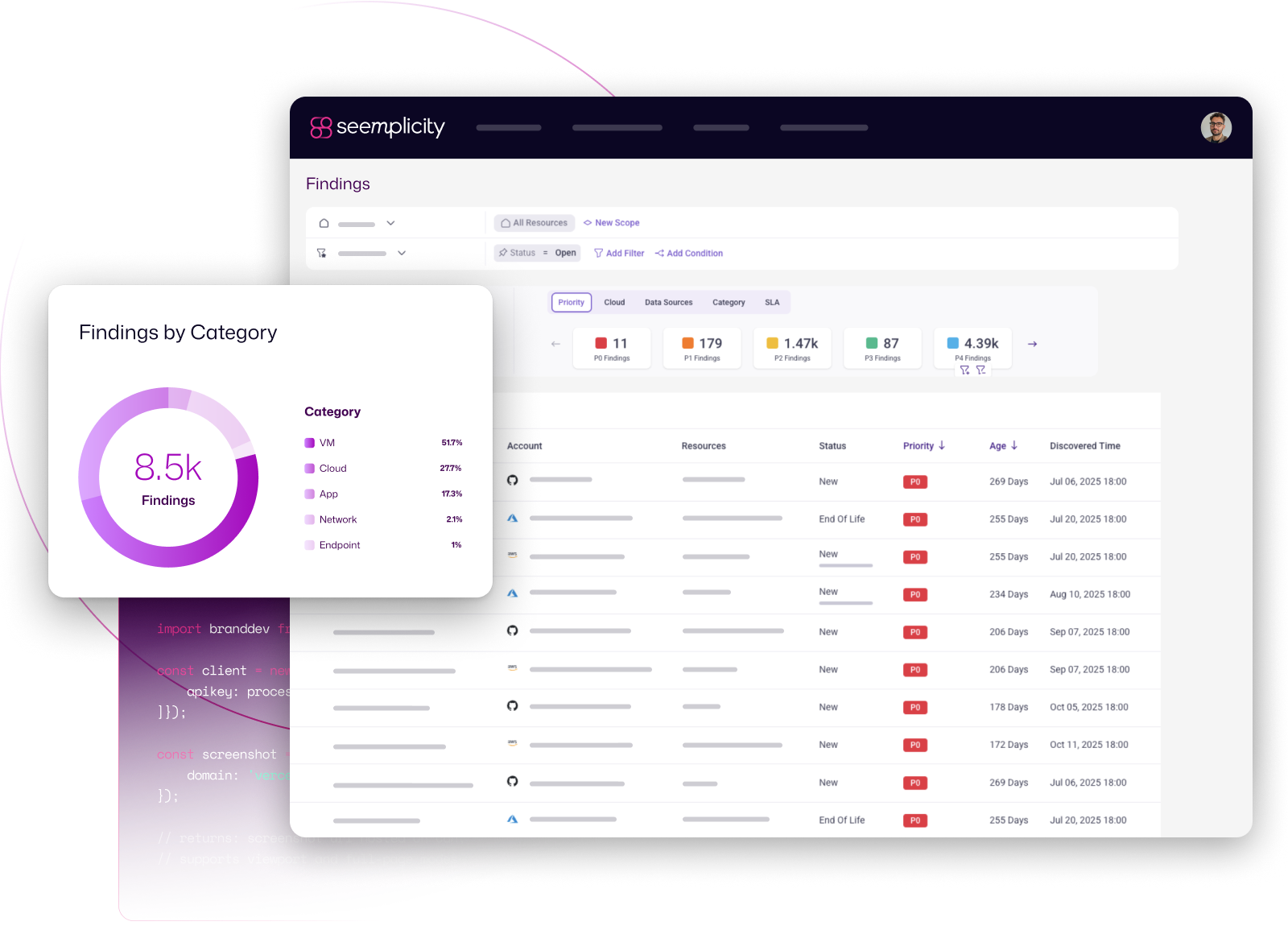
Fragmented Tool Sprawl: Disparate tools and inconsistent data make it impossible to maintain a single, unified view of total risk.

Opaque Risk Posture: A lack of continuous visibility prevents leaders from proving measurable risk reduction to the board and executives.

Inconsistent Prioritization: Without business context, teams waste time on low-impact findings while critical exposures sit in growing backlogs.

Accountability Ambiguity: Unclear asset ownership leads to misrouted tickets, finger-pointing, and remediation cycles that drag on for weeks.
Unified data to fuel proactive risk reduction
Aggregate cloud, code, and infrastructure findings into a single source of truth
Centralize security findings into a single, normalized view
Unify exposures across cloud, infrastructure, and applications into one agent-ready data model.
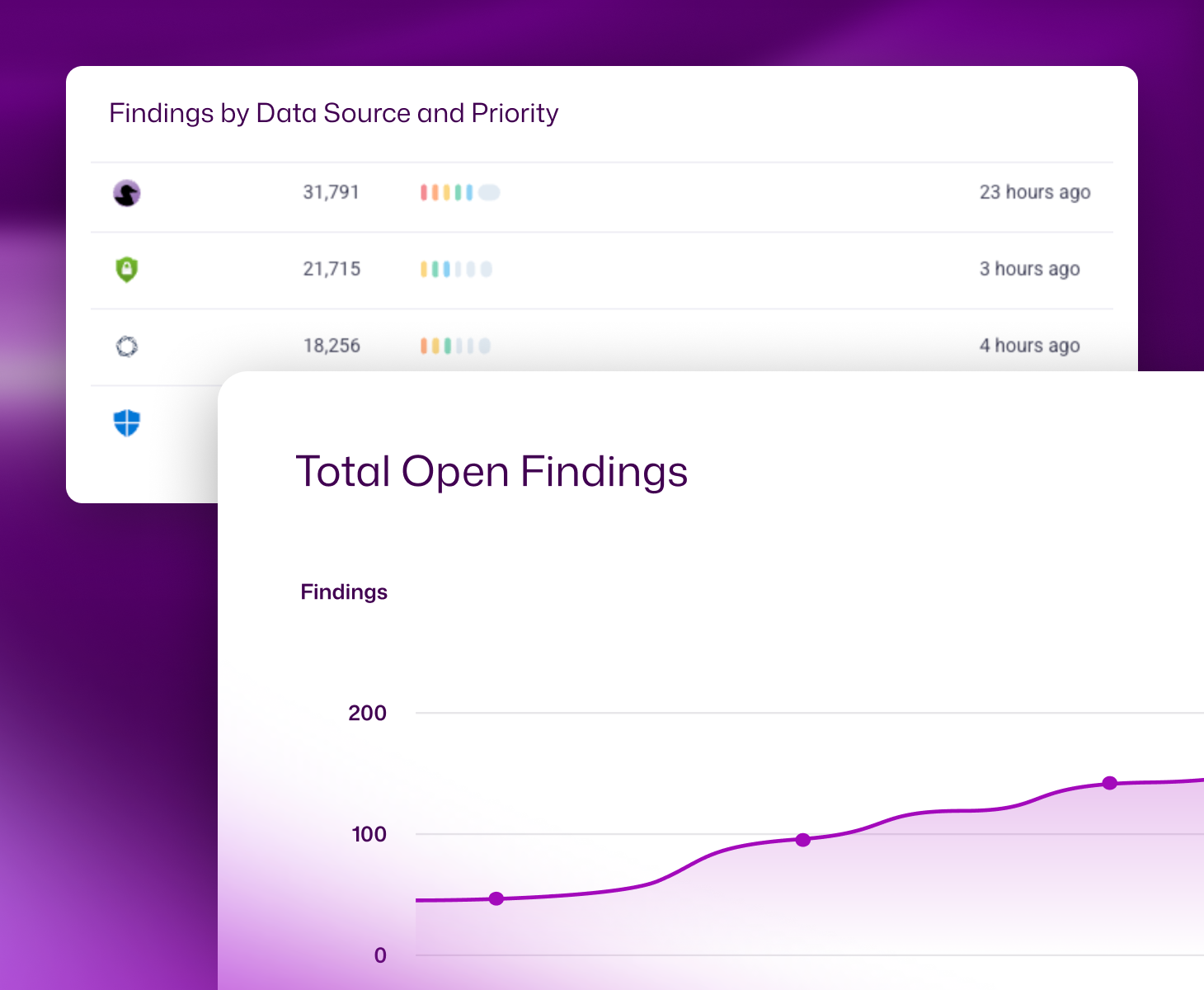
Deduplicate and aggregate findings for maximum impact

Prioritize remediation by business risk and context

Simplify risk oversight with a unified workspace

Risk visibility features for complex, multi-tool security ecosystems
Unified exposure backlog
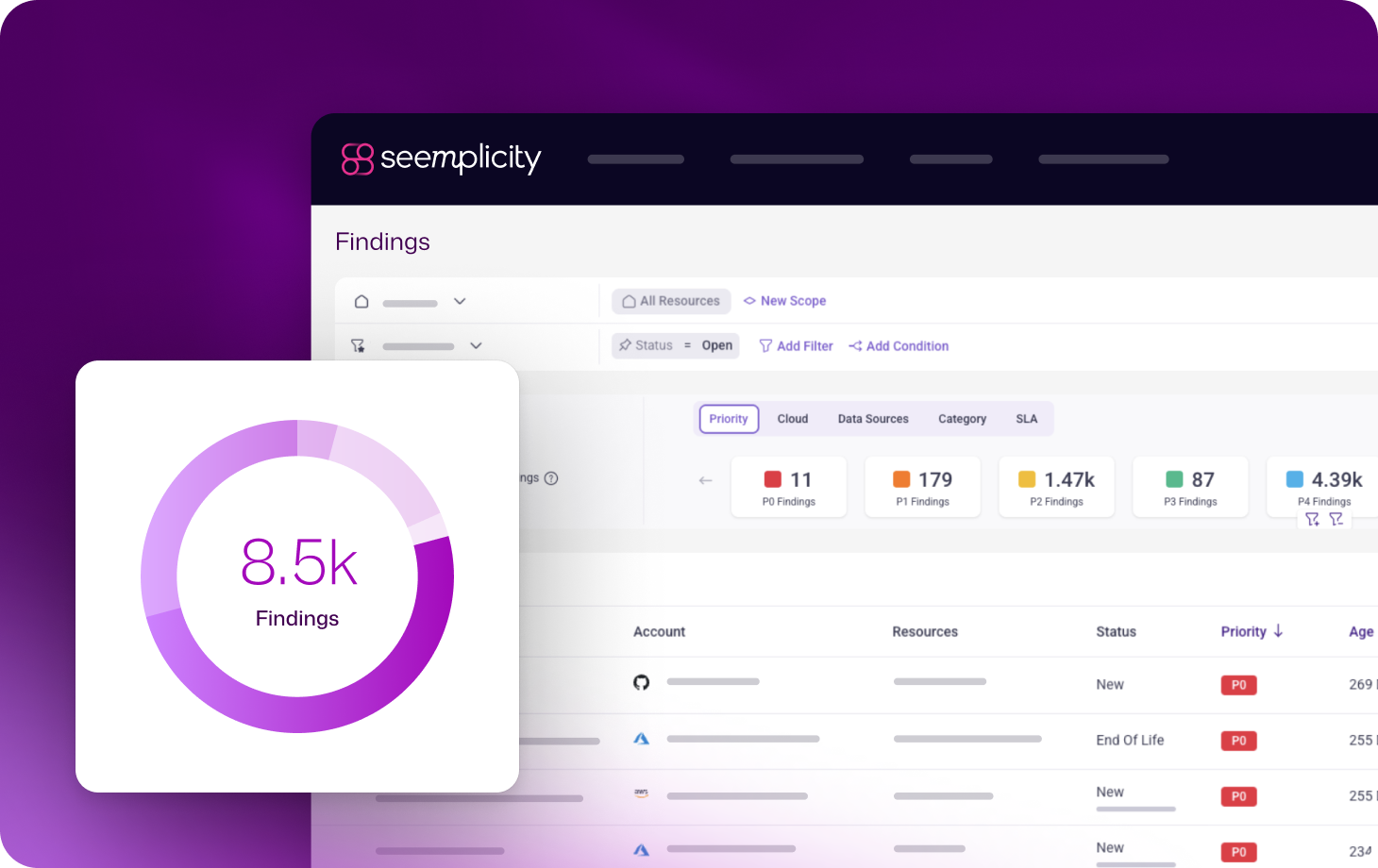
Seemplicity creates a single source of truth across all domains, including code, cloud, SaaS, and on-premises platforms.
Unified risk scoring

The platform translates default scores from various scanners into a single, normalized scoring system.
Context enrichment

The platform enhances raw findings with exploitation intelligence (such as CISA-KEV, VulnCheck-KEV, and EPSS) and organizational context.
Tag explorer & asset visibility

Seemplicity manages how assets are tagged across the environment, helping teams identify consistency gaps and ensure that every asset is accounted for.
Validation and remediation history

Seemplicity provides visibility into recurring issues by automatically reopening tickets with historical context.
Unified visibility for enterprise scale
Eliminate data silos to drive faster fixes across cloud, code, and infrastructure.


/research Report
2026 Exposure Action Report
Real exposure management insights based on 2025 customer data. Learn how teams scale remediation, reduce backlogs, and drive measurable risk reduction.
Frequently asked questions
Most enterprise security programs rely on a fragmented collection of scanning tools, each designed to address a specific domain, such as cloud misconfigurations, application vulnerabilities, infrastructure weaknesses, or identity risks. These tools generate findings in different formats, using different severity scales and asset identifiers, making it exceptionally difficult to aggregate results into a coherent, organization-wide risk picture. The result is that security teams spend significant time manually correlating data across systems rather than acting on it.
Compounding the challenge is the rate at which modern environments change. Cloud-native architectures, CI/CD pipelines, and ephemeral workloads mean that the attack surface shifts continuously, while static or siloed data sources quickly become stale. Without a unified data model that ingests and normalizes findings in real time, teams are effectively managing risk from an incomplete and outdated map.
A single source of truth in exposure management refers to a centralized, continuously updated data layer that consolidates security findings from across all scanning and detection tools into one normalized, queryable view. Rather than maintaining parallel datasets in separate platforms, security teams work from a unified record that reflects the organization’s current risk posture across cloud, code, SaaS, and on-premises infrastructure.
The strategic value of this approach is significant. When all stakeholders – vulnerability management teams, security engineers, GRC professionals, and leadership – operate from the same data, prioritization decisions become consistent, escalation paths become clear, and progress becomes measurable. It also reduces the risk of critical exposures being overlooked because they were captured by one tool but not visible to the teams responsible for remediation.
Tool sprawl occurs when organizations deploy multiple point solutions to address individual security domains without an integration layer to unify their output. Each tool applies its own risk-scoring methodology, asset taxonomy, and finding format, creating significant data inconsistency across the security stack. When teams attempt to prioritize remediation across these disparate data sets, they face conflicting severity ratings for the same underlying exposure and no reliable mechanism to identify which issues represent the greatest actual business risk.
Beyond data quality issues, tool sprawl introduces operational overhead that compounds over time. Security analysts must manually export, normalize, and cross-reference findings; a process that is slow, error-prone, and difficult to scale. As the number of integrated tools grows, the volume of raw findings typically increases faster than team capacity, leading to growing backlogs and inconsistent prioritization. Centralizing exposure data is the foundational step to breaking this cycle.
You’ll get a tailored walkthrough of our cyber risk platform, including key features,
use cases, and how it integrates witWithout a centralized exposure data layer, organizations face several compounding risks. Chief among them is inconsistent prioritization: when different teams work from different data sources, high-severity exposures may be deprioritized in one queue while low-impact findings consume remediation resources in another. This misallocation directly extends mean time to remediation (MTTR) for critical vulnerabilities and increases the window of exploitability. AI-powered reconnaissance tools are increasingly enabling attackers to identify and exploit these gaps faster than they would have been able to in the past, making the cost of delayed remediation materially higher.
There are also significant governance and reporting consequences. Security leaders who cannot present a unified, data-backed view of organizational risk exposure are poorly positioned to demonstrate measurable risk reduction to the board or to justify security investment decisions. Audit and compliance requirements are similarly difficult to satisfy when evidence of remediation activity is scattered across disconnected systems with no traceable chain of record.
Effective normalization begins with establishing a common asset inventory that serves as the authoritative reference for all findings. Because different scanners identify the same asset using different identifiers, such as IP address, hostname, cloud resource ID, container name, a shared asset model is required to correlate findings accurately and avoid both duplication and blind spots. Organizations should also define a unified severity framework that translates each scanner’s native scoring into a consistent internal scale, typically incorporating contextual signals such as EPSS scores, CISA KEV status, and asset criticality alongside raw CVSS values.
From an operational standpoint, normalization should be treated as an ongoing process rather than a one-time project. As new tools are onboarded, as environments scale, and as the threat landscape evolves, the data model must adapt. Teams that build normalization into their exposure management workflows, rather than addressing it reactively, are better positioned to maintain continuous visibility and to feed downstream prioritization and remediation processes with reliable, actionable data.
Raw findings data, even when centralized and normalized, provides limited decision-making value without asset context. Knowing that a vulnerability exists is less actionable than knowing which business unit owns the affected system, what data it processes, whether it is publicly accessible, and whether compensating controls are in place. Asset context transforms a list of findings into a prioritized, accountable remediation plan by surfacing the organizational significance of each exposure alongside its technical severity.
Effective asset context enrichment typically includes tagging assets by environment (production versus development), business function, data classification, and ownership. When this context is embedded into the centralized exposure data model, security teams can segment risk by business unit, route remediation tickets to the correct owners automatically, and apply prioritization logic that reflects actual business impact rather than generic severity scores alone.
Security leaders are increasingly expected to present risk in business terms; not just as a volume of vulnerabilities, but as a measurable posture that can be tracked over time and compared against organizational risk thresholds. Centralized exposure data makes this possible by providing a consistent, authoritative dataset from which meaningful metrics can be derived: risk reduction trends, MTTR by team or asset class, coverage gaps, and the proportion of critical exposures remediated within defined SLAs.
When exposure data is fragmented, reporting requires manual aggregation that is slow, inconsistently produced, and difficult to validate. Centralization enables live dashboards and scheduled reporting that give executives and board members real-time visibility without placing additional burden on the security team. This operational efficiency also strengthens an organization’s position during audits, regulatory examinations, and cyber insurance assessments, where the ability to demonstrate continuous, documented risk management activity is increasingly a baseline expectation.



Say Goodbye to
Backlog of vulnerabilities
Misconfigurations
Scattered findings across tools