




/ensure audit readiness
Prove continuous security compliance
Gain granular visibility and audit-ready tracking across your distributed attack surface.
Manual governance fails the modern audit
Static spreadsheets and manual coordination cannot provide the continuous proof required by today’s regulatory frameworks.

Stale Evidence: A monthly PDF is a snapshot, not a control. Point-in-time reporting is obsolete the moment it’s exported.

The Accountability Gap: “Who owns this?” kills audit readiness. Without a chain of custody, you can’t prove responsibility or why a deadline was missed.

Arbitrary Prioritization: CVSS-only patching isn’t a defensible strategy. Without a risk-based rationale, auditors will flag your program as arbitrary and non-compliant.

Unmanaged SLA Drift: Policy is meaningless without enforcement. If you can’t prove you met remediation deadlines, auditors see your program as unenforced.
Always-On Audit Readiness
Normalize and rank data to turn fragmented scans into a unified, verifiable record of remediation.
Defensible system of record
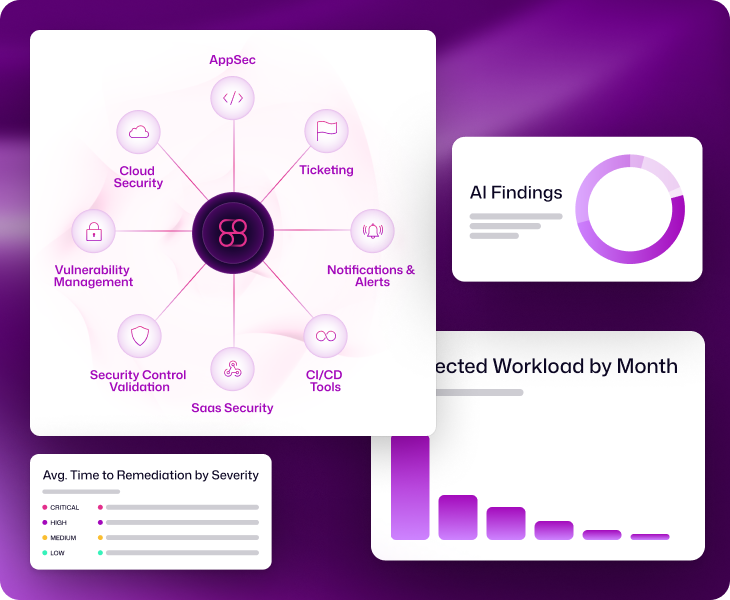
Normalize fragmented tool data into a unified layer. Establish the consistent, high-context evidence needed to prove your security posture to auditors.
Automated accountability
Live policy governance
Verifiable fix cycles

Platform Capabilities for Global Governance
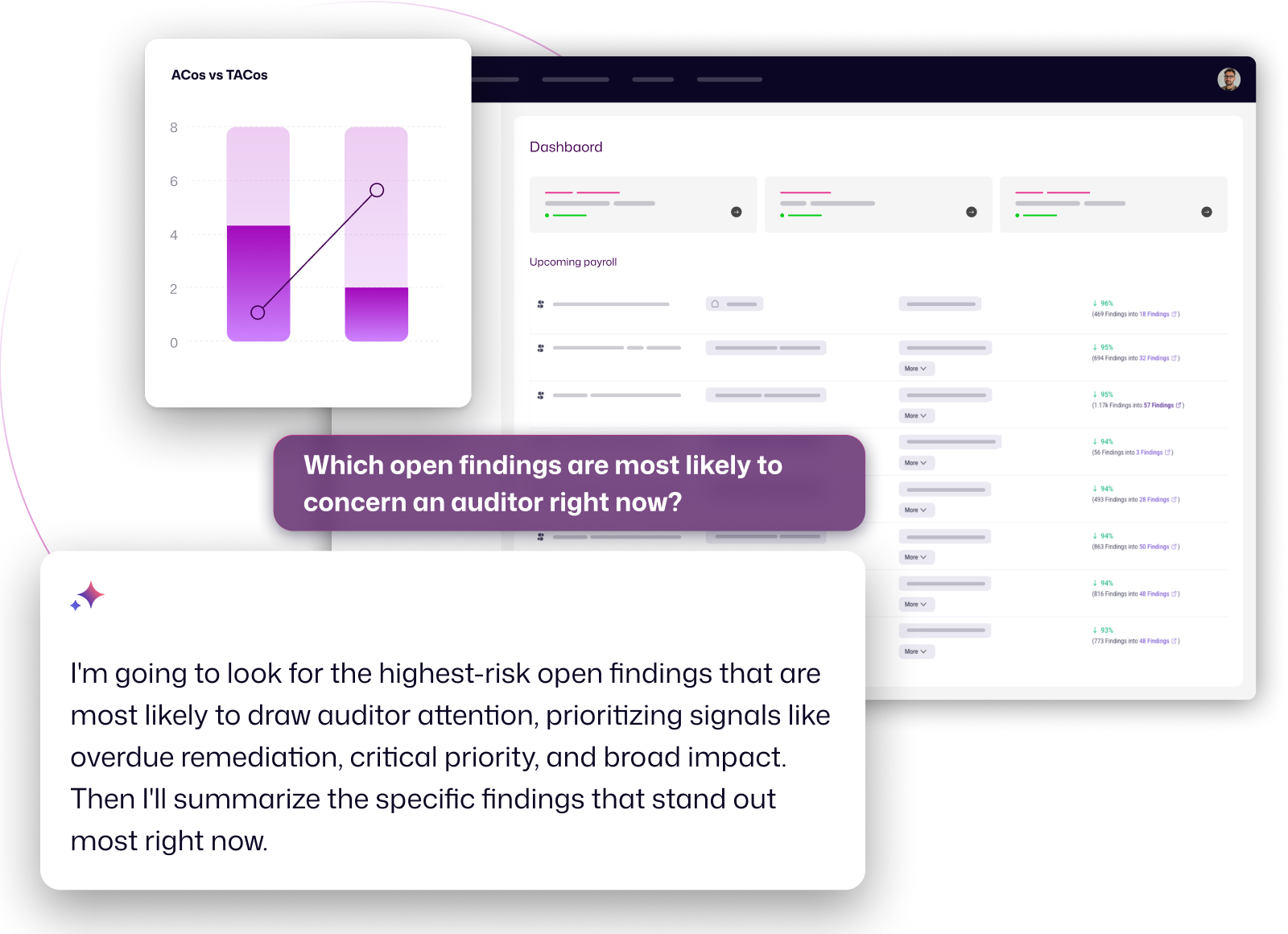
Instant Evidence through Conversational AI
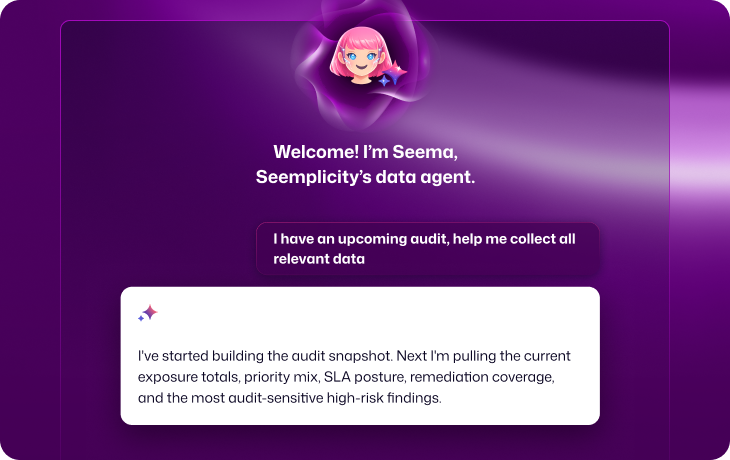
Query your security posture in plain English, providing immediate, documented answers to complex compliance questions without manual data mining.
Full-Timeline Traceability
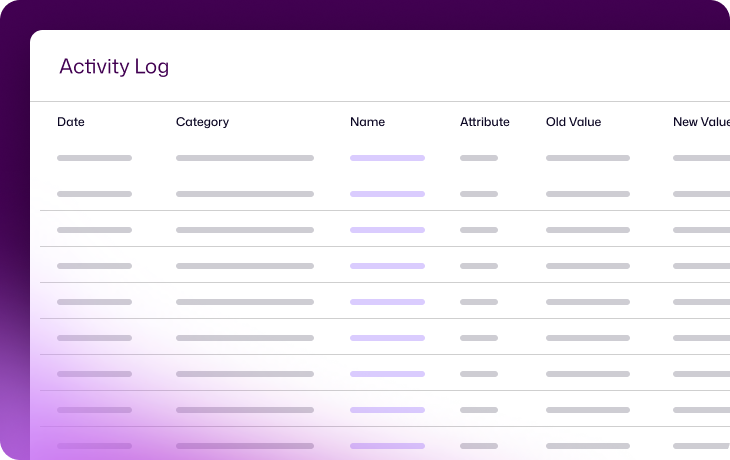
Track every change in your remediation lifecycle. From automated syncs to manual SLA updates, maintain a clear record of exactly who did what and when.
Real-Time SLA Tracking
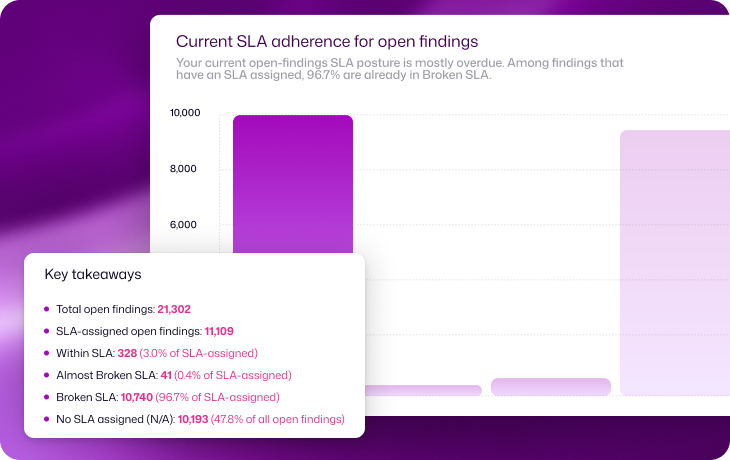
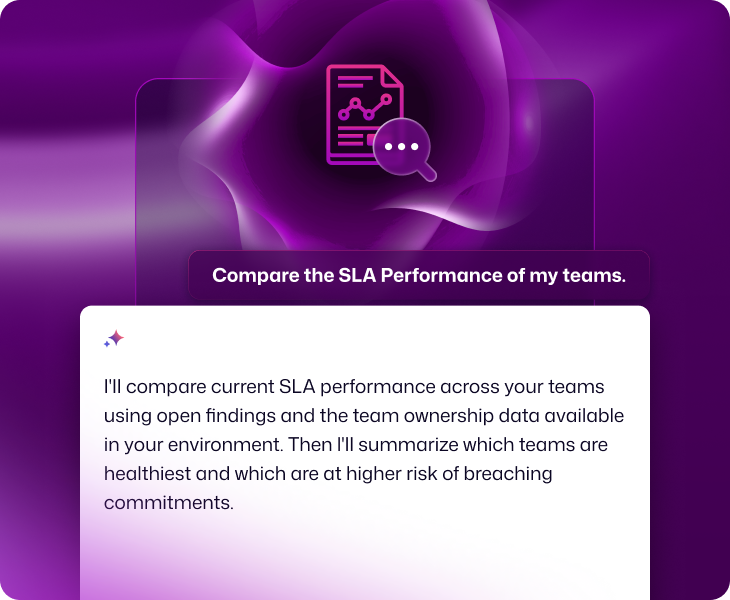
Monitor your security health by mapping every vulnerability to its specific remediation deadline, ensuring teams stay accountable to agreed-upon risk thresholds.
Transform your backlog into a streamlined action plan
Build a scalable process that unifies data streams into a high-impact list of remediation items.


/research Report
2026 Exposure Action Report
Real exposure management insights based on 2025 customer data. Learn how teams scale remediation, reduce backlogs, and drive measurable risk reduction.
Frequently asked questions
Most security programs were designed around periodic assessments rather than continuous compliance, leaving them structurally unfit for the demands of modern regulatory frameworks. Teams typically rely on point-in-time exports, such as spreadsheets, static PDFs, and manual status reports, which are outdated the moment they are generated. When an audit occurs, the scramble to reconstruct evidence of remediation activity, ownership, and policy adherence consumes significant resources and introduces substantial risk of findings gaps.
The underlying challenge is fragmentation. Security data is spread across multiple scanning tools, ticketing systems, and teams, with no unified record connecting a discovered vulnerability to its remediation outcome. Without a centralized, normalized system of record, it is impossible to demonstrate a consistent, defensible security posture to auditors or regulators.
A defensible remediation record is one that provides complete traceability from the initial discovery of a vulnerability through every subsequent action – triage, assignment, remediation, and verification – with documented timestamps and clear accountability at each stage. Auditors are not simply looking for a list of patched items; they require evidence that the organization’s internal controls were actively enforced, not merely documented on paper.
This means the record must capture who was responsible for a given exposure, what risk-based rationale drove its prioritization, whether the applicable SLA was met, and how the resolution was confirmed. Relying solely on CVSS scores as a prioritization method is increasingly indefensible; auditors expect organizations to demonstrate contextual, risk-informed decision-making aligned with recognized frameworks such as NIST, ISO 27001, or CIS Controls.
Remediation SLAs are a core component of most security policies and compliance frameworks, translating risk tolerance into enforceable deadlines. When SLA adherence cannot be demonstrated, whether due to poor tooling, unclear ownership, or inconsistent enforcement, auditors interpret the gap as evidence that the organization’s security program exists on paper but not in practice. This distinction between a documented policy and an enforced control is one of the most common causes of audit findings and regulatory citations.
Beyond the audit itself, unmanaged SLA drift allows high-risk vulnerabilities to remain open well beyond their acceptable remediation window, directly increasing exposure to exploitation. Organizations subject to frameworks such as PCI DSS, SOC 2, HIPAA, or the NIS2 Directive face particular scrutiny around SLA governance, as these standards explicitly require evidence of timely remediation tied to risk classification.
Point-in-time compliance reporting captures a snapshot of an organization’s security posture at a specific moment – typically just before an audit – and offers no insight into how that posture was maintained over the preceding period. This approach is inherently reactive, often requires intensive manual effort to compile, and creates a window of risk between assessments during which control failures can go undetected and unaddressed.
Continuous compliance, by contrast, maintains a living record of security activity across the full remediation lifecycle. It treats audit readiness as an operational state rather than a periodic event, ensuring that evidence of control effectiveness – ownership records, SLA performance data, remediation timelines – is generated automatically and consistently. As regulatory bodies increasingly expect organizations to demonstrate ongoing due diligence rather than annual attestation, continuous compliance has shifted from a best practice to a baseline expectation.
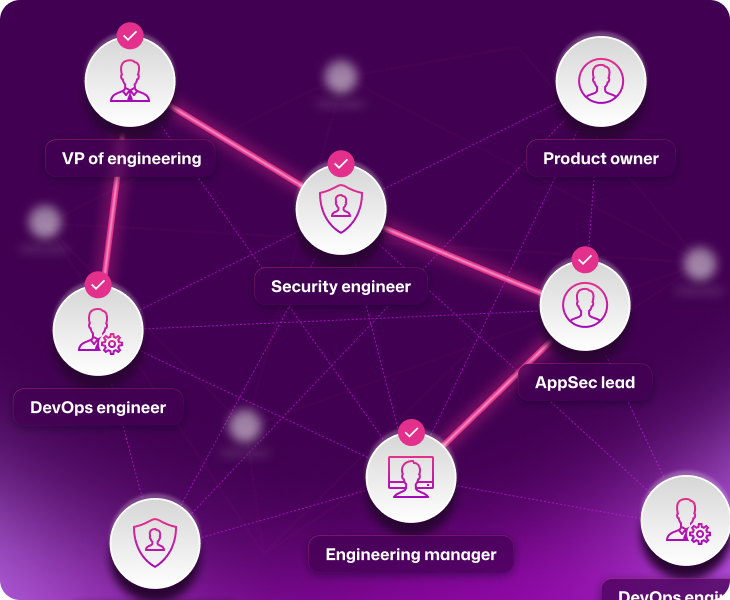
When a vulnerability cannot be definitively mapped to a responsible owner, the entire remediation process becomes difficult to enforce and impossible to audit. Ownership ambiguity leads to missed deadlines, duplicated effort, and an absence of accountability, all of which are red flags during compliance reviews. Auditors evaluating a vulnerability management program will look for clear chain-of-custody evidence: who was assigned responsibility, when, and what actions they took in response.
In organizations with distributed infrastructure spanning cloud environments, on-premises systems, and third-party applications, establishing and maintaining accurate ownership is particularly complex. Effective audit readiness requires that ownership assignment be systematic and consistent, with automated routing that maps findings to the correct remediation team based on asset context, rather than relying on ad hoc escalations that leave no auditable trail.
Most major security and privacy compliance frameworks include explicit requirements for vulnerability management documentation, though the specifics vary by standard. PCI DSS requires organizations to establish a risk-based patching process with defined timelines, while SOC 2’s Availability and Risk Management criteria demand evidence that identified vulnerabilities are tracked, prioritized, and addressed within an acceptable timeframe. ISO 27001 requires organizations to demonstrate systematic management of technical vulnerabilities as part of their information security management system.
The NIS2 Directive, which broadens cybersecurity obligations across critical sectors in the EU, and the SEC’s cybersecurity disclosure rules in the US have added further regulatory weight to the expectation of documented, auditable remediation programs. Across all these frameworks, the common thread is that documentation must be substantive, demonstrating not just that vulnerabilities were identified, but that a consistent, risk-informed process was followed to address them.
AI is reshaping audit readiness in two opposing directions simultaneously. On the defensive side, AI-driven capabilities are enabling organizations to automate the evidence generation, ownership mapping, and SLA tracking processes that previously required extensive manual effort, making continuous compliance more operationally feasible at scale. This shift is raising the bar for what auditors and regulators consider an adequate vulnerability management program, as manual, spreadsheet-driven approaches become increasingly difficult to justify when more rigorous alternatives exist.
On the threat side, adversaries are leveraging AI to accelerate reconnaissance, generate novel attack variants, and compress the time between vulnerability disclosure and exploitation. This shrinks the window in which unpatched vulnerabilities represent acceptable risk, putting additional pressure on organizations to demonstrate not just that they have a remediation process, but that it operates with sufficient speed and consistency to keep pace with an accelerating threat landscape. Regulators are beginning to account for this dynamic when evaluating whether an organization’s security controls are proportionate to the risks it faces.


Say Goodbye to
Backlog of vulnerabilities
Misconfigurations
Scattered findings across tools