


/TL;DR
The security industry has reached a turning point with AI. It’s no longer just hype, as AI has now become a critical part of day-to-day cybersecurity operations. According to The Rise of AI-Powered Vulnerability Management, the latest report from Seemplicity and Dark Reading, 86% of security teams now use some form of AI in their security stack. More than half of respondents say AI is already crucial to their work. Reflecting this shift, 75% of organizations say they’re increasing their AI budget for 2025, according to industry analyst firm Gartner.
As AI is making significant strides within multiple domains, from endpoint protection to malware detection, one area stands out as the most promising for impact: vulnerability and exposure management.
The Case for AI in Vulnerability Management
The report shows that 74% of security professionals believe AI will provide the most value in vulnerability and risk management over the next three years—more than any other area of cybersecurity.
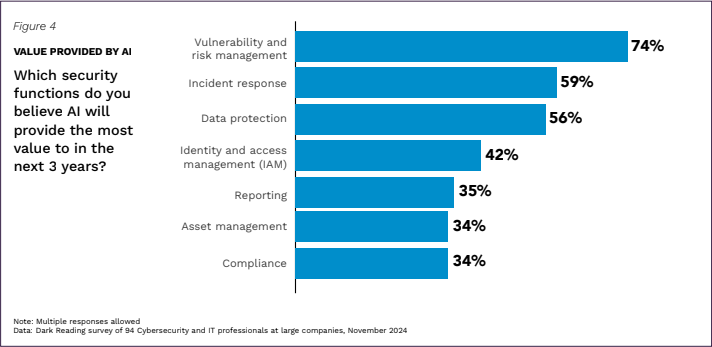
That’s not surprising. Security teams are drowning in alerts, frustrated with fragmented scan results, and struggling to prioritize what to work on first. AI has the potential to change that by:
- Filtering out false positives
- Correlating disparate scan results
- Streamlining prioritization decisions
- Automating portions of remediation workflows
Today, only a quarter of organizations are using AI for vulnerability prioritization, and even fewer are applying it to remediation. But that’s expected to change fast. As teams grow more comfortable with AI, the use cases will mature, and vulnerability management is leading the charge.
Reality Check: AI Is Powerful – But Imperfect
Despite the optimism, the report also reveals that AI isn’t a silver bullet. According to the report, 77% of security professionals say vendors are overhyping their AI capabilities, and many teams are struggling to turn promise into performance.
The top challenges holding AI back include:
- Lack of skilled personnel to implement and manage AI-driven workflows (55%)
- Data quality and accuracy issues that undermine AI effectiveness (51%)
- Limited transparency in how AI makes decisions, making it hard to trust or act on recommendations (46%)
These issues are slowing adoption in more complex use cases like prioritization and remediation. While AI has promise, for many teams it still introduces friction instead of reducing it, creating uncertainty, adding noise, or producing outputs that require too much manual interpretation. Until these challenges are addressed, AI will remain more of a work in progress than a game changer.
Where AI Is Delivering Value
Despite the challenges associated with AI implementation, the report shows that AI is providing value in a few areas already. The top use cases currently include:
- Endpoint security (52%)
- Basic vulnerability scanning (47%)
- Antivirus and anti-malware detection (40%)
These are the “low-hanging fruit” for AI – tasks that benefit from simple machine learning models. But for AI to move the needle in cybersecurity, it needs to move beyond the basics and into more strategic territory like exposure management.
What Security Teams Should Do Next
How can teams make the most of AI without falling into the trap of overhype? The report offers a few practical steps:
1. Be Discerning in Vendor Selection
Not all AI-powered tools are created equal. Ask questions about false positive rates, ease of configuration, and how transparent AI models are. Look for vendors that offer explainable, usable results that won’t require a PhD in data science to make sense of them.
2. Focus AI Where It Can Have the Greatest Impact
Rather than spreading AI thin across dozens of tools, focus on areas where it can provide immediate ROI. Vulnerability and exposure management is a great place to start, especially for teams looking to reduce noise, streamline prioritization, and accelerate remediation.
3. Adopt AI Incrementally, Not All at Once
Start small. Whether you’re enhancing prioritization or automating part of your workflow, taking a phased approach to AI implementation allows your team to adapt and improve without being overwhelmed.
What This Means Going Forward
The analyst perspective is straightforward. Exposure management is becoming the connective tissue between asset intelligence, threat context, and remediation. As security categories continue to converge, the teams that succeed will be the ones focused on outcomes, not tool sprawl.
The priority going forward is not finding more issues. It is reducing the exposure that actually matters.
The 2025 Modern Risk and Exposure Management Platforms report offers a detailed look at how the exposure management landscape is evolving, what practitioners are asking for, and how modern platforms are responding.
The Path Forward for AI
AI is transforming day-to-day cybersecurity operations, and its potential for impact is especially strong in areas like vulnerability and exposure management, where noise, manual effort, and data overload still slow teams down.
The path forward isn’t about chasing hype. It’s about applying AI deliberately, where it can make the biggest difference. That means choosing tools that deliver real value, starting with focused use cases and building trust through transparency and results.
For security teams, this is the perfect time to shift from experimentation to execution—and to implement AI in a way that delivers clear, actionable outcomes without adding complexity.
To download the full report, click here.

Stay updated on Seemplicity blog
Subscribe today to stay informed and get regular updates from Seemplicity.