


/ Seemplicity Remediation Agent: Accelerating Vulnerability Fixes with Contextual Guidance
Seemplicity’s Remediation Agent streamlines exposure management by embedding asset-specific, step-by-step resolution guidance directly into security findings. By eliminating the need for manual research, this context-aware tool empowers security and engineering teams of all skill levels to fix vulnerabilities faster and with greater consistency. Ultimately, the Remediation Agent reduces manual rework, prevents misconfigurations, and significantly accelerates the time-to-resolution from initial assignment to successful remediation.
Fixing a vulnerability should be a straightforward next step, not a research project. Unfortunately for many security and engineering teams, remediation slows down the moment a finding is assigned. Documentation is scattered, vendor guidance quality varies, and routine fixes often require searching, validating, and double-checking before taking action.
The result is an operational challenge: teams know what needs attention, but they don’t always know how to address it confidently.
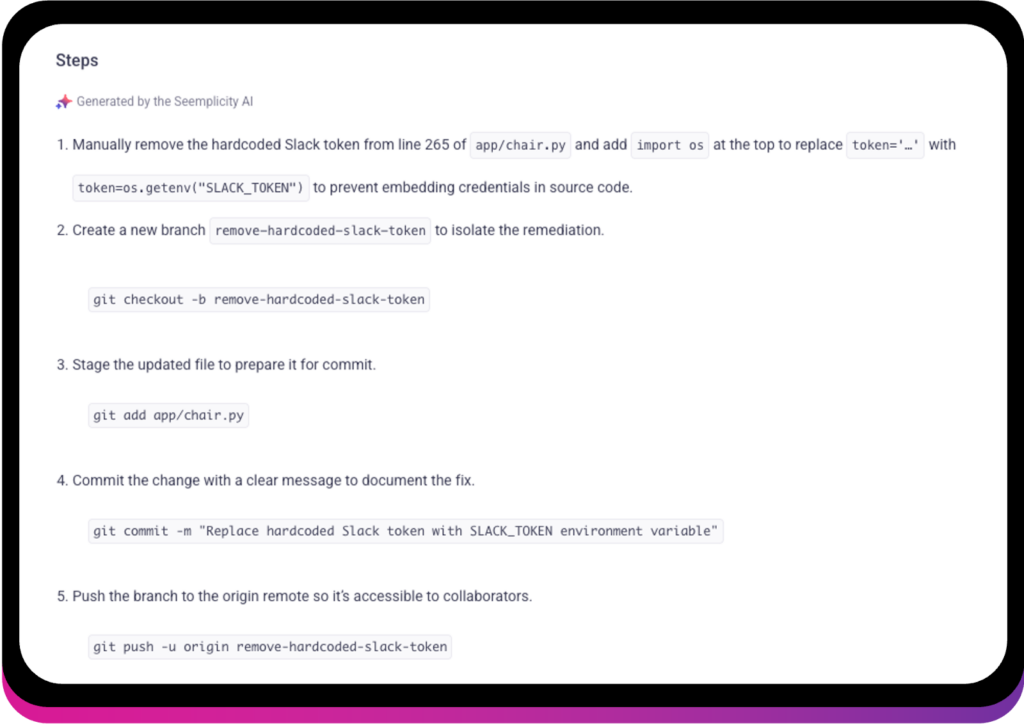
Seemplicity’s Remediation Agent resolves this gap by delivering precise, contextual, step-by-step guidance directly within each finding. Instead of relying on tribal knowledge or external searches, engineers get clear instructions tailored to the asset, the environment, and the specific issue at hand.
From Ambiguity to Actionable Instructions
Remediation can be a time-consuming phase in exposure management. Technical findings describe the problem in detail, but rarely provide a clear path to resolution. The Remediation Agent transforms this experience by embedding guidance that is:
Asset-Specific
Instructions reflect the actual technology involved: containers, web servers, libraries, cloud services, and more. Teams are no longer left to interpret generic recommendations or guess which documentation applies.
Context-Aware
Guidance is shaped by the environment in which the finding exists, providing steps that align with how engineers work across different systems.
Structured and Sequential
Each fix is broken into ordered, actionable steps, reducing the risk of partial resolutions or misconfigurations.
With consistent, high-quality instructions available within every finding, engineers can shift from interpreting problems to resolving them.
Reducing Variance, Rework, and Risk
When remediation is left to individual interpretation, outcomes can vary. Senior engineers may be familiar with the fix path, while junior team members may rely on external searches or incomplete notes. This inconsistency introduces delays, escalations, and potential errors.
The Remediation Agent standardizes the process across teams by ensuring engineers follow trusted guidance. This leads to:
- Faster resolution cycles
- More predictable outcomes
- Fewer reopens and fewer escalations
- Higher-quality, repeatable fixes
By consolidating the “how” of remediation into a reliable, centrally available resource, organizations strengthen both velocity and control.
Supporting Teams at Every Skill Level
Modern engineering teams are distributed, specialized, and often balancing an extensive workload. Clear, authoritative instructions reduce the cognitive overhead required to determine the correct approach to each fix.
For experienced engineers, the Remediation Agent removes unnecessary steps and accelerates work.
For newer team members, it provides structure and clarity that reduce uncertainty and prevent missteps.
For security leaders, it ensures that remediation is performed consistently and correctly across the organization.
The result is a more resilient process that scales with team growth and complexity.
From Assigned to Resolved
The Remediation Agent addresses one of the most persistent bottlenecks in exposure management: the translation of identified issues into reliable fixes. By providing embedded, contextual guidance directly in the workflow, it shortens time to resolution and ensures teams act with confidence from start to finish.
Clear guidance. Consistent execution. Fewer delays.
This is remediation with certainty and without the overhead.
See the Remediation Agent in Action
The Remediation Agent is part of Seemplicity’s suite of AI agents that streamline the journey from identification to resolution. Together, they help organizations reduce ambiguity, accelerate action, and improve the precision of their remediation operations.
See how the Remediation Agent accelerates ownership and routing within Seemplicity’s Exposure Action Platform™ by scheduling a demo here.

Stay updated on Seemplicity blog
Subscribe today to stay informed and get regular updates from Seemplicity.