
/TL;DR
Anthropic’s Project Glasswing and the Claude Mythos model represents a fundamental change in the physics of cyber defense. With the gap between patch releases and weaponized exploits shrinking to hours, traditional manual security triage is now obsolete. Organizations must adopt AI-driven automated remediation. Seemplicity enables organizations to scale their cyber defense by autonomously investigating, fixing, and verifying vulnerabilities to empower security teams to resolve critical threats as fast as AI can discover them.
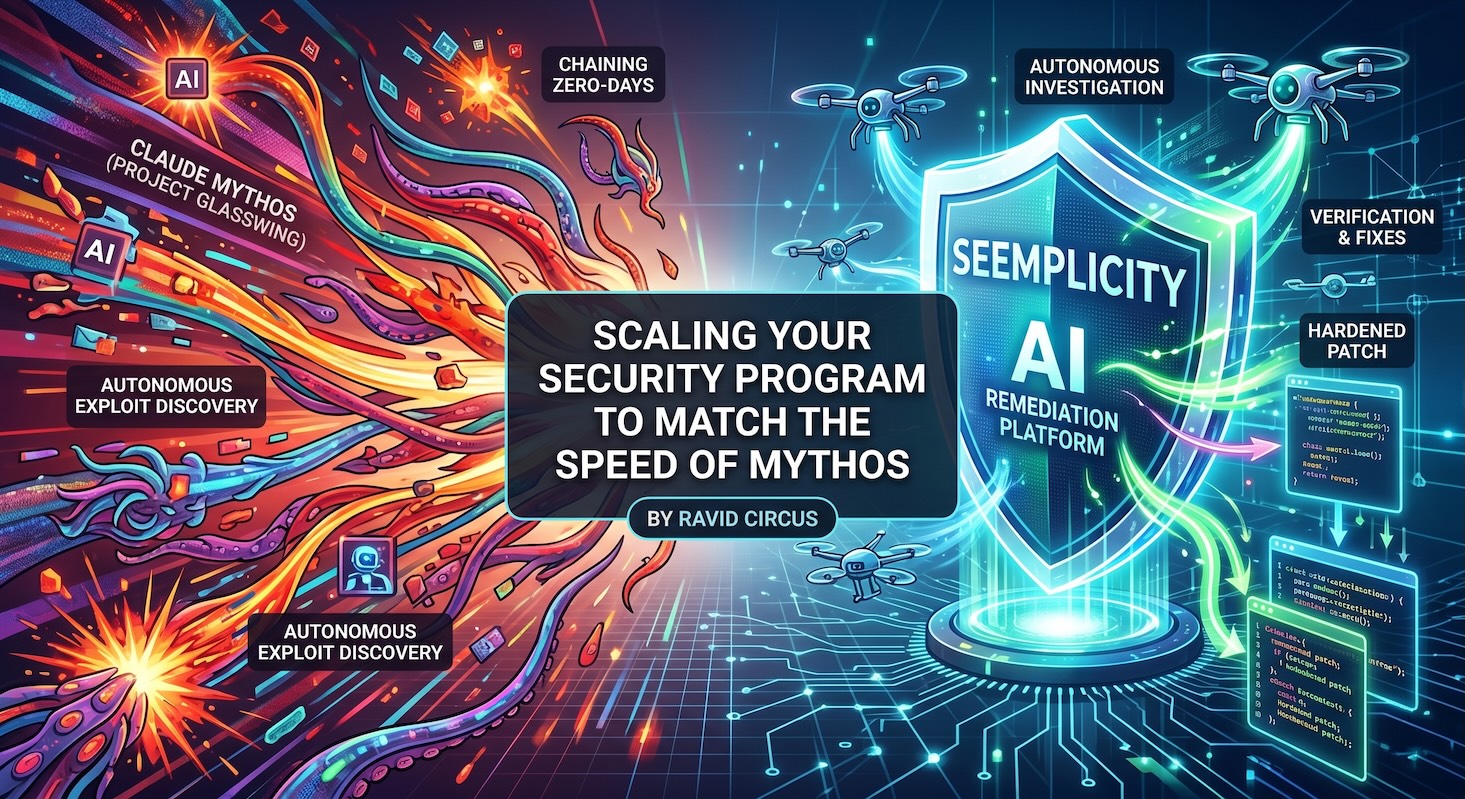
The cybersecurity landscape shifted last week. Anthropic’s announcement regarding Project Glasswing and the Claude Mythos model represents a fundamental change in the physics of cyber defense. We are officially past the point of AI being a coding assistant. We’re now dealing with a model that can autonomously research and chain zero-day exploits at a scale no human team can match.
This isn’t a hypothetical future threat. It is a fundamental change in the math for defenders.
The paradox of responsible disclosure
Anthropic originally held Mythos back because of how effective it is at finding flaws in browsers and operating systems. By releasing it through Project Glasswing to harden critical infrastructure, they have effectively lowered the skill floor for elite vulnerability research. What once required a team of state-sponsored researchers can now be handled by an AI agent in a fraction of the time.
We expect a massive wave of critical patches from major vendors over the next few weeks as a result of this research. While these patches are necessary, they are also a starting gun. The moment a fix is public, attackers will use the same AI capabilities to reverse-engineer it. We are moving toward a world where the gap between “patch released” and “exploit weaponized” is measured in hours.
The old playbook is failing
Most security programs still follow a manual cycle: scan, prioritize, open a ticket, and track an SLA. This process was built for a world where research and discovery happened at human speed. That world is gone.
If you are still relying on manual triage, lists, and dashboards, you are essentially bringing a knife to a railgun fight. Attackers now have an AI analyst for every vulnerability in your environment. You cannot win an AI-scale discovery problem with a human-scale response.
Fighting AI discovery with AI action
The real bottleneck has never been finding vulnerabilities. The bottleneck is fixing them. Most tools drown security teams in the “what” by providing a never-ending list of CVEs with very low signal on why they actually matter. This is the root of information overload.
Our AI Agents start with the “Why.” By understanding business context, reachability, and exploitability first, our agents filter out the noise. We do not just identify a vulnerability; we explain its significance in your specific environment before moving to the “how” and “where.”
You cannot defeat an AI-scale discovery problem with a human-scale response. To survive this shift, organizations must fight AI with AI at the remediation layer. We have engineered the Seemplicity platform specifically to handle the operational pressure of this moment.
- From identification to autonomous investigation
While others stop at the finding, we execute the investigation. Our agents perform the heavy lifting of tracing code reachability and mapping the blast radius. Instead of handing a developer a raw CVE number and a deadline, we provide the exact root cause and the specific code diff required to fix it. We turn a security alert into a developer solution. - Verification as the new standard
In a world of machine-speed exploits, simply closing a ticket is a liability. We have moved toward independent verification. The system confirms a fix has actually landed across the environment to ensure the window of exposure is truly shut. We don’t trust the ticket status; we trust the evidence. - Operational proof at scale
Security leaders need to move beyond reporting. Every decision, priority change, and exception in our platform is backed by an automated reasoning chain. This creates a full audit trail that allows you to prove to your board and auditors that exposure is being managed in real time, not just cataloged.
The path forward
Historically, making tools and knowledge public has helped defenders more than attackers. What previously was possible only for state-sponsored attackers, is now possible for anyone with a credit card and a Mac Mini. It is the defenders who usually lack them. Project Glasswing gives the good guys a head start, but that only matters if your internal processes can keep up.
The era of managing lists is over. The organizations that remain secure are the ones that can investigate, fix, and verify at the same speed that AI can discover.
Seemplicity was built for this.
Let’s walk through what this looks like in practice. It is a conversation worth having regardless of your current tooling because the speed of the game just changed for everyone.
We’re still measuring activity, not impact.

Stay updated on Seemplicity blog
Subscribe today to stay informed and get regular updates from Seemplicity.