

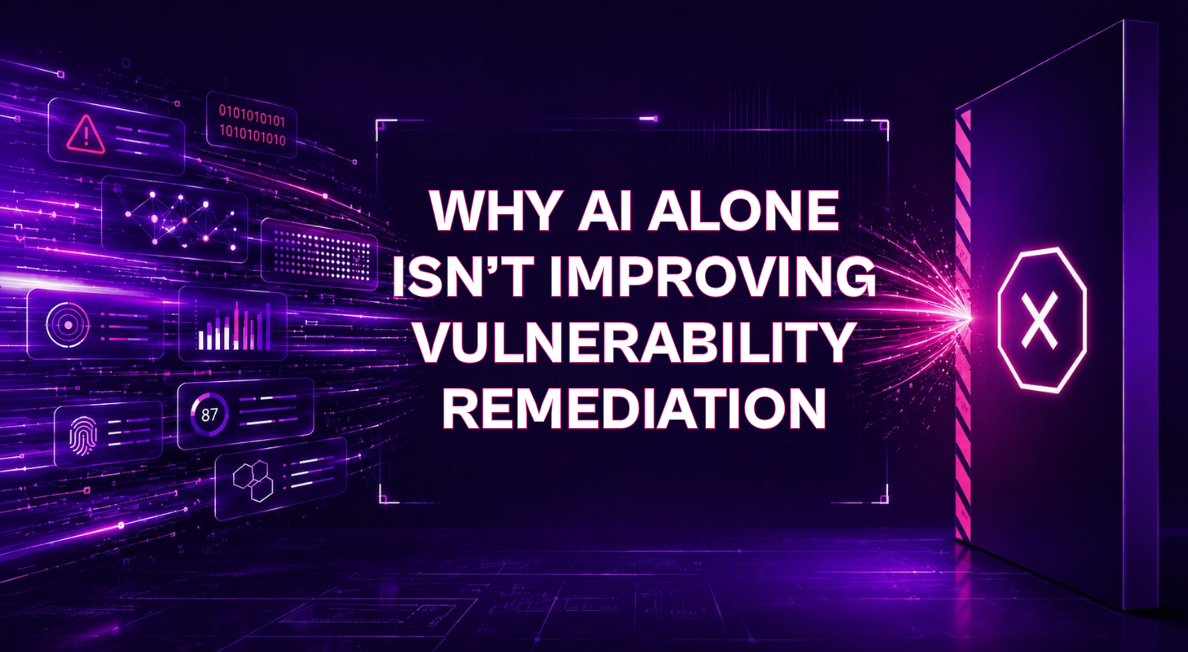
/why is AI alone not improving vulnerability remediation?
AI is widely used in exposure management, but most implementations stop at prioritization and analysis. While AI improves visibility and decision-making, remediation still depends heavily on manual ownership, coordination, and inconsistent processes. To truly improve vulnerability remediation outcomes, AI needs to extend into the execution layer, helping identify owners, define remediation plans, and deliver fix-ready work that turns decisions into action.
AI has quickly become a staple in modern security programs. From prioritizing findings to surfacing patterns across massive datasets, the benefits of AI in cybersecurity are clear and widely embraced. Our recent 2026 State of Exposure Management report found that 88% of organizations now use AI in exposure management, highlighting widespread adoption across the industry.
One would think that would translate into faster, more efficient remediation. But that hasn’t necessarily been the case.
Security teams are still dealing with slow fix cycles, operational bottlenecks, and a growing gap between what they know and what actually gets resolved. And it shows – 61% of organizations say more than a quarter of their findings remain unresolved.
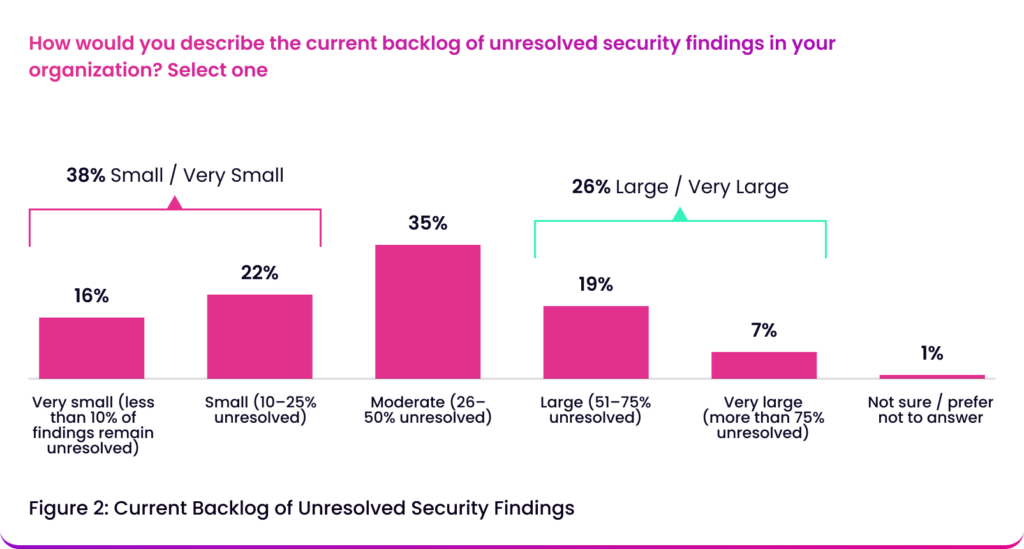
So if AI is already embedded by a majority of organizations, why is AI alone not improving vulnerability remediation?
The answer isn’t about whether AI works. It’s about where, and how, it’s being used.
AI Is Focused on Insight, Not Action
To understand why AI alone isn’t improving vulnerability remediation, you have to look at where it’s actually being used.
Many applications of AI in exposure management sit upstream in the workflow; helping teams prioritize findings, aggregate data from multiple tools, and track remediation progress. These are valuable improvements, making it easier to cut through noise, focus on what matters, and operate with more context. That’s a big part of the benefits of AI in cybersecurity.
But they’re all solving the same type of problem: understanding the work.
They don’t solve the harder part of actually getting that work done.
AI can tell you what’s important, faster and with more precision than ever before. But it doesn’t assign ownership, it doesn’t navigate team dependencies, and it doesn’t tell the fixing teams what needs to be done. And that’s where remediation still slows down.
AI Stops Where Execution Begins
Despite extensive industry adoption, for the most part, AI isn’t embedded in the execution components of exposure management; it doesn’t ensure that fixes are carried through to completion. That responsibility still sits with the organization, with people.
Part of the reason for this is trust. While organizations are increasingly comfortable using AI to support prioritization and analysis, there’s still some hesitation around allowing it to directly influence execution. Many teams still want a person in the loop to validate decisions, verify context, and confirm that the recommended action is actually the right one.
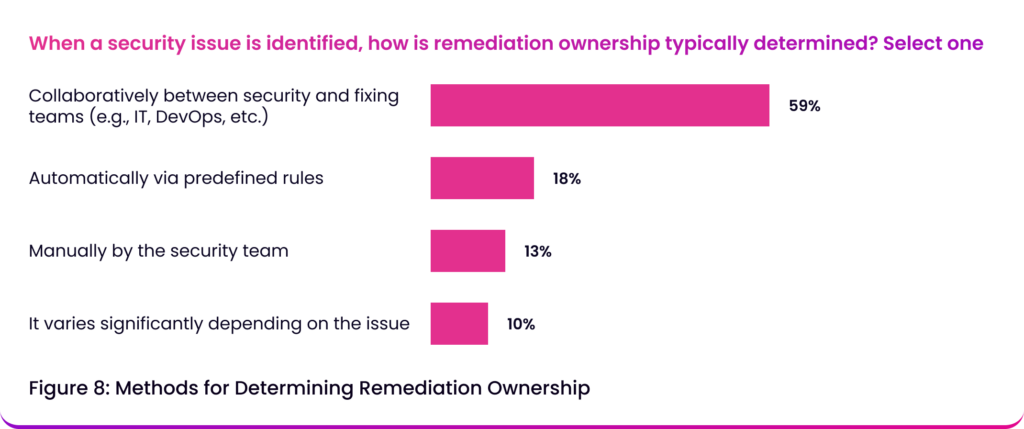
As a result, AI tends to be applied to the lower-risk, advisory side of the workflow, while execution remains heavily manual. And that’s a system that isn’t designed for speed, meaning vulnerability remediation hasn’t quite seen the efficiency gains one might expect from AI alone. Ownership is often determined through cross-team coordination, with 59% of organizations relying on collaborative ownership models to assign a security issue to a fixing team.
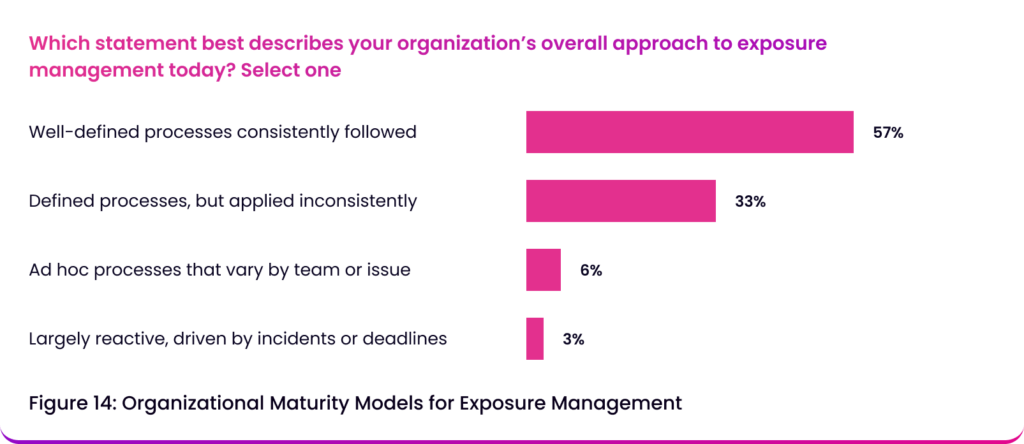
Moreover, many organizations lack standardized exposure management processes – 43% describe their processes as inconsistent, ad-hoc, or reactive. In other words, the transition from decision to execution isn’t just manual, it’s variable.
So, while AI accelerates how quickly teams can identify and validate what needs to be fixed, it has limited influence over whether those fixes actually move forward.
The result is a split system: faster decisions on one side, unchanged execution on the other. And that gap is exactly why remediation continues to stall; you can’t expect action from tools that aren’t built to act.
AI Needs to Operate Inside Execution – Not Just Inform It
If AI is going to impact remediation outcomes, it has to move beyond informing decisions and into the execution layer itself. Not by replacing teams, but by removing the ambiguity and friction that slow them down.
In practice, that means using AI to:
- Identify the right ownerEach finding is mapped to the appropriate team based on asset context, historical ownership patterns, and how the environment is actually structured. This removes the need for back-and-forth between security and engineering teams just to determine who is responsible.
- Define the actual problem to solveInstead of surfacing isolated alerts, AI synthesizes findings into a clear remediation plan, identifying root causes and patterns so teams can address underlying issues rather than continuously reacting to symptoms.
- Deliver fix-ready workIssues are routed to the relevant team with full context and step-by-step remediation guidance, so they can be acted on immediately without additional triage, investigation, or external research.
What all of this does is eliminate the gaps between stages in the exposure management process. The decision doesn’t sit waiting for ownership; ownership doesn’t require alignment; execution doesn’t depend on interpretation… and so on.
Of course, this is easier said than done. Given the level of skepticism that still exists around AI-driven decision-making, most organizations aren’t going to hand over execution overnight, nor should they.
In reality, this shift is likely to happen incrementally: piloting AI in lower-risk environments, keeping humans involved in validation, and gradually expanding trust as teams gain confidence in the outputs and workflows.
But the pressure to get there is increasing.
Attackers are already using AI to accelerate their own workflows – automating reconnaissance, identifying patterns, and even reverse-engineering patches to exploit vulnerabilities faster. The window between disclosure and exploitation is shrinking, which means the ability to execute quickly is no longer a “nice to have”, it’s a requirement.
So while the path to full AI-driven exposure management may be gradual, standing still isn’t really an option.
AI Is Only As Effective As The Layer It’s Applied To
AI is doing exactly what it was designed to do. It’s helping security teams process more data, prioritize more effectively, and make better-informed decisions. That’s real progress and a clear reflection of the benefits of AI in cybersecurity.
But remediation was never just a visibility or decision-making problem. It’s an execution problem; one that depends on ownership, coordination, and the ability to consistently move work from identification to resolution. And that’s the layer where AI has had the least influence so far, which is why AI alone hasn’t translated into better outcomes. Yet.
The opportunity now isn’t more AI, it’s applying it differently, extending it beyond analysis and into the mechanics of execution, where decisions are turned into action.
Because ultimately, the teams that move fastest won’t be the ones with the best insights. They’ll be the ones that can actually act on them.
For more insights on AI in exposure management, read the 2026 State of Exposure Management report.

Stay updated on Seemplicity blog
Subscribe today to stay informed and get regular updates from Seemplicity.