
/what do seemplicity’s ai analysts do in vulnerability management
Security teams are drowning in findings, not because scanners miss things, but because nothing confirms which ones an attacker could actually reach. Seemplicity AI Analysts run the investigation themselves, checking runtime configuration, network reachability, and exploit conditions for each finding, and re-rank your backlog by confirmed exploitability. What rises to the top is backed by evidence. What drops down has been checked and reasoned out. Your team stops chasing theoretical risk and starts fixing what’s real.
These AI Analysts don’t just flag risk. They prove it. They validate which vulnerabilities an attacker can reach, deprioritize the rest, and give your team a clear response plan.
Security teams aren’t losing to attackers because they lack data. They’re losing because there’s too much of it and they don’t know what to act on.
Every scanner, every feed, every new tool adds to a backlog that already runs well ahead of what engineering can work through. Meanwhile the signals teams have leaned on to prioritize that backlog keep getting weaker. CVSS scores never told the full story about whether a vulnerability was a real threat on a given asset. And exploit availability, once a dependable way to sort the urgent from the theoretical, is fast losing its meaning. AI can now spin up proof-of-concept code at scale, and what used to take an attacker days to weaponize now takes hours.
Forrester’s Erik Nost framed the stakes plainly: “Patch Tuesday will no longer be marked on the calendar: A 30-day waiting period for patching won’t be acceptable in an environment where attackers can go from discovery to exploit in minutes.”
Ranking By Score Was Always a Guess
For years, triage meant sorting the pile by score. Rank the findings by CVSS, layer on whatever external signals you trusted, and hand the list to a person to investigate one at a time. That held up while those signals still meant something. It doesn’t now, when a score never reflected whether a vulnerability was exploitable on your specific assets and exploit availability is sliding toward noise.
AI Analysts change what triage gives you. Instead of a backlog ranked by guesswork, you get one ranked by proof. They investigate each eligible finding, confirm whether the vulnerability can be exploited on that asset, and re-order your list around the answer. The handful an attacker could reach rise to the top with the evidence attached so your team can fix faster. The ones that can’t are pushed down, with the reasoning for why.
For your team, that means the end of chasing findings that were never exploitable in the first place. What sits at the top of the list is what’s worth the attention, and the rest has been checked so you can leave it there.
Evidence You Can Act On, Not a Longer List to Manage
Today we’re launching Seemplicity AI Analysts: a team of autonomous agents that take vulnerability triage off your team’s hands and run the investigation themselves, inside the same workflow you already use to remediate.
Rather than hand practitioners one more finding to argue over, the AI Analysts do the investigative work at a scale a human analyst would never be able to. They read live runtime configuration, research what an exploit really requires, test network reachability from the inside out, and confirm whether a given vulnerability can be exploited on a given asset. What comes back is a far shorter list of findings that warrant action, each one backed by evidence the team can inspect. Everything else drops down the list, with the reasoning for why.
How the Analysts Work
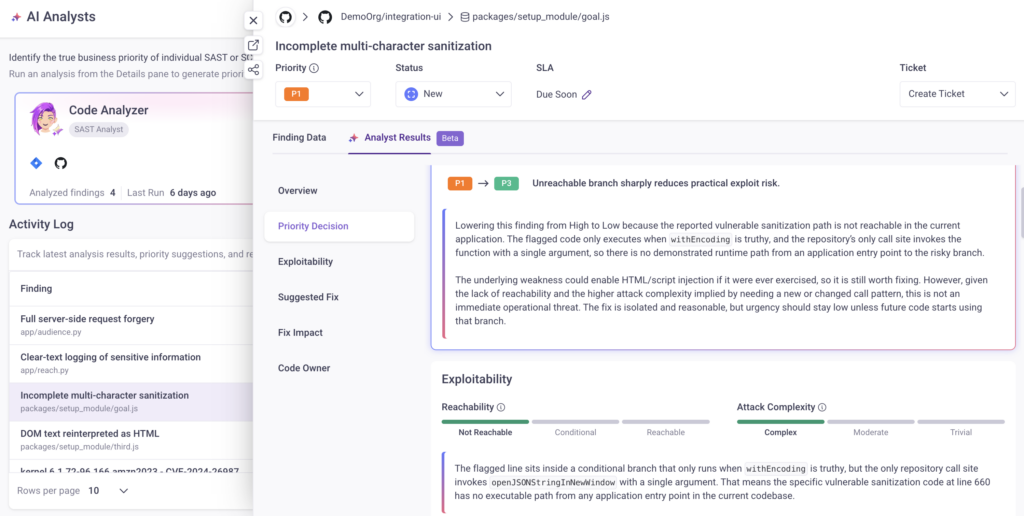
Every analyst follows the same logic. A verdict is the output of a structured investigation into runtime context, threat intelligence, network exposure, and code. Each one carries a reasoning trail that lays out how it was reached, which is what lets security and engineering settle on priorities based on real-time business context. And all of it runs where the work already happens. Verdicts, the reasoning behind them, and recommended fixes show up inside directly in tables, workflow automations, and ticketing rules, so nothing waits in a separate console for someone to go check it.
Autonomous Response for the Full Vulnerability Surface
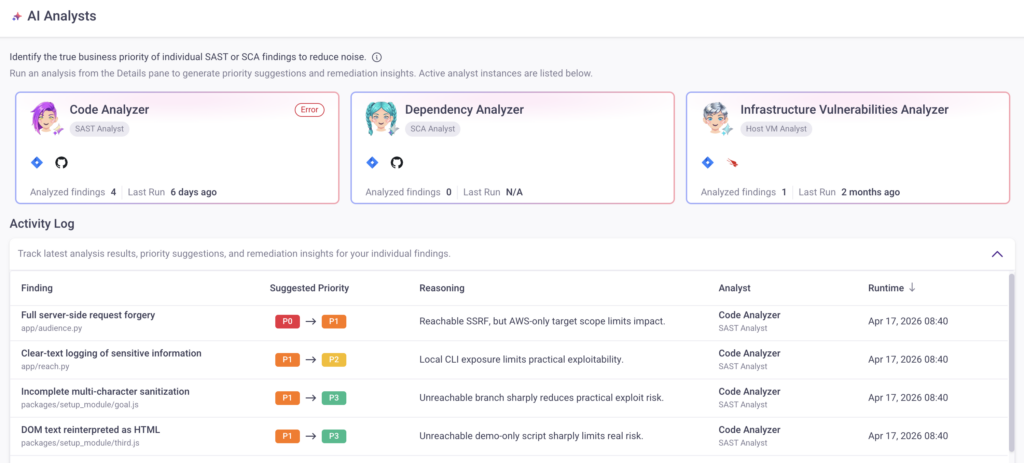
With Seemplicity, one platform handles the full vulnerability surface: infrastructure, code, and dependencies. Nothing to stitch together from separate point tools.
The Host CM Analyst
Decides whether a host vulnerability can be exploited by looking at live runtime configuration, exploit prerequisites, and network reachability, then names the likely owner so the fix moves faster. It draws exploit conditions, checks runtime parameters such as kernel flags and process states, and calls out remediations that carry operational risk, like a kernel update that forces a reboot, so teams can sequence work without setting off new incidents.
The SCA Analyst
Pins down which dependencies are in use and reachable across the build chain, not just present in a manifest. It also drives SBOM-based zero-day response: the moment a new vulnerability lands, a single query returns every instance of the affected component, well before any scanner signature exists.
The SAST Analyst
Reads source straight from connected repositories to see whether vulnerable code is reachable at all, rather than flagging every dependency that happens to contain a vulnerable function. It confirms that the vulnerable library functions are imported and called before a finding ever reaches a developer, then delivers a scoped, PR-ready fix with the blast radius already worked out.
Why It’s Different
Most tools that advertise AI validation hand back a risk score or a covered / not-covered flag. Seemplicity’s AI Analysts do the investigation itself, and every call comes with a reasoning trail you can expand, so none of it is a black box.
They’re built to be configurable and to keep costs in check. You decide which findings are eligible for analysis, and most teams point them at high-signal work like production-external, high-criticality assets. You also decide how often they run. Pricing is consumption-based, so the spend goes toward the analysis worth doing instead of blanket scanning across the whole backlog.
In early deployments, the analysts found that most high-severity findings weren’t exploitable at all. In practice that means most of the backlog gets deprioritized rather than worked, and what rises to the top is the set of exposures that carry real risk.
“The danger was never the alerts we could see, it was the handful of genuinely exploitable ones buried among them,” said Michael Varicak, manager of vulnerability management at Omnissa. “Seemplicity’s AI Analysts surface exactly that with the context to prove it, so we spend our time fixing what attackers could actually exploit.”
Spend Your Time Where the Risk is Real
Programs built on exploit availability as their main signal are going to need new footing under them. AI Analysts give them that: a layer of confirmed exploitability that slots in without forcing anyone to tear up the workflows they already run. The AI Analysts investigate every eligible finding and re-rank it by what an attacker could reach, so the exposures that matter sit at the top and the ones that don’t sit at the bottom, deprioritized. Your team’s attention goes where the real risk is so they can fix the right things faster.
Fix what’s exploitable. Deprioritize the rest.
AI Analysts are available today, priced by consumption. Existing customers can get started through their Seemplicity customer success contact, and new teams can request a demo.
Learn more about Seemplicity AI Analysts.

Stay updated on Seemplicity blog
Subscribe today to stay informed and get regular updates from Seemplicity.