



/What is application security risk management?
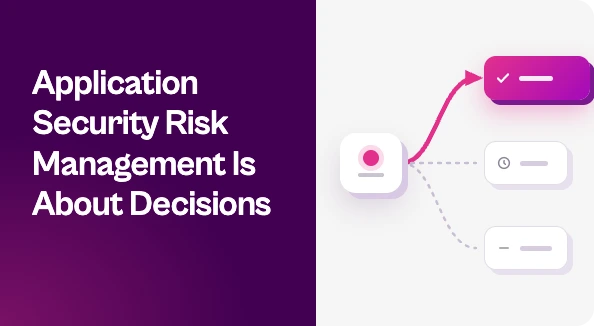
Application security risk management is the practice of assessing risk in the software you build and deciding how to treat each risk: fix it, accept it, transfer it, or avoid it. It scores risk by likelihood and business impact, sets remediation SLAs based on risk appetite, and records every decision, including formal risk acceptances with an owner and an expiry date. The result is a defensible, auditable record of how AppSec risk is handled.
Application security risk management is the practice of assessing risk in the software you build, then deciding what to do about each risk. You can fix it, accept it, transfer it or avoid it. Every one of those is a legitimate choice. What isn’t legitimate is letting a finding sit untouched and calling it a decision.
A lot of AppSec content is about finding vulnerabilities faster or fixing them faster. This post is about the part in between: how to make and record risk decisions you can defend to your CISO, your auditors and your developers.
What is Application Security Risk Management?
Application security risk management is a governance process. It turns application vulnerabilities into business risk decisions, each with a clear owner, rationale and deadline.
It answers four questions for every meaningful risk:
- How likely is it to be exploited?
- How bad would it be if it were?
- What are we going to do about it?
- Who signed off on that choice, and when do we revisit it?
Scanners answer none of these on their own. They tell you a flaw exists. Risk management tells you what the organization has agreed to do about it.
How is Application Security Risk Management Different From Vulnerability Management?
Vulnerability management is about processing findings. Application security risk management is about treating risk.
Vulnerability management asks, “Is this finding closed?” Application security risk management asks, “Is this risk at a level we’ve agreed to live with?” Sometimes the answer is a patch. Sometimes it’s a compensating control. Sometimes it’s a signed exception that expires in 90 days. A finding can stay technically open while the risk is fully managed, and a finding can be closed while the risk underneath it is still there.
What Are the Four Ways to Treat an Application Security Risk
There are four standard risk treatment options, and each one applies to AppSec:
- Mitigate. Reduce the risk by fixing the code, upgrading the dependency or adding a control. This is the default for most high-risk findings.
- Accept. Formally agree to live with the risk because the cost of fixing is higher than the expected impact. This only counts if it’s documented, owned and time-bound.
- Transfer. Shift some of the risk to a third party, for example a vendor-managed component with contractual security obligations, or cyber insurance for residual risk.
- Avoid. Remove the risk entirely by retiring the feature, shutting down the endpoint or dropping the risky dependency.
Mitigation often isn’t a code fix at all. A WAF rule that virtually patches an injection flaw, a feature flag that disables a vulnerable path, or tighter network exposure are all valid ways to reduce risk while a permanent fix is scheduled.
How Do You Score Application Security Risk?
You score application security risk by combining the likelihood of exploitation with the business impact of a successful attack. Severity scores like CVSS describe the flaw. Risk scoring describes what the flaw means for your organization.
Likelihood signals usually include:
- Known exploit or presence on the CISA KEV list
- Reachability of the vulnerable code
- Internet exposure of the application
- Authentication required to reach it
Impact signals usually include:
- Sensitivity of the data the app handles
- Revenue or operational dependency on the app
- Regulatory scope, such as payment or health data
- Blast radius if the app is compromised
Score applications, not just findings. Give each application a tier, for example Tier 1 for customer-facing apps that handle sensitive data and Tier 3 for internal tools with no sensitive access. The same vulnerability should carry a different risk level depending on where it lives.
How Do You Set a Risk Appetite for Application Security?
You set a risk appetite by agreeing, in writing, how much risk the organization will tolerate and how fast it has to be reduced when it goes over that line. In practice this becomes a risk-based remediation SLA policy.
A simple policy might say:
- Exploitable critical risks in Tier 1 apps are fixed within days, not weeks.
- High risks in Tier 1 and Tier 2 apps have a fixed monthly deadline.
- Lower risks in Tier 3 apps are batched into regular maintenance cycles.
- Anything that misses its SLA needs a formal exception or an escalation.
The exact numbers matter less than the fact that security, engineering and leadership all agreed to them. That agreement is what makes an SLA enforceable.
When Should You Accept Application Security Risk?
You should accept application security risk when fixing it costs more than the risk is worth, a compensating control reduces it enough, or the fix is planned and just can’t land yet. Risk acceptance is normal and healthy. Undocumented, permanent acceptance is not.
A defensible risk acceptance includes:
- A named business owner, not just the security team
- A clear justification for why the risk is being accepted
- Any compensating controls in place
- An expiry date that forces a review
- Sign-off from someone with the authority to accept that level of risk
The most common failure here is the exception that never expires. A risk accepted two years ago for a legacy app may be a very different risk today. Build in expiry and review, and your exception list stays honest.
What Should an Application Security Risk Register Include?
An application security risk register is the running record of every significant AppSec risk and the decision made about it. It doesn’t replace your findings backlog. It sits above it and tracks decisions.
Each entry should capture:
- The risk, in plain business language
- The affected application and its tier
- The underlying findings it’s tied to
- The risk score and how it was calculated
- The chosen treatment: mitigate, accept, transfer or avoid
- The owner and the due date or expiry date
- Current status and last review date
When an auditor asks how you handled a specific risk, this is where the answer lives.
Which Frameworks Guide Application Security Risk Management?
Several well-known frameworks give structure to application security risk management:
- NIST Secure Software Development Framework (SP 800-218) for secure development practices
- NIST SP 800-30 for conducting risk assessments
- ISO/IEC 27005 for information security risk management
- OWASP SAMM for measuring and maturing software security programs
- OWASP Top 10 as a baseline for common web application risks
You don’t need to adopt all of them. Pick one risk method and one maturity model, and apply them the same way every time.
How Do You Report Application Security Risk to Leadership?
You report application security risk to leadership in terms of business exposure and decisions, not raw finding counts. Executives don’t need to know you have 40,000 open findings. They need to know whether risk is going up or down and where the organization is carrying it.
Useful measures include:
- Risk by application tier and business unit
- SLA adherence for high-risk items
- Number and age of active risk acceptances
- Exceptions past their expiry date
- Trend of top risks over the last few quarters
Accepted risk is one of the most useful and least reported numbers in AppSec. If leadership doesn’t see it, they can’t own it.
Where Does Seemplicity Fit in Application Security Risk Management?
Seemplicity fits as the system that connects AppSec findings to the decisions and actions taken on them. It doesn’t scan code. It works with the AppSec tools you already have.
Seemplicity helps teams:
- Consolidate findings from SAST, DAST, SCA, pentests and bug bounty into one view
- Assign clear ownership for each finding
- Track progress against defined remediation SLAs
- Keep SLA exception logs with formal risk acceptance sign-off
- Maintain a timestamped record from discovery to verified closure for audits
- Push fix work into developer tools like Jira
That gives AppSec, engineering and GRC teams one shared record of what was fixed, what was accepted and why.
Want one clear record of every AppSec risk decision? See how Seemplicity supports application security teams.

Frequently asked questions about application security risk management
An acceptable level of application security risk is whatever the organization’s leadership has formally agreed to tolerate, usually written down as a risk appetite statement and a risk-based SLA policy.
A business owner with authority over the affected application should accept application security risk, ideally with security reviewing the decision. Security teams advise on risk but usually shouldn’t accept business risk on their own.
Reassess application security risks whenever something material changes, such as a new exploit, a new feature or a change in exposure, and at a set interval for any accepted risk, often every 90 days to a year.
A vulnerability is a specific weakness in code or a component. An application security risk is the potential business harm from that weakness, based on how likely it is to be exploited and how much damage it could cause.
Many security and privacy frameworks expect a documented process for identifying, assessing and treating software risk. A consistent application security risk management process, with records of decisions and exceptions, makes that much easier to prove.
Stay updated on Seemplicity blog
Subscribe today to stay informed and get regular updates from Seemplicity.