



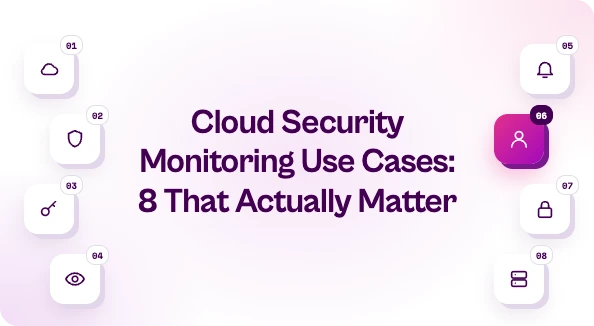
/What are the main cloud security monitoring use cases?
The core cloud security monitoring use cases are catching misconfigurations, watching identities and permissions, detecting threats and unusual activity, protecting running workloads, finding exposed sensitive data, scanning images and infrastructure-as-code, tracking compliance continuously, and spotting unmanaged assets and drift. Monitoring surfaces the risk. The real payoff comes from routing each finding to the right owner and getting it fixed.
Most teams don’t need more cloud alerts. They already have plenty. What they need is to know which monitoring jobs are worth doing and what happens after something gets flagged.
This post covers the cloud security monitoring use cases that matter most across AWS, Azure and GCP. At the end it looks at the part most guides skip: getting findings fixed.
What Cloud Security Monitoring Actually Covers
Cloud security monitoring means watching your cloud setup, identities, workloads and data all the time for risk. It’s not one tool. It’s usually several: CSPM for posture, CIEM for identities, CDR for threats, CWPP for workloads, DSPM for data. Each covers a different use case, and together they give you a live picture of your attack surface.
8 Cloud Security Monitoring Use Cases
1. Catching misconfigurations before someone else does
This is the classic one. It covers public storage buckets, security groups open to the internet, disabled logging and unencrypted databases. Misconfigurations are still one of the most common causes of cloud breaches. They’re also among the easiest to prevent if you catch them early. Posture monitoring checks your resources against benchmarks like CIS and flags drift as it happens.
2. Watching identities and permissions
In the cloud, identity is the perimeter. Monitoring here means finding overprivileged roles, unused access keys, service accounts with admin rights and odd permission changes. An attacker with a leaked key and too much access can do far more damage than one exploiting an unpatched server.
3. Detecting threats and unusual activity
This means watching control-plane logs (CloudTrail, Azure Activity Logs, GCP Audit Logs) for signs of trouble. Examples are logins from strange locations, sudden spikes in API calls, someone switching off logging, or crypto-mining workloads appearing overnight. This is where cloud detection and response fits in.
4. Protecting running workloads
Containers, Kubernetes clusters, VMs and serverless functions all need runtime visibility. This use case covers unexpected processes, container escapes, suspicious network connections and file changes on workloads that should be immutable.
5. Finding exposed sensitive data
You can’t protect data you don’t know about. Data security monitoring finds where sensitive data (PII, credentials, financial records) lives in your cloud. It also flags when that data sits somewhere it shouldn’t, like a dev bucket or a snapshot that’s been shared publicly.
6. Scanning images and infrastructure-as-code
Many cloud risks exist before anything is deployed. Scanning container images for vulnerable packages and Terraform or CloudFormation templates for bad settings catches problems early, when they’re cheapest to fix. The same monitoring should keep running after deployment, because new CVEs appear in images that were clean last week.
7. Continuous compliance tracking
SOC 2, PCI DSS, HIPAA and ISO 27001 all expect you to show controls are working, not just that they worked once during an audit. Continuous monitoring maps your cloud setup to framework controls and shows gaps as they appear, so audit prep isn’t a scramble.
8. Spotting shadow assets and drift
Someone spun up a test environment two years ago and forgot about it. A team created an account outside your organization structure. A resource changed after deployment and no longer matches its template. Tracking assets and drift keeps your inventory honest, and your other monitoring depends on that inventory being right.
The Use Case Nobody Lists: What Happens After the Alert
Here’s the problem with every list of cloud security monitoring use cases, including this one. Monitoring finds things. It doesn’t fix them.
A typical enterprise cloud setup has several tools running across these use cases. Each produces its own findings in its own format with its own severity scale. The same issue often shows up in three places. Nobody’s sure which team owns the resource. The ticket goes to the wrong queue, sits there, and the finding stays open.
That’s why teams with good visibility can still struggle to cut real risk. The bottleneck isn’t detection. It’s the path from finding to fix:
- Bringing findings from every cloud tool into one place
- Removing duplicates and grouping related issues
- Ranking by real risk, not just tool severity
- Sending each fix to the right owner in the tools they already use
- Tracking it until it’s verified closed
Where Seemplicity Fits
Seemplicity doesn’t replace your cloud monitoring tools. It works after them. As an Agentic Exposure Action Platform, it pulls in findings from your CSPM, CNAPP, scanners and other security tools, then removes duplicates, adds context and ranks them. It then routes each fix to the team that owns it and tracks it through to closure. Your monitoring keeps finding the risk, and Seemplicity makes sure it gets fixed.
If your cloud findings keep piling up faster than they get closed, see how Seemplicity handles cloud security remediation.

Stay updated on Seemplicity blog
Subscribe today to stay informed and get regular updates from Seemplicity.