



/what is continuous vulnerability management?
Continuous vulnerability management is an always-on process for finding, prioritizing, fixing, and verifying vulnerabilities across every asset, instead of treating it as a periodic scan-and-report exercise. It’s formalized as CIS Control 7, which covers documented VM and remediation processes, automated patching, regular internal and external scanning, and ongoing remediation. The goal is to shrink the window between when a vulnerability appears and when it’s actually fixed.
Most teams say they do continuous vulnerability management. What they usually mean is that they scan a lot. That’s a good start, but it’s only half of it.
Scanning tells you what’s broken. Continuous vulnerability management means the whole loop keeps moving: find it, prioritize it, get it to the right person, fix it, and confirm the fix worked. If any step in that loop waits for a quarterly review, you’re not continuous. You’re periodic with extra steps.
What is Continuous Vulnerability Management?
Continuous vulnerability management is an always-on process for finding, prioritizing, fixing, and verifying vulnerabilities across every asset you own. It replaces the old model of a big scheduled scan, a big report, and a big backlog.
The goal is simple. Shrink the time between when a vulnerability shows up in your environment and when it’s actually gone. Attackers scan your perimeter constantly, and they often move faster than a traditional remediation cycle. Every day a known issue sits open is a day someone else can use it.
Continuous Vulnerability Management and CIS Control 7
If you want an official definition, the Center for Internet Security has one. Continuous vulnerability management is Control 7 in the CIS Critical Security Controls (v8). CIS frames it as having a plan to keep assessing and tracking vulnerabilities on all enterprise assets, remediating them to limit attacker opportunity, and watching industry sources for new threat and vulnerability info.
Control 7 breaks down into seven safeguards. In plain English:
- Have a documented VM process and review it at least once a year.
- Have a documented remediation process with a risk-based strategy and regular reviews.
- Automate operating system patching.
- Automate application patching.
- Scan internal assets automatically, at least quarterly, with both authenticated and unauthenticated scans.
- Scan externally exposed assets automatically, at least monthly.
- Remediate what you find on a regular cadence using tools and processes, not goodwill.
The first four are part of CIS Implementation Group 1, the baseline CIS expects every organization to meet regardless of size. The rest are aimed at more complex environments.
Look at that list again. Two of the seven safeguards are about scanning. The rest are about process, patching, and remediation. CIS is pretty clear that continuous means continuous action, not just continuous discovery.
Why Scanning More Doesn’t Make you Continuous
Here’s the trap. A team adds cloud scanning, container scanning, AppSec tools, and an external attack surface tool. Coverage goes up. Scan frequency goes up. Finding volume goes way up.
But the team fixing things is the same size it was last year. Every new finding still needs someone to:
- Dedupe it against the same issue reported by three other tools
- Figure out if it actually matters in this environment
- Track down who owns the asset
- Write a ticket with enough context that the owner will act on it
- Chase it until it’s closed, then check that it’s really fixed
When those steps are manual, more scanning just means a bigger backlog. Discovery becomes continuous. Remediation stays stuck in batch mode. That mismatch is where risk actually lives.
The Continuous Vulnerability Management Lifecycle
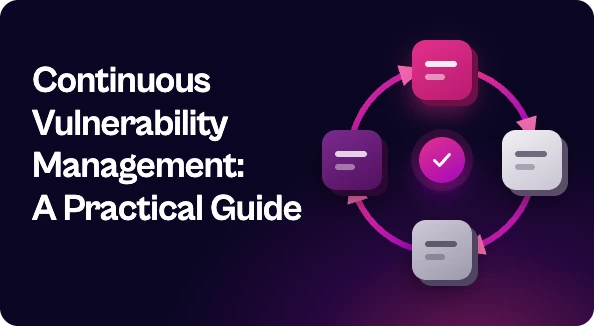
A continuous program runs as a loop where every stage feeds the next without waiting for a meeting.
- 1. Discover
Keep an accurate, current asset inventory and scan it on a steady cadence. Include internal, external, cloud, and code. Coverage gaps are vulnerabilities you just don’t know about yet. - 2. Prioritize
Not every critical is critical. Factor in exploitability, whether it’s being used in the wild, how exposed the asset is, how important it is to the business, and whether compensating controls already block it. The point is to fix what matters first, not what the scanner shouted loudest about. - 3. Assign
This is where most programs slow down. A finding without an owner doesn’t get fixed. Ownership should be mapped automatically from asset data, tags, and org structure, so tickets land with the right team the first time. - 4. Fix
Give fixers what they need to act fast: clear context, environment-specific remediation steps, and a ticket in the system they already work in. Automated patching handles the routine stuff so humans can focus on the hard fixes. - 5. Verify
Closing a ticket isn’t the same as fixing a vulnerability. Rescan or validate to confirm the fix worked, then track the result against SLAs. This is also where your metrics come from.
Then the loop starts again. Constantly.
Metrics That Show You’re Actually Continuous
If you want to know whether your program is truly continuous, track these:
- Mean time to remediate (MTTR), broken down by severity and team
- SLA adherence, meaning the percentage of findings fixed inside their target window
- Time to assign, or how long a finding sits before it has an owner
- Backlog trend, whether open findings are growing or shrinking over time
- Scan coverage, meaning the share of assets scanned within your target cadence
- Reopen rate, how often “fixed” issues come back
If your scan coverage looks great but MTTR and time to assign are flat or getting worse, you’ve automated discovery and left remediation behind.
How To Get There
You don’t need to rebuild your program from scratch. A few moves make the biggest difference:
- Consolidate findings from every tool into one view. You can’t run a continuous loop across a dozen disconnected consoles.
- Automate ownership. It’s the single biggest source of delay in most programs.
- Move to risk-based prioritization. Severity alone creates noise that buries the real problems.
- Automate the routine fixes. OS and app patching should run on their own.
- Close the loop with verification. Measure fixed, not ticketed.
If you’re not sure where your program stands today, a vulnerability management maturity model is a good way to find your weakest link before you start.
Where Seemplicity Fits
Seemplicity isn’t a scanner, and it doesn’t try to be. It picks up where your scanners leave off and handles the part of continuous vulnerability management that usually stays manual: turning findings into fixes.
It pulls findings from across your security stack into one normalized, risk-based view, dedupes them, and figures out who owns each one. AI agents handle the busywork, like building ownership maps from messy scanner tags and putting environment-specific remediation guidance right inside the finding. Then it tracks each issue through to a verified fix, so your remediation runs as continuously as your discovery does.
If your scanners never stop but your fixes still move in batches, it might be worth seeing how Seemplicity keeps remediation moving

Stay updated on Seemplicity blog
Subscribe today to stay informed and get regular updates from Seemplicity.