

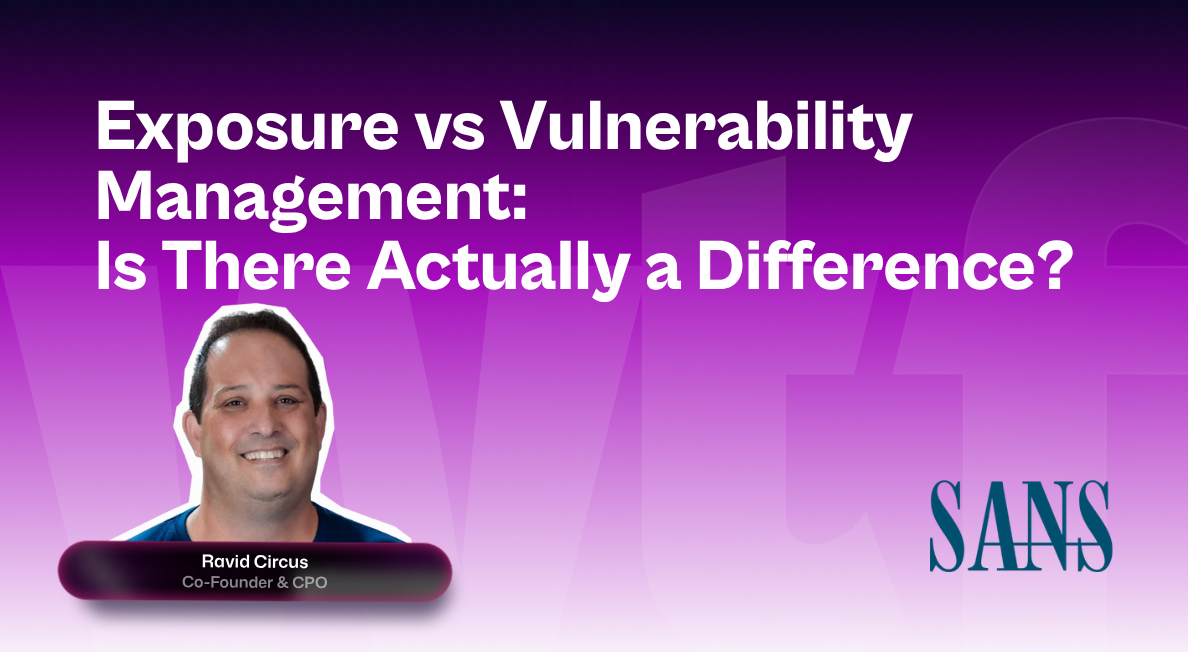
/What is the real difference between exposure vs. vulnerability management?
In this exclusive fireside chat, Seemplicity CPO Ravid Circus and SANS instructor Jonathan Risto break down this critical distinction and why mastering it is vital as AI rapidly reshapes the cybersecurity threat landscape. Here’s a summary of what they covered.
If you’ve been in security for any length of time, you’ve probably wondered whether exposure management is just vulnerability management with a fresh coat of paint. The terminology shifts, the vendor decks change, but the underlying problem feels the same: find vulnerabilities, prioritize them, try to get someone to fix them.
It’s a fair question. And it’s exactly what SANS instructor Jonathan Risto put to Seemplicity Co-Founder and CPO Ravid Circus at the SANS 2026 Spring Cyber Solutions Fest.
Ravid’s answer: the exposure vs vulnerability management debate is real, but not for the reasons most people think. The difference isn’t in the discovery. It’s in everything that happens after.
Why Vulnerability Management Alone Isn’t Enough Anymore
The core problem with traditional vulnerability management has never really been finding vulnerabilities. Tools have gotten pretty good at that. The problem is what happens next.
Ravid framed it this way:
The fundamental problem of vulnerability management is that the security team is responsible for remediating vulnerabilities, but they are not authorized to remediate them.
Ravid CircusCo-Founder & CPO, Seemplicity
The security team identifies the risk. A completely different team — developers, IT ops, infrastructure — has to actually fix it. And those two groups often use different tools, speak different languages, and have different priorities.
That gap between responsibility and authorization is where most vulnerability management programs quietly fall apart. Exposure management, done well, is specifically designed to close it.
The most mature security organizations aren’t necessarily the ones running the most sophisticated scans. They’re the ones who have figured out how to reduce friction between the team that finds problems and the teams that fix them, and built processes that actually hold up at scale.
The Core Difference: Problems vs Actions
Here’s where the exposure vs vulnerability management distinction gets practical.
Vulnerability management programs tend to optimize for discovery. More findings, more coverage, more visibility. That seems logical until you look at what it produces on the other end: sprawling backlogs, auto-generated Jira queues with hundreds of ‘critical’ tickets, and remediation teams with no clear sense of where to start.
Ravid used a simple example to illustrate the problem. If you haven’t updated Chrome in five months, you might be sitting on 30 CVEs. But the solution is still one thing: upgrade Chrome. Thirty vulnerability records, one action.
When you flip the lens and look at your environment from the perspective of the people doing the fixing, this pattern shows up constantly. The same vulnerability flagged by three different tools with three different scores. Developers sent back to the same file twice in the same sprint because findings weren’t grouped together. Tickets opened inside an agreed-upon patch window that add noise without changing anything.
Exposure management asks a different question than vulnerability management does. Not “what did we find?” but “what do we need to do?” That shift from a problems-oriented view to a solutions-oriented one sounds subtle, but it changes how you build your entire program.
Sharing Findings Means Sharing Responsibility
One thing Ravid pointed to that doesn’t get talked about enough: security teams have historically kept findings close to the chest. The instinct is understandable: surface only what’s relevant to each team, on a need-to-know basis.
But there’s a cost to that approach. If you don’t share information, you also don’t share ownership.
When developers, IT owners, and product managers can see the same backlog, work from the same priorities, and understand the same constraints, the dynamic changes. It stops feeling like the security team is lobbing tickets over the wall and starts feeling like a shared problem. People are more likely to actually engage with it.
This doesn’t mean giving everyone access to everything across the organization. But if someone owns an application, they should be able to see all of its exposure, not just the slice the security team chose to surface this week.
What AI Changes About Both Sides of This
The exposure vs vulnerability management conversation looks different now than it did even 18 months ago, largely because of AI.
Mean time to exploit is sitting at negative seven days, meaning attackers are weaponizing vulnerabilities before many organizations are even aware they exist. That changes the math on almost everything.
Ravid drew a distinction between automation and agentic AI that’s worth understanding:
Automation does the exact same steps every time. Agentic learns to do step one, sees the results, and based on that, decides what step two will be.
Ravid CircusCo-Founder & CPO, Seemplicity
That adaptive quality is what makes AI-based attacks different from scripted ones. An agentic attacker isn’t brute-forcing combinations. It’s reasoning through what it discovers and adjusting in real time, the same way a human attacker would.
The same capability is available on the defense side. Agentic AI can check whether the preconditions for a given exploit are actually present in your environment, verify whether compensating controls are in place, and validate exploitability at a scale no human team could sustain. That’s one of the clearest arguments for why exposure management — with its emphasis on context and actionability — is better positioned for this environment than traditional VM.Ravid also made a counterintuitive point about where human judgment fits in: humans should be focused on reducing priority, not increasing it. The default assumption built into vulnerability management is worst-case. What’s actually hard and valuable is being able to say with confidence “this doesn’t apply here” and redirecting that capacity to something that does.
What You Should Actually Be Reporting to Leadership
When Jonathan asked what security leaders should be telling their boards, Ravid pushed back on leading with risk scores and pointed toward something more durable: program performance.
Risk is always going to look bad on Patch Tuesday. You can’t control when Microsoft releases vulnerabilities or when a new CVE drops. What you can control is how quickly your program responds.
He referenced a metric a QA colleague gave him early in his career: open bugs versus closed bugs. When you’re closing more than you’re opening, you’re stabilizing. Translate that into an exposure management context and you get remediation throughput, patch window compliance rates, and recovery cadence by asset type, metrics that actually tell a story about organizational resilience rather than just a point-in-time risk snapshot.
Risk will always be there. The thing I have control over is how my program recovers from that.
Ravid CircusCo-Founder & CPO, Seemplicity
That framing is one of the clearer ways to explain the exposure vs vulnerability management distinction to a non-technical audience. It moves the conversation from “here’s how exposed we are” to “here’s how well we respond,” which is a much stronger position to be in.
There’s a Lot More in the Full Session
The fireside chat goes deeper on where most organizations actually sit on the CTEM maturity curve, how to think about AI adoption with the right guardrails in place, and what Ravid expects the next 12 to 18 months to look like for teams trying to get ahead of this.
If any of this landed, it’s worth watching the full conversation.
Watch the full fireside chat with Ravid Circus and SANS

Stay updated on Seemplicity blog
Subscribe today to stay informed and get regular updates from Seemplicity.