

/Who are the top CTEM vendors and how do I compare them?
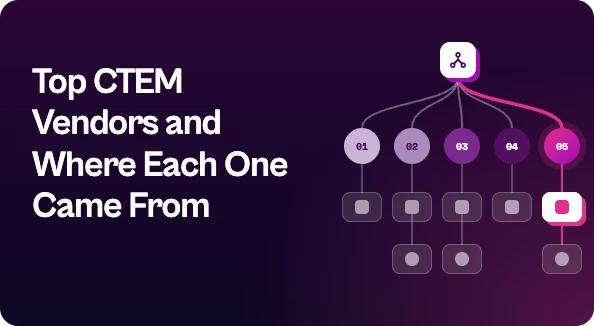
The top CTEM vendors fall into five families based on where they started: scanner vendors (Tenable, Qualys, Rapid7), platform giants (Microsoft, CrowdStrike, Palo Alto Networks, Google with Wiz, ServiceNow with Armis), attack path and validation specialists (XM Cyber, Pentera, Cymulate, Picus), asset and attack surface vendors (Axonius, CyCognito, IONIX), and the newer aggregation and action layer (Nagomi, Reach Security, Brinqa, Seemplicity). A vendor’s heritage predicts its strengths and its blind spots, so compare vendors within a family and ask each family different demo questions.
Every CTEM vendor will tell you it covers all five stages of continuous threat exposure management. Some cover more than others. The most reliable way to tell is to look at what each company was before “CTEM” was on the homepage.
A vendor’s origin shapes its data model, what it’s good at, and the places it quietly skips. So this list of top CTEM vendors is grouped by family, not ranked. Compare vendors within a family, and ask each family different questions.
If you’d rather see vendors mapped stage by stage, we covered that in our guide to the top providers of CTEM platforms. If you know what’s broken in your program, start from the problem instead.
How to Read a List of Top CTEM Vendors
CTEM is a program, not a product. Gartner defines it as five stages: scoping, discovery, prioritization, validation and mobilization. No vendor started out doing all five. Each one started with one stage and grew outward from there.
That matters because the stage a vendor started in is usually its strongest. The stages it added later are usually its weakest. Knowing the family tells you where to push in a demo.
Family 1: Scanner Vendors That Moved Up
These companies built their names on vulnerability scanning and grew into exposure management. Tenable, Qualys and Rapid7 were all named Leaders in Gartner’s 2025 Magic Quadrant for Exposure Assessment Platforms.
Best for broad native asset coverage: Tenable (Tenable One). Tenable has a huge scanning footprint and has spent years adding cloud, identity and OT context on top of it.
Best for a single risk score across IT and cloud: Qualys (Enterprise TruRisk). Qualys is strong if you want one scoring model applied consistently across a large estate.
Best for programs run alongside the SOC: Rapid7 (Exposure Command). Rapid7 ties exposure data closely to detection and response, which helps if the same team owns both.
Where they’re strong: discovery and assessment. Their data is deep and mature.
Ask in the demo: “Show me findings from a competitor’s scanner and from our AppSec tools in the same queue, prioritized the same way.” Scanner vendors tend to treat their own data as the main source and everyone else’s as an add-on.
Family 2: Platform Giants Bundling Exposure Management
These companies added exposure management to a much bigger security or IT suite. The 2026 deals made this family larger: Google completed its Wiz acquisition in March, and ServiceNow completed its $7.75 billion purchase of Armis.
Best for Microsoft-standardized shops: Microsoft Security Exposure Management. It makes sense if Defender and Entra already hold most of your telemetry.
Best for endpoint-first teams: CrowdStrike (Falcon Exposure Management). It uses the Falcon agent you already have deployed, so there’s no new sensor.
Best for consolidating on a SOC platform: Palo Alto Networks (Cortex Exposure Management). It suits teams already standardizing on Cortex.
Best for cloud-native environments: Wiz (now part of Google Cloud). Wiz has some of the strongest cloud context in the market.
Best for IT, OT and IoT asset visibility tied to IT workflows: Armis (now part of ServiceNow). It’s a natural fit if ServiceNow already runs your IT operations.
Where they’re strong: fewer contracts, fewer agents, one console.
Ask in the demo: “How well do you handle exposures your platform didn’t find?” Bundled exposure management tends to see its own telemetry clearly and everything else in less detail.
Family 3: Attack Path and Validation Specialists
These vendors started out answering one question: could an attacker actually exploit this? That’s the validation stage, and the one most programs skip.
Best for mapping attack paths to critical assets: XM Cyber. It models how exposures chain together, so you can fix the points where many attack paths meet.
Best for automated pentesting: Pentera. It runs real, safe attack techniques against your environment on a schedule.
Best for breach and attack simulation across many controls: Cymulate. It tests email, web, endpoint and cloud controls against current threats.
Best for tuning detection and prevention controls: Picus. It’s strong at showing where your controls miss a threat and how to fix the configuration.
Where they’re strong: proof. They cut the “is this real?” debate short.
Ask in the demo: “After you prove something is exploitable, what happens next?” These tools are good at telling you what an attacker can reach. They aren’t built to figure out who owns the fix and make sure it gets done.
Family 4: Asset and Attack Surface Vendors
These vendors started with scoping and discovery: finding everything you own, especially what you didn’t know about.
Best for asset inventory you can trust: Axonius. It pulls asset data from hundreds of existing tools into one inventory.
Best for finding unknown external assets: CyCognito. It discovers internet-facing assets from the outside in, the way an attacker would.
Best for external attack surface with exploitability context: IONIX. It maps your external attack surface and the connections between assets, including third-party exposure.
Where they’re strong: the “you can’t protect what you can’t see” problem.
Ask in the demo: “Once you’ve found an asset, how do you help me prioritize and fix what’s on it?” Discovery is the first step of CTEM, not the whole thing.
Family 5: CTEM Platforms Built for Action
This is the newest family of CTEM vendors, and the fastest growing. These platforms were built around the stages where most programs stall: prioritization and mobilization. They don’t add another scanner. They take in findings from the tools you already run and focus on getting the riskiest exposures fixed.
Best for getting more out of the security tools you already own: Nagomi. Nagomi maps current threats against your existing defenses to show where they’re underused or misconfigured.
Best for fixing drifted security control configurations: Reach Security. Reach compares how your identity, endpoint, email and network tools are configured against how they should be, then helps correct the drift.
Best for a custom risk model across many data sources: Brinqa. It suits teams that want to define their own prioritization logic.
Best for running CTEM from prioritization through mobilization: Seemplicity. Seemplicity is a CTEM platform built as an agentic Exposure Action Platform. It brings findings from your scanners, cloud, AppSec and attack surface tools into one normalized, deduplicated view, then prioritizes them by real risk. Then it handles mobilization, the stage most CTEM programs never get right. AI agents find the right owner for each fix, give remediation guidance specific to that environment, and track the work until it’s done. The program ends with fewer exposures, not just a longer report. Gartner listed Seemplicity in several 2026 reports, including research on preemptive exposure management.
Where they’re strong: prioritization and mobilization, the stages that decide whether a CTEM program actually reduces risk.
Ask in the demo: “Show me a finding go from detected, to assigned to the right owner, to verified fixed, without anyone on my team copying it into a ticket by hand.”
How to build a shortlist from these top CTEM vendors
Most mature programs end up with one vendor from two or three families. A common setup has three parts:
- A discovery and assessment base, from Family 1, 2 or 4
- A validation layer, from Family 3, to prove what’s actually exploitable
- A platform built for action, from Family 5, to run prioritization and mobilization and make sure fixes happen
Before you sit through a demo, find out which family the vendor belongs to and ask that family’s question. You’ll learn more in five minutes than in an hour of slides.
Seemplicity is the CTEM platform that turns exposures across your whole stack into remediation your teams actually finish.

Stay updated on Seemplicity blog
Subscribe today to stay informed and get regular updates from Seemplicity.