




/How does Mythos-class AI change vulnerability management?
Modern exposure management has evolved beyond vulnerability scanning and alert volume into a discipline focused on measurable risk reduction. As the exposure management market matures, security leaders are adopting cyber exposure management platforms that unify signals across vulnerability, cloud, application, and attack surface tools to prioritize what truly matters. This blog explores how exposure management cybersecurity is shifting toward outcomes-driven decision-making, faster remediation, and clearer business alignment, helping organizations move from fragmented findings to effective exposure and risk management.
It’s Monday morning, and your VM lead opens the triage queue before finishing their coffee, and the number at the top of the screen is higher than it was on Friday. A lot higher.
That’s not a scanner glitch, that’s the new baseline. Claude Mythos and other Mythos-class AI models can now read through massive codebases, reason about how the code behaves, and identify security flaws with a level of skill that used to take a specialized human researcher days or weeks to match. Some of these models have gone further, independently producing working exploits for vulnerabilities that survived decades of testing by human experts.
For a vulnerability management team, this isn’t an abstract industry trend. It’s a direct hit to the queue you manage every day. Here’s what it actually changes, and what it doesn’t.
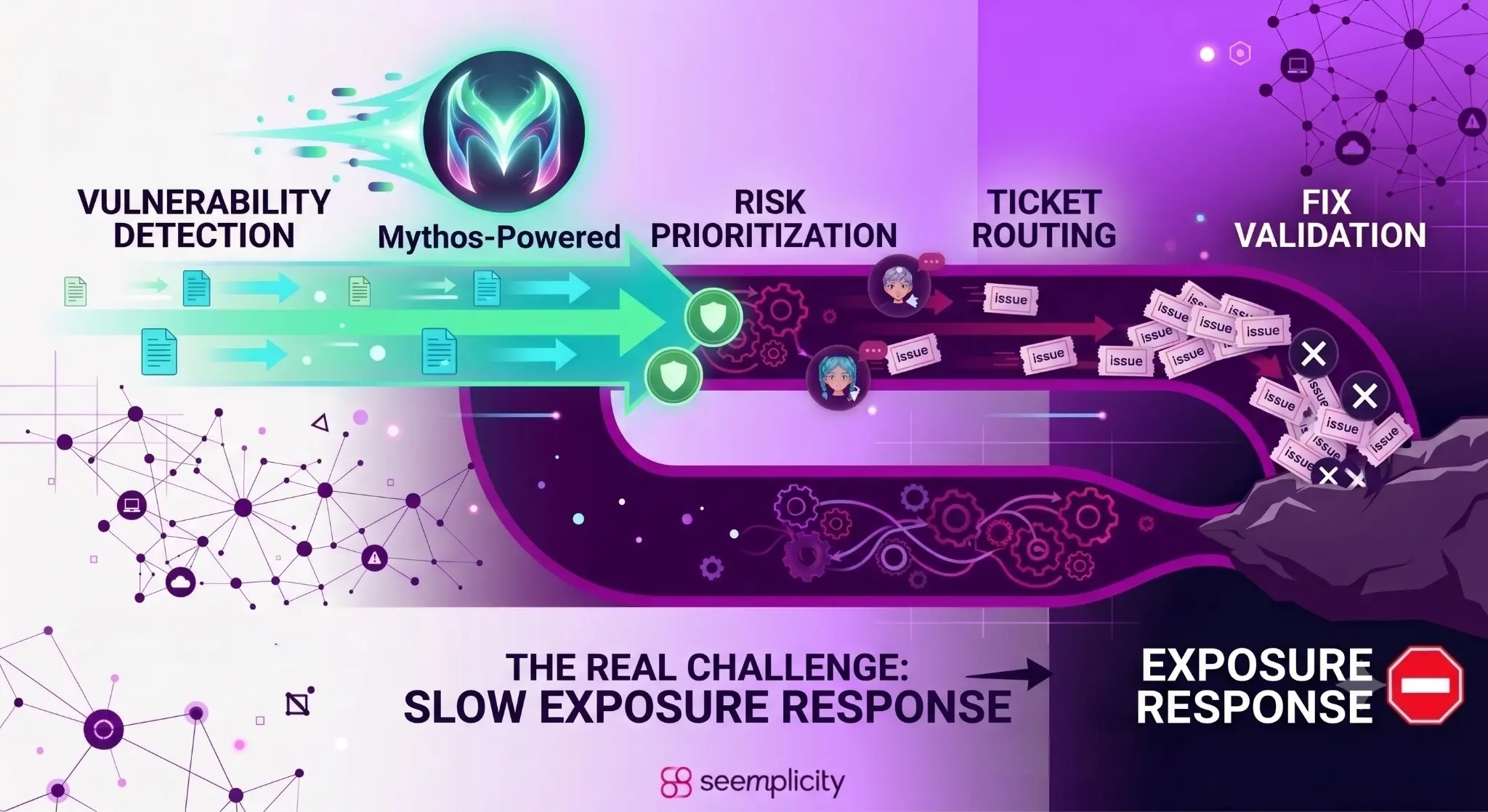
Detection Was Never the Real Bottleneck
Here’s the part that’s easy to miss in all the discourse about AI-driven vulnerability discovery: better detection has never been the thing standing between security teams and a secure environment. Scanners have gotten steadily better for years, and most organizations already have more findings than they can act on.
What AI changes is the speed and scale on both sides of that equation. Attackers get faster at finding and weaponizing flaws. Defenders, in theory, get the same lift from AI-assisted discovery tools, so the tools get sharper for everyone. The team that actually wins isn’t the one with the most sophisticated scanner, it’s the one whose response can absorb a spike in findings without falling apart.
That’s a hard truth for a lot of security programs, because most of the investment over the past decade has gone into finding things, not fixing them.
The Skill Floor Just Dropped
For years, one of the quiet assumptions behind vulnerability triage was that exploitation takes real expertise. A vulnerability with high attack complexity or no public proof of concept got a lower priority because, realistically, not many attackers had the skill or the time to weaponize it.
That assumption is getting shakier. Evaluations of Mythos-class models have shown them chaining multiple vulnerabilities together to escape sandboxing entirely, the kind of attack that normally takes a senior security researcher months to build. When a model can approach that level of work with a fraction of the human guidance previous tools needed, the pool of people capable of turning a finding into a working attack gets a lot bigger. It’s no longer limited to nation-state teams or elite red teamers.
That doesn’t mean every vulnerability in your backlog is suddenly a five-alarm fire. It means the old shortcut of “nobody has the skill to exploit this one yet” is a lot less reliable than it used to be.
Questions Worth Asking Your Team This Quarter
Before you can decide what to change, it helps to know where you actually stand. A few questions worth asking are:
- Do you know your mean time to remediation for each severity level?
- If the number of new findings tripled overnight, would your ticket routing hold up, or would it fall back on someone manually deciding who owns what?
- When a ticket gets marked “closed,” is that backed by verification that the fix actually landed?
- Do your engineers get a root cause and the specific fix they need, or just a CVE number and a due date?
None of these questions require an AI threat model to matter. But an environment where findings can spike overnight makes the gaps in these answers a lot more expensive.
What Keeping Up Actually Requires
If detection speed is no longer the differentiator, then the organizational muscle that matters is everything that happens after a finding shows up. In practice, that means:
- Consolidating findings across tools so your team isn’t stitching together context from five different scanners by hand.
- Routing ownership automatically, instead of a person manually deciding who on the engineering team gets which ticket.
- Prioritizing based on what’s actually reachable and exploitable in your environment, not just a static severity score that treats every instance of a CVE the same way.
- Verifying that a fix landed, instead of trusting a ticket status that might just mean someone clicked a button.
None of this requires abandoning the tools you already have. It requires a layer that can absorb the volume, route it correctly, and prove the work actually got done, at a pace that matches how fast the findings are showing up.
The Bottom Line
Mythos-class AI didn’t invent the gap between finding vulnerabilities and fixing them. That gap has existed for as long as vulnerability management has been a discipline. What it did was make the gap a lot more expensive to leave open. The teams that come out ahead won’t be the ones who found the most. They’ll be the ones who fixed the most, fastest, with the receipts to prove it.
If your team is looking to solve these particular issues, we’d love to show you how Seemplicity is innovating in agentic technology to impact exposure response at speed and at scale. It’s a conversation worth having no matter your current tech stack, since the speed of the game has changed drastically in recent months.

Stay updated on Seemplicity blog
Subscribe today to stay informed and get regular updates from Seemplicity.