



BloodHound Enterprise
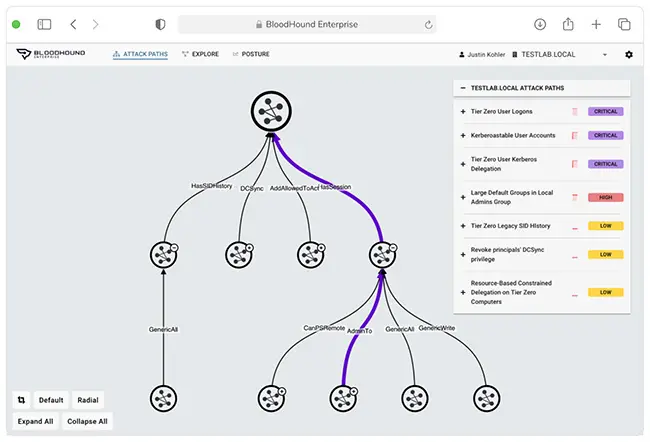
BloodHound Enterprise continuously maps identity relationships and permissions across Active Directory and Entra ID to reveal hidden attack paths to your most critical assets. It prioritizes the choke points that eliminate the most risk with the fewest operationally safe changes.
Identify Exploitable Attack Paths
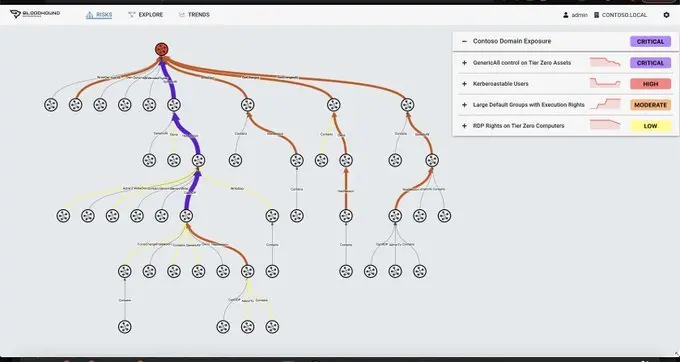
Active Directory and Entra ID environments accumulate years of small, seemingly harmless permission grants: a group membership here, a delegated right there. BloodHound Enterprise uses graph analysis to reveal how those individual grants combine into full attack paths to your most sensitive assets, then continuously tracks and reconciles that data as your environment changes. Instead of a one-time assessment, it gives security and identity teams an always-current map of identity risk across the environment.
Seemplicity + BloodHound Enterprise
BloodHound Enterprise identifies which identity relationships create real attack paths to critical assets and pinpoints the choke points that remove the most risk. Seemplicity ingests those findings through BloodHound Enterprise’s API, enriching asset data with Tier Zero status and other BloodHound tags. It then correlates that data with vulnerability, cloud, and application findings from other tools that see the same assets, organizes everything into a prioritized queue, and routes each item to the team that owns the fix, with SLAs and status tracked until the attack path is closed.

Key Benefits
Attack paths are one of the most consequential forms of identity risk, but they rarely get the attention they deserve because they live in a separate tool from the rest of the security backlog. Bringing BloodHound Enterprise’s attack path intelligence into Seemplicity closes that gap: identity risk is prioritized, owned, and tracked the same way as every other exposure in your environment.
- Unified Risk Prioritization — Attack paths surfaced by BloodHound Enterprise sit alongside vulnerability, cloud, and application findings in one Seemplicity queue, so identity risk is prioritized by real business impact.
- Automated Choke Point Remediation — BloodHound Enterprise’s highest-leverage choke points become precise Seemplicity tickets, routed to the identity or IT team that owns the fix.
- Continuous Attack Path Visibility — As BloodHound Enterprise’s ongoing collection and data reconciliation surface new attack paths, they flow into Seemplicity automatically to keep risk posture current.
- Faster Time-to-Remediation — Attack path data becomes a tracked workflow with SLAs and clear ownership, so teams can show measurable identity risk reduction over time, not just a list of findings.
Seemplicity Integration Features
The integration is built around BloodHound Enterprise’s REST API, which gives Seemplicity direct, ongoing access to attack path data as BloodHound Enterprise’s collectors and reconciliation engine keep it current.
- Automatic Attack Path IngestionSeemplicity connects to BloodHound Enterprise’s REST API to continuously pull attack path findings, including impacted tier zero assets, without manual export or upload.
- Cross-Source CorrelationAttack path findings are normalized alongside vulnerability, cloud, and application security data, so identity risk is scored and ranked using the same business-impact criteria as every other exposure.
- Automated Remediation RoutingEach finding is converted into a Seemplicity ticket and routed to the identity or IT owner responsible for the fix, with SLAs and status tracked through resolution.