

/how is ai changing application security?
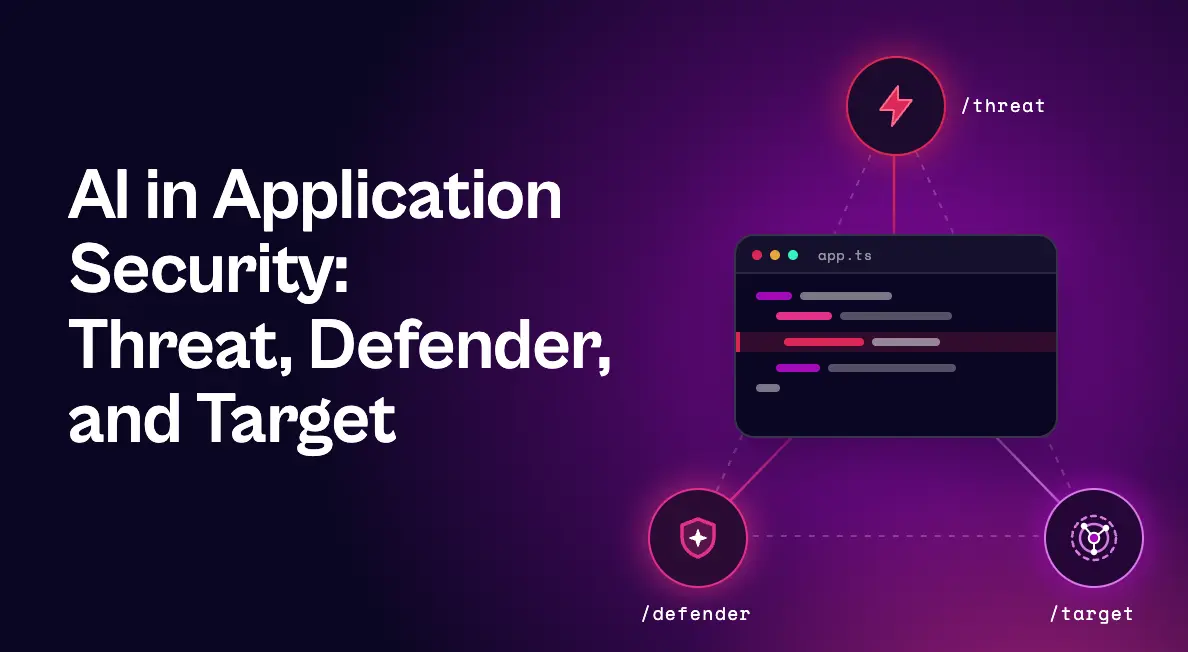
AI in application security plays three roles at once. As a threat, it helps attackers find and exploit vulnerabilities faster and increases the volume of code teams must secure. As a defender, it helps AppSec teams triage findings, confirm reachability, generate fixes, and route work to the right owners. As a target, AI-powered applications introduce new risks like prompt injection and over-permissioned agents. Winning programs use AI to validate and fix faster, while securing the AI they build.
AI in application security is no longer a future trend. It’s reshaping how code gets written, how vulnerabilities get found, and how quickly attackers can turn a flaw into a working exploit, all at the same time.
That’s why conversations about AI and AppSec often talk past each other. One person means AI-powered security tools. Another means securing AI-powered applications. A third means defending against AI-assisted attackers. All three are real, and every AppSec program now has to deal with each of them.
This guide breaks down the three roles AI plays in application security, where AI genuinely helps defenders, what’s different about securing AI applications, and how to evaluate AI capabilities in AppSec tools.
The Three Roles of AI in Application Security
Different parts of your environment need different kinds of scans. Most organizations run several of these at once:
| Role | What it means | What AppSec teams need |
|---|---|---|
| AI as a threat | Attackers use AI to discover and exploit vulnerabilities faster, and AI coding tools increase the volume of code to secure | Faster validation and remediation, not just faster detection |
| AI as a defender | Security teams use AI to triage, validate, fix, and route findings at scale | Trustworthy AI that explains its reasoning and reduces real work |
| AI as a target | Applications built on AI models and agents introduce new attack surfaces | New testing, access controls, and inventory for AI components |
AI as a Threat: Faster Exploits and More Code
The most visible change is on the attacker’s side. In 2026, frontier AI models demonstrated the ability to discover and exploit vulnerabilities autonomously, including long-hidden flaws in widely used software. In controlled evaluations, the UK AI Security Institute found that Anthropic’s Claude Mythos Preview could carry out multi-stage attacks on vulnerable networks, work that would take human professionals days. We’ve written about what that means for defenders in 5 ways to address Claude Mythos cybersecurity risks.
The downstream effect is already visible in open source. A Cloud Security Alliance report noted that Linux kernel maintainers saw a 10 to 15 times surge in vulnerability submissions following the Mythos disclosure. More vulnerabilities are being found, and the time between discovery and exploitation is shrinking.
At the same time, AI coding assistants are helping developers ship far more code, far faster. That code isn’t automatically secure. AI assistants can reproduce insecure patterns, suggest outdated dependencies, or even recommend packages that don’t exist, a gap attackers can exploit by registering those invented package names.
The combined result for AppSec teams: more code, more findings, and less time to act on them.
AI as a Defender: Where AI Actually Helps AppSec Teams
On the defensive side, AI in application security is most valuable where it removes repetitive investigation and coordination work that doesn’t scale with human effort.
Smarter detection
AI-assisted SAST, DAST, and SCA tools can recognize vulnerable patterns across large codebases and understand context that rule-based scanners miss, reducing some false positives at the source.
Triage and deduplication
AI can correlate findings from multiple scanners, merge duplicates, and group findings that share a single fix, such as one dependency upgrade that resolves dozens of alerts.
Reachability and exploitability analysis
This is one of the highest-value uses of AI in application security. AI agents can read source code, trace whether a flagged function is actually called, and confirm whether a vulnerable library function is invoked in a real execution path. That separates the findings that matter from the ones that are theoretical.
Fix generation and guidance
AI can produce step-by-step remediation guidance or proposed code changes tailored to the specific codebase and environment. Human review remains essential, especially for changes that touch production.
Ownership and routing
AI can identify the developers and teams responsible for a piece of code and route work into the tools they already use, cutting the time findings spend waiting for an owner.
Plain-language answers
AI assistants let security leaders and engineers ask questions like “which exploitable findings in our payment services are past SLA?” without building a dashboard or writing a query.
AI as the Target: Securing AI-Powered Applications
The third role is the newest. Applications that call large language models, use retrieval pipelines, or deploy autonomous agents introduce risks traditional AppSec wasn’t designed for. The OWASP Top 10 for LLM Applications is a useful reference, with prompt injection at the top of the list.
Key risks to address include:
- Prompt injection: Malicious instructions hidden in user input or retrieved content that manipulate a model’s behavior
- Sensitive data exposure: Models revealing confidential data from prompts, training data, or connected systems
- Excessive agency: AI agents with more tool access and permissions than their task requires
- Insecure output handling: Treating model output as trusted when it’s passed to code, databases, or other systems
- AI supply chain risk: Vulnerable or tampered models, datasets, plugins, and tool servers
Practical defenses start with fundamentals: inventory every AI component in your applications, apply least privilege to agents and the tools they can call, treat model output as untrusted input, and test AI features adversarially before release. Findings from that work belong in the same prioritized backlog as the rest of your application risk, not in a separate silo.
How to Evaluate AI in AppSec Tools
Nearly every AppSec vendor now markets AI features. Ask these questions to separate real value from marketing:
Does it show its reasoning? Every AI verdict should come with an evidence trail practitioners can inspect.
Does it analyze your actual code and environment? Generic risk scores dressed up as AI add little. Look for analysis grounded in your source code, dependencies, and configuration.
Does it reduce work or add alerts? Measure whether AI shrinks the backlog, shortens time to fix, and cuts ticket volume.
Is there a human in the loop where it matters? Automated fixes and changes should be reviewable and controllable.
How is your code and data handled? Understand where analysis happens and how your data is stored and used.
How Seemplicity Applies AI in Application Security
Seemplicity is the only technology that fuses exposure management with autonomous response, and its AI is built to close the gap AI-era attackers are exploiting: the time between finding a vulnerability and fixing it. For AppSec teams, that looks like this:
AI Analysts that confirm what’s reachable
Seemplicity’s Code Analyst reads source directly from GitHub or GitLab and traces whether a flagged function is actually reachable in how the application is built. The SCA Analyst confirms whether a vulnerable library function is imported and invoked in a real execution path, supporting fast, SBOM-driven response when a new zero-day lands. Every verdict includes an expandable reasoning trail.
Fewer tickets, clearer fixes
Findings from SAST, DAST, SCA, and other AppSec tools are deduplicated and grouped by fix. The Remediation Agent attaches step-by-step, environment-specific guidance, and Response Options lay out Fix, Mitigate, or Neutralize choices with a safety rating for each.
Work routed to the right developers
Seemplicity identifies code owners and routes findings to each team’s remediation queue, where AppSec teams can set their own priority rules. Bi-directional Jira sync keeps status, comments, and SLAs aligned without developers leaving their workflow.
Answers without dashboard digging
Seema, Seemplicity’s AI assistant, answers plain-language questions about findings, owners, queues, and SLAs. For a broader look at how application security posture management is evolving, read ASPM: from visibility to action or our guide to choosing ASPM tools.
See Seemplicity in Action
The organizations that benefit most from AI in application security will be the ones that use it to fix faster, not just find more. Request a demo to see Seemplicity in action for yourself.

Frequently asked questions
AI in application security is used to detect vulnerabilities in code, deduplicate and prioritize findings, confirm whether vulnerable code is reachable, generate remediation guidance, and route fixes to the right developers. It’s also a new attack surface, since AI-powered applications need their own security controls.
Not automatically. AI coding assistants can introduce insecure patterns, outdated or nonexistent dependencies, and logic flaws. AI-generated code should go through the same security testing and review as human-written code.
It’s an OWASP project that lists the most critical security risks for applications built on large language models, including prompt injection, sensitive information disclosure, and excessive agency. It’s a common starting point for securing AI features.
Unlikely. AI takes on repetitive investigation, triage, and coordination work, which frees AppSec engineers to focus on architecture, threat modeling, complex issues, and decisions that require human judgment.
Stay updated on Seemplicity blog
Subscribe today to stay informed and get regular updates from Seemplicity.