/what is the best brinqa alternative?
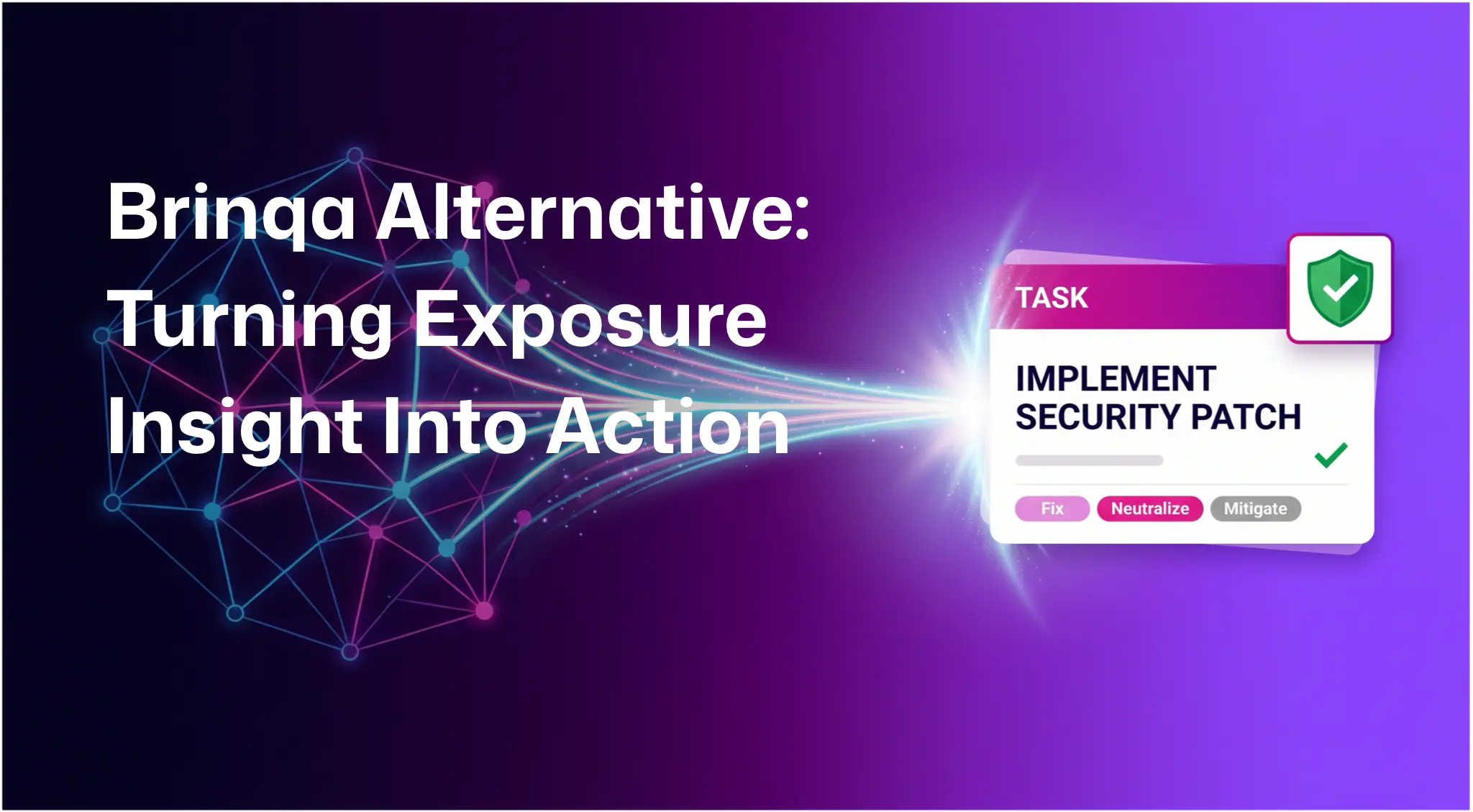
The best Brinqa alternative is the one that fixes your specific bottleneck. If you need a highly customizable enterprise risk data model, Brinqa is built for that. If your team already understands its risk and needs to act on it faster, look for a platform that confirms real exploitability, offers response options beyond patching, consolidates findings into root cause fixes, and routes work to the right owners automatically. That action-first approach is what Seemplicity’s Agentic Exposure Action Platform is designed to deliver.
Teams searching for a Brinqa alternative usually aren’t short on data. They’re short on time between knowing about a risk and getting it closed.
That gap matters more every month. AI has shortened the window between a vulnerability’s disclosure and a working exploit, and exposure management programs are now judged less on how completely they model risk and more on how quickly they reduce it.
This guide takes a fair look at what Brinqa does well, the reasons teams explore other options, the questions worth asking during an evaluation, and how Seemplicity takes a different, action-first approach to exposure management.
What Brinqa Does Well
Brinqa is an established exposure management platform built primarily for large enterprises. Its foundation is the Brinqa CyberRisk Graph, a data model that connects assets, vulnerabilities, threat intelligence, and business context into a single correlated view of risk. It supports a broad portfolio of IT, business, and security integrations, and customers frequently highlight how much it can be customized to match their organization.
Brinqa has also added AI capabilities, including BrinqaIQ for natural-language questions about risk data, agents for deduplicating findings and attributing ownership, and SmartFlows for building workflow automations such as ticket creation and routing.
For organizations that want a deeply modeled, enterprise-wide picture of cyber risk, that’s a meaningful set of strengths.
Why Teams Look for a Brinqa Alternative
Even with strong data foundations in place, several challenges lead security teams to evaluate other platforms.
Time and expertise to reach full value
Flexibility has a cost. Reviewers on G2 and Gartner Peer Insights often praise Brinqa’s customization while also noting a learning curve during initial setup and integration. Heavily customized deployments can require dedicated expertise to build and maintain, which is a challenge for lean teams.
A trusted risk picture doesn’t close tickets
Knowing exactly where risk lives is valuable, but the backlog only shrinks when fixes get done. Many teams find that the hardest part of exposure management isn’t analysis. It’s the operational work of turning analysis into completed remediation across dozens of teams.
Scores are no longer enough to prioritize
Traditional signals like CVSS, attack complexity, and exploit availability are losing their value as AI makes exploit development faster and easier. Teams increasingly want evidence that a specific finding is exploitable in their environment, not another score to debate.
Patching isn’t always an option right away
A full patch or upgrade often needs testing, change windows, and coordination, sometimes including a production reboot. When the fix is weeks away, teams need safe ways to reduce exposure now.
5 Questions to Ask When Evaluating a Brinqa Alternative
Use these questions to test any platform on your shortlist against the outcomes that matter most: less exposure, faster.
- How soon will tickets reach the right owners? Ask for realistic timelines from connecting your tools to assigned, correctly routed work, and how much configuration that requires.
- Does it confirm exploitability or just score it? Look for evidence-based investigation of whether a vulnerability is reachable and exploitable in your environment.
- What can we do before a patch is ready? The platform should surface interim responses, such as compensating controls or targeted configuration changes, rather than treating patching as the only answer.
- How much ongoing maintenance does it need? Ownership mappings, scoping rules, and workflows should adapt as your organization changes without constant manual upkeep.
- Will fixing teams actually use it? Fewer, consolidated tickets with clear guidance, delivered in the tools engineers already work in, drive adoption far more than another dashboard.
How Seemplicity Compares as a Brinqa Alternative
Seemplicity is an Agentic Exposure Action Platform built around a simple idea: exposure management succeeds when findings turn into fixes. It consolidates findings from your scanners and security tools, but the platform’s focus is on validating what’s truly dangerous and driving the fastest safe response.
AI Analysts that confirm what’s actually exploitable
Seemplicity’s AI Analysts are autonomous agents that investigate findings and determine whether they’re exploitable in real-world conditions, with a full evidence trail behind every verdict. The Host Analyst evaluates host vulnerabilities against live runtime conditions and network exposure, the Code Analyst checks whether vulnerable code is actually reachable, and the SCA Analyst validates dependency reachability. Teams spend their time on the findings attackers could really use.
Response options beyond “patch or nothing”
With Response Options, Seemplicity presents multiple paths to closing a finding, including compensating controls and targeted configuration changes that reduce exposure immediately while a full fix is planned. Each option includes a readiness indicator showing whether it can be deployed now or needs review, and the AI Analysts recommend an option while keeping every alternative and its reasoning visible. Seemplicity can also factor in live EDR context when assessing compensating controls.
Root cause fixes and automatic ownership
Instead of flooding teams with one ticket per finding, Seemplicity groups related alerts into single root cause fixes, reducing alert volume by up to 90%. Find the Fixer builds accurate ownership structures by cleaning and enriching scanner tags, and the Remediation Agent adds environment-specific, step-by-step guidance to each task before it lands in Jira, ServiceNow, or Azure DevOps.
Built to deliver value quickly
Seemplicity is designed to work with your organization as it exists today, with Automatic Scoping building logical groupings from attributes like environment, business unit, and ownership. Customers have reported data flowing within hours and tickets assigned within days.
If you’re weighing the two platforms, this summary can help you match each one to your priorities:
| If your top priority is… | Consider |
|---|---|
| A deeply customized, enterprise-wide cyber risk data model | Brinqa, whose CyberRisk Graph is built for flexible data modeling |
| Confirmed exploitability before assigning work | Seemplicity AI Analysts with evidence-based verdicts |
| Reducing exposure before a patch is available | Seemplicity Response Options, including compensating controls |
| Cutting ticket volume for engineering teams | Seemplicity root cause fixes (up to 90% fewer alerts) |
| Fast time to value with a lean team | Seemplicity, with data flowing in hours and tickets assigned in days |
When Brinqa May Be the Better Fit
Brinqa can be the right choice for large enterprises that have the staff to build and maintain a highly customized deployment, want to model risk across many business and IT domains in their own way, or rely on custom queries and reporting over a unified risk graph. If those are your defining requirements, weigh them carefully in your evaluation.
If your team’s defining problem is speed, and specifically the time it takes to confirm what’s dangerous and get it fixed, an action-first platform is likely the better match.
Planning a Move Away From Brinqa
A thoughtful transition protects your program’s momentum. Before you switch:
Document your current risk models and SLAs. Decide which rules still serve you and which were workarounds you can retire.
Confirm integration coverage. Match every data source and ticketing system in use today against the new platform’s supported integrations.
Run both platforms side by side on real data. Compare time to assignment, ticket volume, and mean time to remediate (MTTR).
Set a baseline for executive reporting. Agree on the metrics leadership will see so progress stays visible through the change.
See Seemplicity in Action
The clearest way to evaluate a Brinqa alternative is to see how quickly it turns your own findings into confirmed, prioritized, and completed fixes. Request a demo to see Seemplicity in action for yourself.

Frequently asked questions
Brinqa is an exposure management platform for large enterprises. It unifies security, IT, and business data in its CyberRisk Graph to create a correlated view of risk, and supports prioritization, workflow automation, and reporting.
The best alternative depends on your goals. For teams that want to confirm real exploitability, reduce exposure before patches are ready, and accelerate remediation with automated ownership and root cause fixes, Seemplicity is purpose-built for the job.
In most cases, yes. Seemplicity ingests findings from widely used scanners and security testing tools, such as Wiz, Snyk, Checkmarx, Veracode, and Prisma Cloud, and connects to ticketing systems like Jira and ServiceNow. Confirm coverage for your specific stack during evaluation.
Preemptive exposure management goes beyond visibility by using AI and automation to reduce exploitable risk before attackers can act, triggering responses such as mitigation, remediation, or containment. Seemplicity was recognized in multiple 2026 Gartner reports covering preemptive exposure management.
Stay updated on Seemplicity blog
Subscribe today to stay informed and get regular updates from Seemplicity.