



/what is mobilization in ctem?
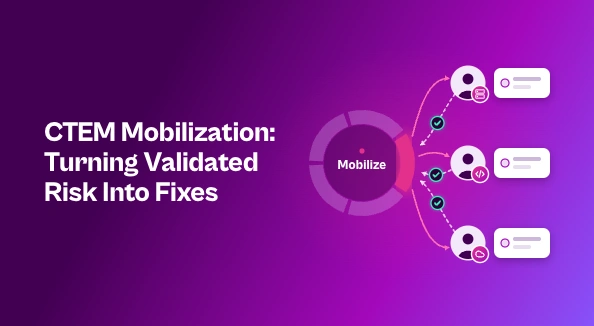
Mobilization is the fifth and final stage of continuous threat exposure management (CTEM). It turns validated, prioritized exposures into action by assigning clear owners, delivering context-rich work into the tools teams already use, choosing the fastest safe response, tracking SLAs, and verifying that fixes worked. It’s often the hardest stage because security teams find exposures but IT, engineering, and cloud teams fix them. Strong CTEM mobilization depends on shared ownership, automation, and outcome-based metrics.
CTEM mobilization is where a continuous threat exposure management program either delivers results or stalls. Every earlier stage, from scoping through validation, exists to answer one question: what should we fix first? Mobilization is the stage that actually gets it fixed.
It’s also where many programs struggle. Security teams can identify and validate exposures with increasing precision, but the people who patch servers, change cloud configurations, and update code usually sit in other teams with their own priorities. Without a deliberate mobilization process, even perfectly prioritized findings sit in a backlog.
This guide explains what mobilization means in CTEM, why it’s the hardest stage, the components of an effective mobilization process, how to build one, and how to measure it.
What Is Mobilization in CTEM?
Mobilization is the fifth stage of Gartner’s CTEM framework, following scoping, discovery, prioritization, and validation. If you’re new to the framework, start with our overview of what continuous threat exposure management is or our breakdown of the phases of CTEM.
In practice, CTEM mobilization means getting the right people to take the right action on validated exposures, and removing the friction that slows them down. That includes much more than opening tickets:
- Assigning each exposure to an accountable owner
- Delivering the context and guidance needed to act
- Choosing the best response, whether that’s a fix, a mitigation, or a documented risk acceptance
- Coordinating approvals and change windows
- Tracking progress against SLAs and verifying closure
- Communicating status to every stakeholder, from engineers to the board
Mobilization depends on the stage before it. Validation, covered in our guide to CTEM validation, confirms which exposures are real and not already contained, so mobilization can focus effort where it matters.
Why Mobilization Is the Hardest CTEM Stage
Security finds, but other teams fix
Remediation work belongs to IT operations, developers, cloud engineers, and application owners. They’re measured on uptime, feature delivery, and their own roadmaps. Security findings compete for their time.
Ownership is often unclear
Inconsistent asset tags, shared cloud accounts, reorganizations, and legacy systems make it hard to know who owns a given exposure. Misrouted tickets bounce between teams while the exposure stays open.
Findings arrive without context
A ticket that just says “critical CVE on host X” forces the fixer to research the issue, find the right fix, and assess the risk of change. Multiply that by hundreds of tickets, and work slows to a crawl.
Patching isn’t always possible right away
Fixes often depend on testing, maintenance windows, and change approvals. Without alternatives, high-risk exposures stay open for weeks.
The clock is getting shorter
AI has shortened the time between vulnerability disclosure and working exploit. Mobilization processes built around weekly meetings and manual ticket chasing can’t keep pace.
The Core Components of CTEM Mobilization
| Component | Vulnerability Management |
|---|---|
| Ownership | Every exposure maps automatically to an accountable team or person, and the mapping stays current as the organization changes |
| Shared priorities and SLAs | Security and fixing teams agree on risk-based timelines and an exception process before work starts |
| Context-rich work items | Related findings are grouped by fix, with asset-specific guidance attached |
| Workflow integration | Work arrives in Jira, ServiceNow, or the team’s existing tool, with status syncing both ways |
| Response options | Teams can choose to fix, mitigate, or neutralize an exposure, or formally accept risk, based on what’s fastest and safest |
| Communication | Engineers, managers, and executives each get the view of progress they need |
| Verified closure | Fixes are confirmed by rescans or revalidation, and results feed back into the next CTEM cycle |
How to Build a CTEM Mobilization Process That Works
- Make mobilization a shared responsibility. Agree on an ownership model with IT and engineering leaders so remediation is co-owned, not something security hands off and hopes for the best.
- Set risk-based SLAs and an exception path. Define timelines by validated risk, and give teams a clear way to request exceptions or document compensating controls.
- Group findings by fix. When one patch or one template change resolves many findings, send one work item instead of dozens.
- Send work where teams already work. Deliver tasks into existing ticketing and work management tools, and sync status, comments, and SLAs in both directions.
- Offer more than one way to close risk. Interim mitigations reduce exposure immediately while permanent fixes wait for a change window.
- Automate the routine. Routing, reminders, escalations, and status updates shouldn’t depend on someone chasing tickets by hand.
- Verify and close the loop. Confirm fixes worked, reopen what didn’t, and feed lessons back into scoping and prioritization.
- Report outcomes, not activity. Show leaders how exposure is shrinking, not how many tickets were opened.
CTEM Mobilization Metrics to Track
The right metrics show whether CTEM mobilization is actually reducing risk, not just generating activity:
- Mean time to remediate (MTTR) by severity, team, and business unit
- SLA compliance for validated, high-risk exposures
- Risk-weighted exposure burndown over time
- Reassignment rate, showing how often work lands with the wrong owner
- Findings per work item, showing how effectively related findings are grouped
- Closure by response type, comparing fixes, mitigations, and accepted risks
- Reopen rate, showing how often exposures return after being closed
How Seemplicity Powers CTEM Mobilization
Seemplicity was built to close the gap between finding an exposure and resolving it. As the only technology that fuses exposure management with autonomous response, it turns mobilization from manual coordination into an automated, measurable process.
The right owner, every time
Find the Fixer builds accurate ownership structures by cleaning and enriching scanner tags, and Automatic Scoping groups assets by environment, business unit, and owner. Findings route to each team’s remediation queue, where teams can set their own priority rules and role-based access control keeps them focused on their own work.
Fewer, better work items
Findings are deduplicated and grouped by fix, so ten findings closed by the same patch become one remediation item. Seemplicity then attaches step-by-step, environment-specific guidance, so fixers can act without researching from scratch.
Work that flows both ways
Bi-directional Jira and ServiceNow integrations keep status, comments, and SLA tracking in sync, so teams can update from either side. Routing, deduplication, and assignment happen automatically the moment a finding comes in.
The fastest safe response
AI Analysts confirm exploitability and check EDR coverage from your EDR solutions before work is assigned, so teams only mobilize on what’s real and uncontained. Response Options then lay out Fix, Mitigate, or Neutralize choices, with one recommended, the reasoning a click away, and a safety rating for each.
Clear communication at every level
Seema, Seemplicity’s AI assistant, answers plain-language questions about findings, queues, and SLAs. The Clarity agent turns technical findings into readable narratives for business stakeholders, and the Insights agent surfaces trends and posture changes for security leaders.
Frequently Asked Questions
What happens in the mobilization stage of CTEM?
In the mobilization stage, validated and prioritized exposures are assigned to owners, delivered with context into their workflows, resolved through fixes or mitigations, tracked against SLAs, and verified as closed. Results then feed back into the next CTEM cycle.
Who is responsible for CTEM mobilization?
Responsibility is shared. Security teams typically coordinate and measure mobilization, while IT, engineering, cloud, and application teams carry out remediation. Programs perform best when those teams co-own mobilization goals and metrics.
How is mobilization different from remediation?
Remediation is the act of fixing an exposure. Mobilization is broader: it includes deciding who acts, choosing between fixing, mitigating, or accepting risk, coordinating approvals, communicating progress, and verifying results.
What’s the difference between validation and mobilization in CTEM?
Validation confirms whether a prioritized exposure is actually exploitable and uncontained. Mobilization acts on that confirmation, getting validated exposures fixed or mitigated by the right people as quickly and safely as possible.
See Seemplicity in Action
CTEM mobilization is where exposure management turns into reduced risk. Request a demo to see Seemplicity in action for yourself.

Stay updated on Seemplicity blog
Subscribe today to stay informed and get regular updates from Seemplicity.