
/ what are the five ctem stages?
The five CTEM stages are Scoping, Discovery, Prioritization, Validation, and Mobilization. Together, they create a continuous process for defining what matters, identifying exposures, determining which pose the greatest risk, validating that risk, and coordinating action to reduce it.
Continuous Threat Exposure Management (CTEM) gives security teams a structured way to continuously identify, evaluate, and reduce the exposures that pose the greatest risk to the business. Rather than treating exposure management as a periodic scan-and-patch exercise, CTEM organizes the work into a repeatable cycle that connects what matters to the business with what security teams find, validate, and ultimately fix.
The five CTEM stages are Scoping, Discovery, Prioritization, Validation, and Mobilization. Each stage has a distinct role: defining what matters, identifying exposures within that scope, determining which deserve attention first, validating real-world risk, and mobilizing the right teams to act.
We’re breaking down each of the five CTEM stages, explaining how they work together, and looking at what it takes to turn the CTEM framework into an operational process for reducing exposure.
What is CTEM?
Continuous Threat Exposure Management (CTEM) is a cybersecurity framework for continuously evaluating and reducing the exposures that pose the greatest risk to an organization. Rather than focusing only on finding and scoring vulnerabilities, CTEM uses business context, threat intelligence, exploitability, and other risk factors to help security teams determine where action will have the greatest impact.
Importantly, CTEM is not a specific product or technology. It is an ongoing, business-aligned process that brings together different security tools, data, and teams in a continuous, business-aligned process for reducing exposure. As the environment and threat landscape change, the cycle repeats so organizations can continually reassess what matters most and where to focus their efforts.
What Are the Five CTEM Stages?
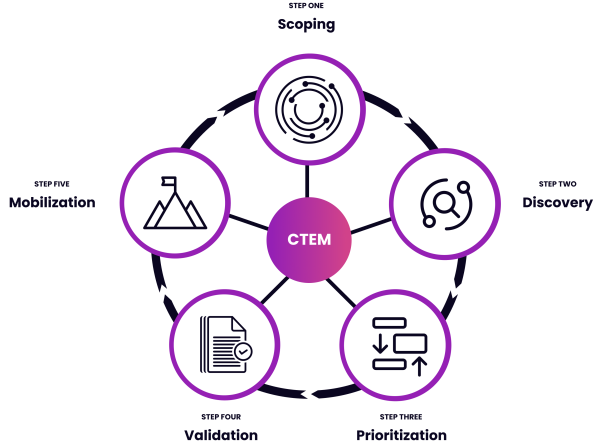
The CTEM framework consists of five stages: Scoping, Discovery, Prioritization, Validation, and Mobilization. Together, they create a continuous process for identifying the exposures that matter most, determining which require action, and driving that action through to remediation.
| CTEM Stage | What it Does |
|---|---|
| 1. Scoping | Defines which business services, assets, environments, and areas of the attack surface the CTEM program should focus on. |
| 2. Discovery | Identifies assets, vulnerabilities, misconfigurations, identity risks, and other exposures within that scope. |
| 3. Prioritization | Determines which exposures deserve attention first based on factors such as business impact, threat context, and likelihood of exploitation. |
| 4. Validation | Tests whether prioritized exposures present a credible path to compromise and whether existing controls effectively reduce the risk. |
| 5. Mobilization | Turns CTEM insights into action by coordinating remediation with the teams responsible for addressing the exposure. |
These stages are not intended to be completed once and checked off. CTEM is a continuous cycle: changes to the environment, new threat intelligence, and the outcomes of each cycle can all influence what should be scoped, discovered, and prioritized next.
The 5 CTEM Stages Explained
Stage 1: Scoping
Scoping defines what the CTEM program should focus on and why. Rather than starting with everything your security tools can already see, organizations should begin with the business services, systems, applications, data, and environments where exposure could have the greatest impact.
This means identifying what matters most to the business and defining the relevant attack surface around it. Depending on the organization, a scope might center on a critical application, a cloud environment, internet-facing assets, sensitive data, or another high-priority area of the business.
The goal is not to make everything equally “in scope.” A scope that is too broad can create an overwhelming volume of findings, while one that is too narrow can leave meaningful risk outside the program. Starting with a focused, business-aligned scope gives the remaining CTEM stages a clear foundation for deciding what to discover, prioritize, validate, and ultimately act on.
Scoping should also be revisited as the business and technology environment change. New applications, cloud migrations, acquisitions, third-party services, and shifting business priorities can all change what requires the most attention.
Stage 2: Discovery
Once the scope is defined, the Discovery stage focuses on building a clear picture of the assets and exposures within it. This means identifying not only known systems and applications, but also unmanaged or previously unknown assets that may introduce additional risk.
Discovery goes beyond traditional vulnerability scanning. Depending on the scope, security teams may need to identify software vulnerabilities, cloud and configuration weaknesses, identity and access risks, exposed services, insecure permissions, shadow IT, and other security exposures across the environment.
The goal is to understand both what exists within the defined scope and what could expose it to attack. Bringing together data from relevant security tools helps create a more complete view of the attack surface and provides the foundation for the next CTEM stage: determining which exposures actually deserve attention first.
Stage 3: Prioritization
Discovery can surface a huge number of exposures, but they do not all present the same level of risk. The Prioritization stage determines which exposures require attention first so security teams can focus their resources where they will have the greatest impact.
Rather than relying on technical severity alone, CTEM prioritization brings together multiple signals, such as asset criticality, business impact, exploitability, threat intelligence, exposure and reachability, and the potential role an issue could play in an attack path. A critical vulnerability on an isolated, low-value asset, for example, may warrant less immediate attention than a lower-severity exposure affecting an internet-facing system that supports a critical business service.
The result should be a focused set of exposures that represent the most meaningful risk to the organization, rather than an ever-growing list of findings ranked by severity. Those priorities can then move into the Validation stage, where teams determine whether the risk holds up in the context of their actual environment.
Stage 4: Validation
Prioritization identifies the exposures most likely to matter. Validation tests whether that risk holds up in the context of the organization’s actual environment.
This can involve determining whether an exposure is reachable or exploitable, whether it contributes to a viable attack path, what an attacker could potentially achieve by exploiting it, and whether existing security controls are effective enough to reduce the risk. Validation may use techniques such as attack simulation, penetration testing, attack path analysis, control testing, and re-testing after remediation.
This step helps security teams separate theoretical risk from exposures that present a credible threat in practice. It can also challenge earlier assumptions: an exposure initially ranked as high priority may prove difficult to exploit, while validation may reveal that another creates a more significant path to critical assets.
By validating risk before mobilizing remediation, organizations can focus action on exposures that have both meaningful business impact and a realistic potential to be exploited.
Stage 5: Mobilization
Mobilization is where the insights generated throughout the previous CTEM stages are turned into action. Once an exposure has been prioritized and validated, the organization needs to determine what should be done, who is responsible for doing it, and how the work will be tracked through to completion.
Remediation may involve patching a vulnerability, changing a configuration, restricting access, applying a mitigating control, or taking another action that reduces the exposure. The right response will depend on the nature of the risk, the affected asset, and the operational context surrounding it.
Effective mobilization also requires coordination between security teams and the people responsible for making the change. That means identifying the correct owner, providing enough context for them to understand why the issue matters and what action is required, and integrating remediation into the workflows and tools they already use.
The stage does not end when a remediation ticket is created. Progress needs to be tracked, delays or blockers addressed, and the outcome verified so the organization knows the exposure has actually been reduced.
Completing Mobilization closes one CTEM cycle, but it also generates information that can feed back into the next. Changes to the environment, remediation outcomes, and lessons from the process can all influence how the organization scopes, discovers, and prioritizes exposures going forward.
How the CTEM Stages Work Together
The five CTEM stages are designed to work as a continuous cycle, not a one-time checklist. Each stage informs the next, while the outcomes of later stages can change how the organization approaches earlier ones in future cycles.
For example, Validation may reveal that an exposure initially considered high priority presents little practical risk, while Mobilization may uncover ownership gaps or remediation blockers that need to be addressed in the next cycle. Changes to the business, technology environment, or threat landscape can also affect what should be included in scope and which exposures deserve the most attention.
This feedback loop is what makes CTEM continuous. Rather than periodically generating another list of findings, organizations repeatedly reassess what matters, where meaningful exposure exists, and what action will reduce risk most effectively.
Over time, the CTEM stages should help organizations refine both their understanding of exposure and their ability to respond to it.
The CTEM Framework in Action
Understanding the five CTEM stages is relatively straightforward. Operationalizing them continuously across a complex security environment is much harder.
Most organizations already have many of the tools needed to support CTEM, from vulnerability scanners and cloud security platforms to threat intelligence, asset inventories, and validation technologies. The challenge is connecting the data and workflows across those tools so that Scoping, Discovery, Prioritization, Validation, and Mobilization operate as one continuous process rather than disconnected activities.
That means bringing exposure data together, applying consistent business and threat context, validating which risks require action, identifying who owns the fix, and tracking remediation through to completion. Just as importantly, information from each cycle needs to feed back into the next so the program can adapt as the environment and threat landscape change.
Seemplicity’s Exposure Action Platform helps organizations operationalize CTEM by connecting these stages across the exposure management lifecycle. The platform unifies findings from existing security tools, applies organizational and threat context, helps validate and prioritize meaningful exposures, and turns those priorities into remediation work by identifying the right owners, delivering fix-ready guidance into their existing workflows, and tracking progress through resolution.
By connecting the five CTEM stages from exposure discovery through action, organizations can move beyond simply identifying risk and build a repeatable process for reducing it.

Stay updated on Seemplicity blog
Subscribe today to stay informed and get regular updates from Seemplicity.