




/what is prioritization in CTEM?
Prioritization in CTEM is the process of determining which exposures should be addressed first based on the risk they pose in your specific environment. Rather than relying on severity scores alone, effective prioritization combines internal business and asset context with external threat intelligence, then focuses teams on the fixes that reduce the most meaningful risk.
In the CTEM Framework, Discovery tells you what’s actually in your environment. Prioritization tells you what to fix first, and that sounds simple until you’re staring at a backlog of tens of thousands of findings, and a severity score that treats a critical CVE on an internet facing production server the same as the identical CVE on an isolated dev sandbox.
This is the third post in our series walking through Seemplicity’s approach to each stage of CTEM. This post covers the role of prioritization in the framework, and why a good score is only half the answer.
The Problem with Scoring Findings Instead of Fixes
Most vulnerability tools prioritize by assigning a score to each individual finding, usually built from CVSS plus a handful of external signals. That’s not wrong exactly. It’s incomplete, in two specific ways.
- Ambiguous rationale. A remediation team gets handed a list ranked by severity, with no clear explanation of why one item outranks another beyond “the number is higher.” When two findings have similar scores, the team is left guessing which one actually matters more to the business.
- External dependency. Generic severity scores and industry standard threat intelligence are built to apply everywhere, which means they’re tuned for nowhere in particular. They don’t know that one server sits in a regulated business unit and another doesn’t. They don’t know that one machine is confirmed internet exposed and another only might be.
That second point isn’t hypothetical, it’s the exact gap our last post walked through. A finding on a machine with unclear exposure status looks very different once you know, with confidence, that it’s actually facing the internet. Prioritization is where that confirmed context gets put to work.
Findings Aren’t the Unit of Work
There’s a structural issue underneath both problems: findings and remediation work aren’t the same thing. A single vulnerable package can generate dozens or hundreds of individual findings across different assets, teams, and scan sources. Prioritize at the finding level, and you can end up asking a remediation team to work through the same underlying fix ten separate times, in ten separate tickets, each with its own priority score, and those scores may not even agree with each other.
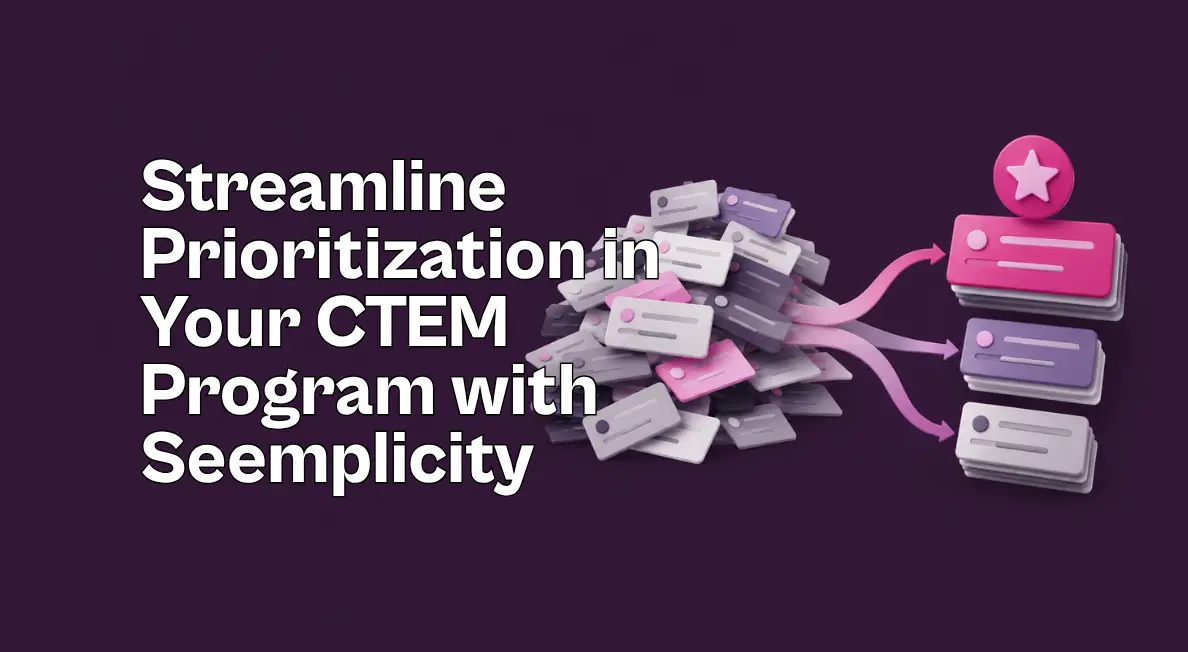
Seemplicity prioritizes at the level of the fix, not the finding. A single remediation action (upgrade this package, close this misconfiguration) gets one priority, and every finding it resolves is deduplicated underneath it. That turns the backlog from “here are 40,000 findings, good luck” into “here are the fixes that actually move the needle, ranked by what happens if you do them.”
What Actually Drives the Ranking
Two categories of context feed into that ranking, and neither one alone is enough.
- Internal context
is specific to your organization: which business units are mission critical, which systems fall under regulatory scope, which assets sit in which geographic region, and, as in the Discovery example, which machines are confirmed exposed to the internet versus which ones aren’t. This is context a generic scanner has no way of knowing on its own. - External context
is the threat landscape: CISA’s Known Exploited Vulnerabilities list, VulnCheck KEV, broader threat intelligence feeds, EPSS percentages, and flags for specific high risk vulnerability classes like remote code execution or privilege escalation. This tells you which vulnerabilities are being actively exploited in the wild right now, regardless of your environment.
Put them together and the picture gets sharp fast. A finding that scores moderately on CVSS but is confirmed exploited in the wild, sitting on a confirmed internet facing asset in a regulated business unit, should outrank a nominally “critical” finding on an isolated internal system that nothing points to being actively targeted. Getting that ranking right takes both kinds of context at once. Either one alone leaves a blind spot.
Prioritization Still Needs Oversight
None of this is meant to run on autopilot with no oversight. Teams can adjust scoring rules, assign fixed priority values that reflect their own risk tolerance, and manually override priority in real time when something urgent comes up that the rules haven’t caught yet. The goal isn’t to remove judgment from the process. It’s to make sure the starting point is already informed by the context a team would otherwise have to gather by hand.
Prioritization also isn’t a one time ranking exercise. Once fixes are prioritized, they need to move: routed to the right team, tracked against SLAs, and reported on so nothing quietly stalls in a backlog nobody’s watching.
Prioritization Sets Up the Rest of CTEM
Validation runs faster when teams are only validating fixes that were worth prioritizing in the first place. Mobilization depends entirely on the ranking being trustworthy enough that a team acts on it without re-litigating the order themselves. Get prioritization wrong, and every later stage inherits the confusion.
If you want to see how Seemplicity handles context-aware prioritization in practice, our Demo Center walks through it directly. You can explore it here at seemplicity.ai/demo-center.

Stay updated on Seemplicity blog
Subscribe today to stay informed and get regular updates from Seemplicity.