

/What is cloud security configuration management?
Cloud security configuration management is the ongoing practice of defining secure settings for cloud resources, enforcing them through code and guardrails, detecting drift, and fixing misconfigurations where they originate. It combines security baselines like the CIS Benchmarks, infrastructure as code, policy as code, and drift detection. The goal is cloud environments that stay secure by default instead of being fixed one alert at a time.
Cloud security configuration management is the ongoing practice of defining secure settings for your cloud resources, enforcing them, detecting when they change, and fixing problems where they start. It’s what keeps a storage bucket private next month, not just today.
Most cloud breaches don’t need a zero-day. They need a public bucket, an overly broad IAM role or a security group left open to the internet. Those problems are easy to fix once. The hard part is keeping them fixed while hundreds of engineers deploy changes every day. That’s what cloud security configuration management is for.
What is Cloud Security Configuration Management?
Cloud security configuration management is the discipline of keeping every cloud resource aligned with an approved, secure configuration over time. It covers the full lifecycle of a setting, from the moment it’s defined to the moment it drifts and gets corrected.
It usually includes:
- Security baselines that define what “secure” means for each resource type
- Infrastructure as code (IaC) so configurations are versioned and repeatable
- Policy as code that checks configurations automatically before and after deploy
- Preventive guardrails that block the riskiest settings outright
- Drift detection that flags when live resources no longer match the approved state
- Remediation workflows that route fixes to the people who own the resource
Why Does Cloud Security Configuration Management Matter?
Cloud security configuration management matters because misconfiguration is one of the most common causes of cloud security incidents, and cloud environments change too fast for manual review.
A few things make cloud configuration especially tricky:
- Everything is an API call. Anyone with the right permissions can change a critical setting in seconds.
- Defaults aren’t always safe. New services and features don’t always ship locked down.
- Scale hides mistakes. One risky setting across thousands of resources is easy to miss.
- Many hands touch the same environment. Platform, DevOps, app and data teams all make changes.
Without a real configuration management process, security teams end up fixing the same types of issues over and over.
What Is Cloud Configuration Drift?
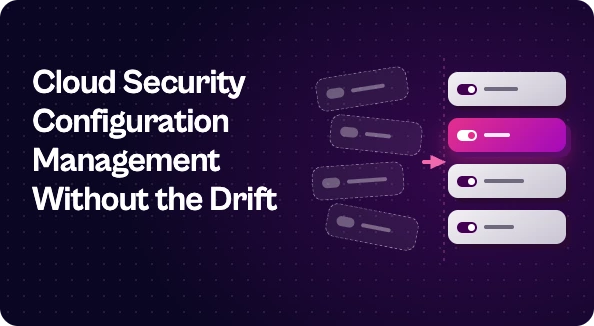
Cloud configuration drift is when a live cloud resource no longer matches its approved or intended configuration. It’s the gap between what your code says and what’s actually running.
Drift usually comes from:
- Manual changes made in the cloud console, often during an incident
- Emergency hotfixes that never make it back into code
- Scripts or tools that change resources outside the normal pipeline
- New resources created by hand instead of through IaC
Not all drift is bad, but all drift is unmanaged until someone decides what to do about it. That’s why drift detection is central to cloud security configuration management.
Why Do Cloud Misconfigurations Keep Coming Back?
Cloud misconfigurations keep coming back because they get fixed in the wrong place. When someone fixes an issue directly in the console, the underlying IaC template still has the bad setting. The next deployment quietly puts the misconfiguration back.
This is one of the most common sources of repeat findings in cloud security. The fix looked done, the alert closed, and a week later it’s open again.
The rule of thumb is simple. Fix it where it was created. If a resource is managed by Terraform, CloudFormation, Bicep or another IaC tool, the permanent fix belongs in that template. A console fix can be a temporary step during an emergency, but it should always be followed by a code change.
How Do You Build a Cloud Security Baseline?
You build a cloud security baseline by deciding, for each resource type, which settings are required, which are forbidden, and which are allowed with justification. The baseline becomes the reference every configuration is measured against.
A practical approach:
- Start from a known standard. The CIS Benchmarks for AWS, Azure and Google Cloud are the most common starting point.
- Adapt it to your environment. Not every recommendation fits every workload, so document where you deviate and why.
- Set stricter rules for sensitive environments. Production and regulated workloads usually need tighter controls than sandboxes.
- Write it as code. Express the baseline as policy-as-code rules so it can be checked automatically.
- Version it. Treat the baseline like software, with reviews and change history.
What Are the Most Common Cloud Security Misconfigurations?
The most common cloud security misconfigurations are the ones that expose data or grant too much access:
- Publicly accessible storage buckets or blobs
- Security groups or firewall rules open to the whole internet on sensitive ports
- Overly permissive IAM roles and wildcard permissions
- Unused or long-lived access keys
- Missing encryption at rest or in transit
- Logging and monitoring turned off or incomplete
- Databases and management interfaces exposed publicly
- Missing multi-factor authentication on privileged accounts
Most of these can be caught before deployment with policy-as-code checks on IaC.
How Do You Prevent, Detect and Correct Cloud Misconfigurations?
You manage cloud misconfigurations with three layers of control: prevent, detect and correct. Each layer catches what the one before it misses.
Prevent
Stop the riskiest configurations from ever being deployed.
- Scan IaC in pull requests and CI pipelines
- Use organization-level guardrails, such as AWS Service Control Policies, Azure Policy or Google Cloud Organization Policies, to block forbidden settings
- Provide secure, pre-approved modules and templates so the easy path is also the safe path
Detect
Find misconfigurations and drift in running environments.
- Use cloud security posture management (CSPM) tools to continuously check live resources against your baseline
- Run drift detection to compare live state with IaC state
- Watch for resources created outside your pipelines
Correct
Fix what’s found, and make sure it stays fixed.
- Identify who owns the resource and the code behind it
- Route the fix to that owner in the tools they already use
- Fix at the source, in IaC, whenever the resource is code-managed
- Group findings that share a root cause, so one template change resolves many alerts
- Track fixes against SLAs and verify they hold after the next deploy
Most programs are strong at detection and weak at correction. That’s usually where the backlog grows.
Who Owns Cloud Security Configuration Management?
Cloud security configuration management is shared. Security usually owns the baseline and the detection tooling. Platform and DevOps teams usually own the IaC modules and guardrails. Application teams own the resources they deploy.
The model that works best is simple. Security sets the rules, platform makes the rules easy to follow, and resource owners fix what drifts. Clear ownership mapping, usually through tags, accounts or repos, is what makes that model work at scale.
How Do You Measure Cloud Security Configuration Management?
You measure cloud security configuration management by tracking how well configurations match your baseline over time and how quickly issues are fixed for good.
Useful metrics include:
- Percentage of resources compliant with the baseline
- Percentage of resources managed through IaC
- Number of drift events per month
- Mean time to remediate misconfigurations by severity
- Repeat findings, meaning misconfigurations that reappear after being closed
- Findings caught before deploy versus after deploy
Repeat findings are especially telling. A high number usually means fixes are happening in the console instead of in code.
Where Does Seemplicity Fit In Cloud Security Configuration Management?
Seemplicity fits at the correction layer. It doesn’t scan cloud accounts or replace your CSPM. It takes the findings those tools produce and helps turn them into fixes.
Seemplicity helps cloud security teams:
- Aggregate findings from CSPM, CWPP and CIEM tools in one place
- Prioritize by reachability and business impact, not severity alone
- Automatically identify the right owner for each fix
- Group findings by shared root cause, so one fix can close many
- Track remediation progress with SLA dashboards
The result is fewer repeat alerts and a clearer path from “misconfiguration detected” to “fixed for good.”
Tired of fixing the same misconfiguration twice? See how Seemplicity helps cloud security teams fix issues at the root.

Frequently asked questions about cloud security configuration management
CSPM is a category of tools that continuously checks cloud resources for misconfigurations. Cloud security configuration management is the broader practice, which also includes baselines, IaC, guardrails, ownership and remediation.
No. Traditional configuration management tools automate server and software setup. Cloud security configuration management focuses on keeping cloud resource settings secure, though those tools can be part of the process.
Cloud configurations should be checked continuously. Checks should run in CI before deploy and on a continuous or near-real-time basis in live environments.
The CIS Benchmarks are the most widely used starting point for cloud security configuration. Cloud providers’ own security best practice guides are a common complement.
If the resource is managed with infrastructure as code, fix it in code. Console fixes are fine for emergencies, but without a matching code change the misconfiguration is likely to return on the next deploy.
Stay updated on Seemplicity blog
Subscribe today to stay informed and get regular updates from Seemplicity.