/What questions should you ask CTEM vendors?
Ask CTEM vendors how they ingest and dedupe data from your existing tools, how their prioritization works and whether you can see why something ranks high, how findings reach owners and get tracked to closure, and how they measure reduced exposure over time. Push for a proof of value on your own data, and treat vague AI claims, closed integrations and dashboards with no remediation workflow as red flags.
Every CTEM demo looks good. The dashboards are clean, the risk scores go down, and the attack path graph lights up in all the right places. Then you sign, connect your real data, and find out what the tool actually does with it.
There are plenty of CTEM vendors out there now, and most of them describe themselves in nearly identical language. If you want a rundown of who’s who, we’ve covered that in our guide to the top providers of CTEM platforms. This post is for the next step. You’ve got a shortlist, you’ve got demos booked, and you need to figure out which claims hold up.
Here are the questions worth asking, the answers worth listening for, and the red flags that should make you pause.
Why Evaluating CTEM Vendors is Harder Than It Looks
CTEM isn’t a single product category. It’s a program with five stages (scoping, discovery, prioritization, validation and mobilization), and vendors come at it from very different starting points. Some started as vulnerability scanners. Some started in attack surface management or breach simulation. Some focus on remediation.
That means two CTEM vendors can both say “end-to-end exposure management” and mean completely different things. The only way to sort it out is to ask specific questions and make them show you, not tell you.
Questions About Your Data and Integrations
This is where most evaluations should start, because everything else depends on it.
Which of our current tools do you integrate with today? Not on the roadmap. Today. Bring your actual list of scanners, cloud tools, EDR, identity platforms and ticketing systems.
How do you handle duplicates across tools? The same vulnerability on the same asset can show up in three different scanners. Ask them to explain how they decide that’s one issue, not three.
How do you match assets across sources? Hostnames, IPs, cloud IDs and agent IDs rarely line up cleanly. Ask what happens when they don’t.
How often does data refresh? “Continuous” means very different things to different vendors. Get a real number.
Can we bring in a source you don’t support natively? You’ll always have one weird internal tool. Find out if there’s a generic import or API option.
Questions About Prioritization
Almost every CTEM vendor claims smarter prioritization. Here’s how to test it.
What inputs go into your risk score? Listen for business context, asset criticality, reachability, exploit activity and compensating controls. If the answer is mostly CVSS with extra steps, that’s worth knowing.
Can I see why a specific finding ranked high? A score you can’t explain is a score you can’t defend to an engineering team. Ask them to click into one and walk through it.
Can we adjust the logic? Your business isn’t the same as every other customer’s. You should be able to tune what matters.
How many findings would you tell us to fix first? If the “top priority” list is still thousands of items long, prioritization isn’t doing much.
Questions About Validation
Validation is where a lot of CTEM programs either earn trust with engineering or lose it. Vendors approach it in different ways, so get specific.
How do you validate exploitability? Some vendors run simulated attacks. Others investigate each finding using evidence like exploit prerequisites, network reachability and code paths. Some do both. Know which one you’re buying.
Do you validate every finding, or only a sample? Point-in-time tests are useful, but they can’t cover a backlog of tens of thousands of issues. Ask how much of your real volume gets checked.
Do you look at code reachability, not just network reachability? A vulnerable library that’s never called is a very different risk from one sitting in a live execution path.
Do you account for compensating controls? If your EDR already blocks the technique an exploit depends on, the finding should reflect that.
How does validation change priority? If a finding is proven exploitable, does it move up? If it’s blocked or unreachable, does it move down?
Can I see the reasoning behind a verdict? “Not exploitable” is only useful if you can show an auditor or an engineer why.
If you run active tests, are they safe in production? For attack simulation, ask what guardrails exist and what’s happened when tests have gone wrong.
Our post on CTEM validation goes deeper on this stage if you want more detail.
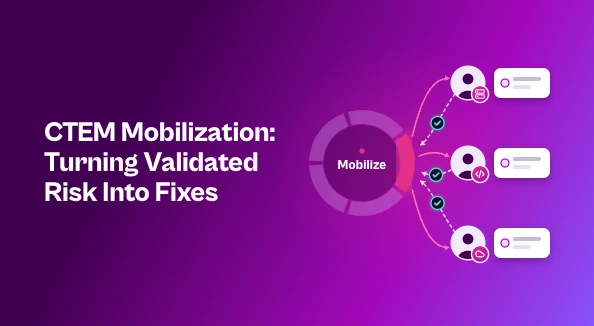
Questions About Remediation and Mobilization
This is the stage where programs succeed or stall, so spend real time here.
How do findings get to the person who fixes them? Ask to see the actual ticket a developer or IT owner would receive. Does it have enough context to act without a follow-up meeting?
How do you figure out who owns an asset? Ownership is usually the messiest data in the building. Ask how they infer it, and what happens when it’s missing or wrong.
Can you group related findings into one fix? One base image update might close 400 container findings. Engineers want one ticket for that, not 400.
Does it sync both ways with our ticketing system? If a ticket closes in Jira or ServiceNow, does the platform know? If the finding reappears in the next scan, does the ticket reopen?
What if a fix isn’t possible right away? Patching isn’t always an option. Ask whether the platform can recommend mitigations or other ways to reduce risk in the meantime.
How do you handle SLAs and exceptions? Real programs have risk acceptances, deadlines and escalations. Make sure those live in the platform, not in a side spreadsheet.
Questions About Measuring Results
How will we know exposure is actually going down? Ask for the specific metrics they track, like mean time to remediate, SLA adherence and exposure trends by business unit. Our post on CTEM metrics has a list worth bringing along.
Can we report by team, business unit or asset group? Leadership will ask which teams are keeping up. You’ll want an answer that doesn’t take a week to build.
What does a good first 90 days look like? Strong vendors can describe realistic early wins. Weak ones talk only about the long-term vision.
Questions About AI Claims
Most CTEM vendors now talk about AI or agents. Some of it is useful. Some of it is a new label on old features.
What specifically does the AI do? Get concrete examples. Is it deduping, enriching, validating, assigning owners, drafting fix guidance or something else?
Can I see and override what it decided? Automation you can’t inspect is automation you can’t trust.
What happens when it’s wrong? Every model makes mistakes. Ask how errors are caught and corrected.
Red Flags to Watch For
A few answers should make you slow down.
“That’s on the roadmap.” For a core integration you need on day one, that’s a no for now.
A demo that only uses sample data. If they can’t or won’t show the product on a slice of your environment, ask why.
A risk score nobody can explain. If the sales engineer can’t walk through why something ranked high, your engineers won’t trust it either.
Great visibility, no workflow. A beautiful dashboard with no real path to tickets, owners and closure is a reporting tool, not a CTEM platform.
Everything is included, nothing is specific. When a vendor claims to do all five stages equally well, dig into the stage you care about most.
How to Run a Proof of Value
Demos are scripted. A proof of value isn’t. If you can, run a short one, usually two to four weeks.
Pick a defined scope, like one business unit or one cloud environment. Connect the real tools that cover it. Then measure a few concrete things. How many raw findings came in? How many unique issues came out after deduping? How many were confirmed as exploitable, and how many were ruled out? How many got routed to an owner automatically? How many actually got fixed?
Those numbers will tell you more than any slide deck. They also give you something solid to show leadership when you make the case to buy.
Where Seemplicity Fits In Your Evaluation
Seemplicity is an Agentic Exposure Action Platform that covers prioritization, validation and mobilization. It doesn’t replace your scanners. It pulls findings from them, dedupes and groups them, and adds business and ownership context.
From there, Seemplicity’s AI Analysts investigate eligible findings automatically before they reach a practitioner. They check exploit prerequisites against live asset configuration and network reachability. They trace whether vulnerable code and dependencies are actually reachable in GitHub or GitLab. They also read live EDR policy from CrowdStrike or Microsoft Defender to see whether a technique is already blocked. Every verdict comes with a reasoning trail you can open up and check.
Confirmed exposures move straight into mobilization. Response Options recommends whether to fix, mitigate or neutralize, and the work goes to the right team in the tools they already use and gets tracked to closure.
So if you put the validation and remediation questions above to Seemplicity, those are exactly the areas where we’d expect to be tested.
Go In With Better Questions
Choosing among CTEM vendors gets easier once you stop comparing feature lists and start comparing answers. Bring your real data, ask them to show their work, and pay the most attention to what happens after a finding is found.
If you want to put these questions to the test, bring them to a Seemplicity demo and see how we answer them with your data.

Stay updated on Seemplicity blog
Subscribe today to stay informed and get regular updates from Seemplicity.