


/what is the best nucleus security alternative?
The best Nucleus Security alternative depends on where your program is stuck. If your team already has visibility but struggles to turn findings into fixes, look for a platform built around remediation: automated ownership and routing, root-cause grouping that cuts ticket volume, fix guidance delivered in the tools engineers already use, and reachability context for prioritization. Seemplicity’s Agentic Exposure Action Platform is designed for exactly that gap between finding an exposure and resolving it.
If you’re researching a Nucleus Security alternative, chances are your program has already solved one big problem and run straight into the next one.
Nucleus has earned its place in a lot of security stacks. It pulls vulnerability data from a long list of scanners and security tools, normalizes and deduplicates it, and gives teams one place to see what’s open. For many vulnerability management programs, that consolidation was a genuine step forward.
But consolidation is a starting point, not a finish line. Once findings live in one place, a new bottleneck appears: someone still has to figure out who owns each issue, group duplicate work, explain the fix, chase the ticket, and prove it got resolved. That work is where most programs lose time, and it’s usually the moment teams start comparing alternatives.
This guide covers why teams look beyond Nucleus, what to evaluate in a replacement, and how Seemplicity approaches the problem, so you can decide what fits your program.
Why Teams Look for a Nucleus Security Alternative
Most teams evaluating an alternative to Nucleus Security aren’t unhappy with their visibility. They’re frustrated by what happens after it. A few patterns come up again and again.
- The backlog keeps growing, even with better prioritization
Risk scores tell you what matters most. They don’t reduce the amount of work. If thousands of prioritized findings still turn into thousands of tickets, fixing teams stay buried and the backlog never meaningfully shrinks. - Ownership is still a manual hunt
Tagging schemes drift, assets change hands, and teams reorganize. Security analysts end up spending hours tracking down who should fix what, and misrouted tickets bounce between teams while SLAs slip. - Engineers receive findings, not fixes
Scanner output is written for security teams. Developers, cloud engineers, and IT operators need to know exactly what to change on the asset in front of them. Every ticket that requires research is a ticket that waits. - Attackers are moving faster
AI is compressing the time between vulnerability disclosure and working exploit. Programs built on periodic review cycles and manual handoffs struggle to keep pace, which shifts the key metric from how fast you find issues to how fast you fix them.
If those challenges sound familiar, the gap probably isn’t in your data layer. It’s in your remediation layer, and that’s where your evaluation should focus.
What to Look for in a Nucleus Security Alternative
Nearly every vulnerability and exposure management platform will tell you it aggregates, deduplicates, and prioritizes. Those capabilities are table stakes. To separate the options, ask about the work that happens after a finding is prioritized.
1. Automated ownership and routing
Can the platform determine who owns a finding on its own, using signals like code ownership, cloud tags, environment, and business unit? And can it route that work into Jira, ServiceNow, or Azure DevOps without an analyst triaging each ticket by hand?
2. Root-cause grouping that reduces ticket volume
Does it consolidate related findings into a single fix, such as one base image update instead of hundreds of individual container findings? Fewer, better tickets is the fastest way to win back engineering goodwill.
3. Fix guidance built into the workflow
Does each ticket include clear, asset-specific remediation steps, or does the person fixing it have to start from scratch? Guidance that lives inside the ticket shortens time to resolution and makes outcomes more consistent across teams.
4. Exploitability and reachability context
Beyond CVSS, EPSS, and known-exploited lists, can the platform tell you whether an attacker can actually reach the vulnerable asset? Reachability is what separates urgent exposures from theoretical ones.
5. SLA tracking and audit-ready reporting
Can you show leadership and auditors what was fixed, how fast, and by whom, without assembling reports by hand? Measurable risk reduction is how exposure management programs earn continued investment.
6. Time to value
How long until data is flowing and tickets are assigned? A long implementation can erase much of the ROI you expected when you started the evaluation.
How Seemplicity Works as a Nucleus Security Alternative
Seemplicity is an Agentic Exposure Action Platform built for the gap between finding an exposure and actually resolving it. It still consolidates findings from your scanners and security tools into a unified backlog, but its center of gravity is execution: getting the right fix to the right person, with the context they need to act.
AI agents that handle the remediation legwork
Seemplicity’s suite of AI agents takes on the manual steps that slow programs down. Find the Fixer identifies who is responsible for remediating each exposure. Automatic Scoping surfaces attributes like environment, business unit, and ownership to build groupings that reflect how your organization actually operates. The Remediation Agent embeds step-by-step, asset-specific guidance directly into each finding, so fixers can act without a research project.
Root cause fixes that shrink the noise
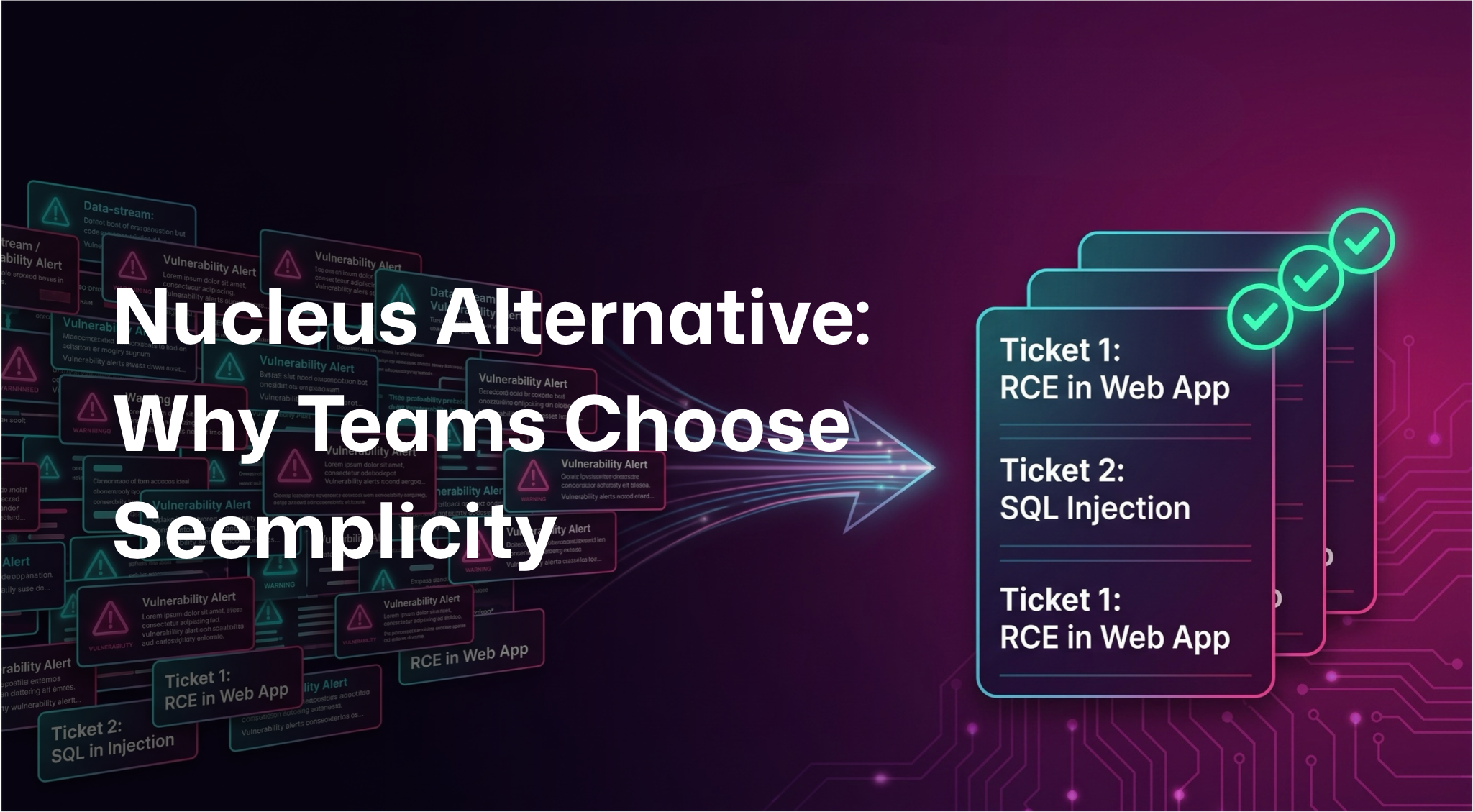
Instead of opening one ticket per finding, Seemplicity synthesizes related alerts into single root cause fixes, reducing alert volume by up to 90%. Fixing teams see a short list of meaningful work instead of an endless queue.
Prioritization based on what attackers can reach
Seemplicity links exposure data, threat intelligence, and business context, and analyzes network paths so teams focus on what an attacker can actually reach, not just what scores highest on paper.
Work delivered where teams already are
Remediation tasks flow into the ticketing and work management tools your developers and IT teams already use, with SLA tracking and reporting built in. Security can measure progress without chasing status updates, and fixing teams never have to log into yet another console.
Fast time to value
Customers have reported receiving data from their tools within hours of connecting Seemplicity and having tickets assigned within days.
Here’s how Seemplicity answers the evaluation questions above:
| Evaluation Question | What Seemplicity Delivers |
|---|---|
| Who owns this finding? | AI-powered ownership detection (Find the Fixer) and automated routing to the right team |
| How many tickets will this create? | Root cause fixes that consolidate related findings, reducing alert volume by up to 90% |
| How does the fixer know what to do? | Step-by-step, asset-specific guidance from the Remediation Agent inside each ticket |
| Can an attacker actually reach it? | Contextual reachability analysis based on network paths |
| Can we prove progress? | SLA tracking and reporting across teams, tools, and business units |
| How fast can we get started? | Data flowing within hours and tickets assigned within days |
When Nucleus Security May Still Be the Right Fit
A good evaluation is an honest one. Nucleus is a mature platform with a broad connector library and FedRAMP Moderate authorization, which matters for many public sector teams. If your primary need is aggregating and normalizing data across a very large number of tools, or if a specific authorization is a hard procurement requirement, weigh those factors carefully and confirm requirements with every vendor on your shortlist.
If your team already has visibility and the real struggle is getting fixes done at scale, that’s where a platform built around remediation operations tends to pull ahead.
Tips for Switching Vulnerability Management Platforms
Replacing a core platform is easier when you plan for it. A few practices make the transition smoother:
- Inventory your integrations first. List every scanner, asset source, CMDB, and ticketing system you rely on today and confirm each one is supported.
- Map your current workflows and SLAs. Treat the migration as a chance to simplify rules that have accumulated over time rather than recreating them one for one.
- Run a proof of value on real data. Measure ticket volume, routing accuracy, and mean time to remediate (MTTR) before and after.
- Bring fixing teams in early. Their day-to-day experience determines whether remediation actually speeds up.
See Seemplicity in Action
If your team has the visibility and needs the follow-through, the best way to evaluate a Nucleus Security alternative is to watch it work on your real remediation challenges. Request a demo to see Seemplicity in action for yourself.

Frequently asked questions
Nucleus Security is a unified vulnerability management platform. It aggregates, normalizes, and prioritizes vulnerability data from scanners and other security tools, and automates parts of the vulnerability management workflow.
It depends on your bottleneck. If you need to go beyond aggregation and prioritization to automate ownership, reduce ticket volume, and accelerate remediation across teams, Seemplicity is purpose-built for that.
Yes. Seemplicity integrates with the scanners and security testing tools teams already rely on, such as Wiz, Snyk, Checkmarx, Veracode, and Prisma Cloud, along with ticketing systems like Jira and ServiceNow.
Vulnerability management focuses on finding and fixing software flaws. Exposure management takes a broader, continuous view that also covers misconfigurations, identities, cloud assets, and business context, then prioritizes, remediates, and validates fixes across all of them.
Stay updated on Seemplicity blog
Subscribe today to stay informed and get regular updates from Seemplicity.