

/how can i reduce my attack surface?
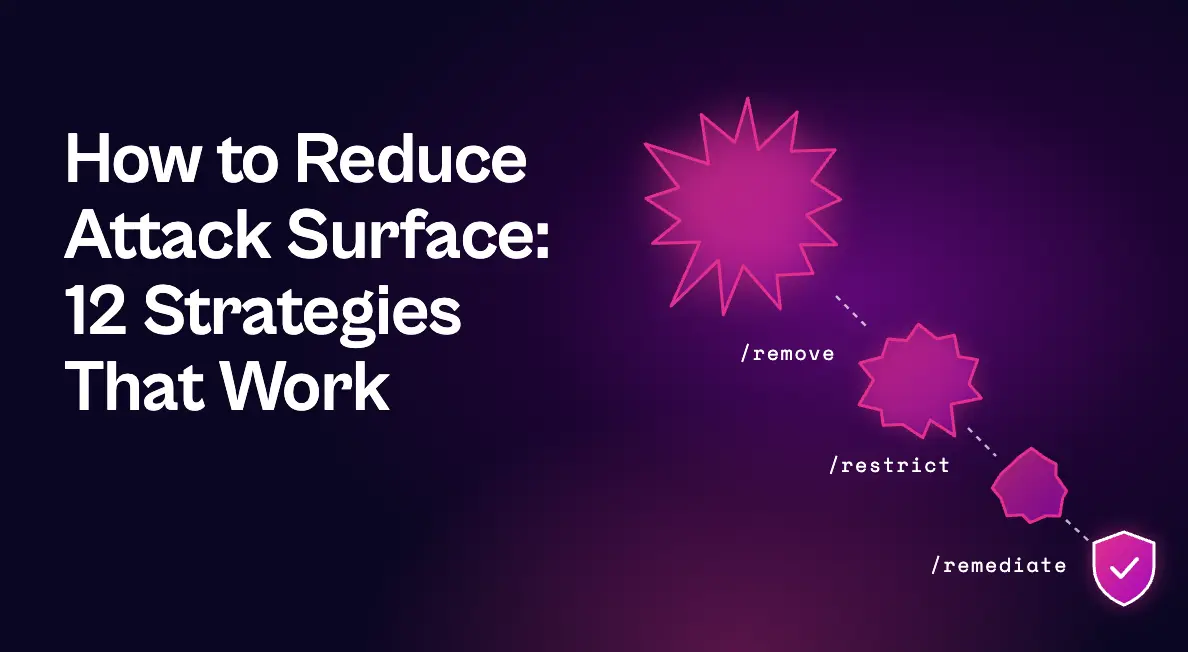
To reduce attack surface, pull three levers. Remove what you don’t need: unknown assets, unused systems, open ports, and stale accounts. Restrict what must stay with least privilege, segmentation, and hardened configurations. Then close the exposures that remain by prioritizing what’s actually exploitable, checking whether existing controls already block it, and choosing the fastest safe response, whether that’s a patch or an interim mitigation. Measure progress by exploitable exposure and time to close, not raw vulnerability counts.
Every security team wants to reduce attack surface, but the attack surface keeps growing faster than most programs can shrink it. New cloud resources, SaaS apps, AI tools, APIs, and identities appear every week, and each one is a potential entry point.
Most advice on attack surface reduction stops at a list of good habits. Those habits matter, but a smaller attack surface on paper isn’t the goal. The goal is fewer ways for an attacker to actually get in. That means removing what you don’t need, restricting what you keep, and quickly closing the exposures attackers can really exploit.
This guide covers 12 strategies to reduce attack surface across those three levers, how to measure progress, and how to shrink your exploitable exposure at the speed attacks now move.
What Does It Mean to Reduce Attack Surface?
Your attack surface is the sum of every point where an attacker could try to gain access: devices, servers, cloud services, applications, APIs, identities, credentials, and the vulnerabilities and misconfigurations on all of them. To reduce attack surface is to shrink that total, and to make what remains harder to exploit.
It helps to think about two layers. The total attack surface is everything that exists and could be targeted. The exploitable attack surface is the subset an attacker could actually use right now, given reachability, configuration, and existing defenses. Good programs work on both, but the second layer is where risk is decided.
Why It’s Harder, and More Urgent, Than Ever
Cloud adoption, remote work, SaaS sprawl, and the rapid spread of AI tools and agents have expanded attack surfaces dramatically, often outside the view of central IT. At the same time, AI has shortened the time it takes attackers to turn a newly disclosed vulnerability into a working exploit. The window between exposure and exploitation is shrinking, so the speed at which you can close exposures matters as much as how many you have.
Lever 1: Remove What You Don’t Need
The most effective way to reduce attack surface is to eliminate parts of it entirely. Anything that doesn’t exist can’t be attacked.
- 1. Discover everything first. Use attack surface management to find unknown and unmanaged assets, including shadow IT, forgotten cloud accounts, and unsanctioned AI tools. You can’t remove what you can’t see.
- 2. Decommission unused and end-of-life systems. Retire legacy servers, abandoned test environments, and unsupported software that no longer serves a business purpose.
- 3. Close unnecessary ports, services, and features. Disable services that are running but not required, block unused network ports, and turn off features nobody uses.
- 4. Clean up stale identities and secrets. Remove dormant user and service accounts, revoke unused API keys and tokens, and rotate credentials that may have been exposed.
Lever 2: Restrict What Must Stay
For the systems and access you need, reduce how much of each is exposed and to whom.
- 5. Enforce least privilege and strong authentication. Give users and services only the access they need, and require multi-factor authentication for anything sensitive.
- 6. Segment networks and adopt zero trust access. Limit lateral movement by dividing networks into smaller zones and verifying every access request instead of trusting location.
- 7. Harden configurations against a baseline. Apply secure configuration standards, such as CIS Benchmarks, to servers, endpoints, and cloud services, and monitor for drift.
- 8. Keep admin interfaces off the internet. Remote desktop, management consoles, and database ports should never be directly exposed. Put them behind VPN or zero trust access.
Lever 3: Close the Exposures That Remain
No matter how much you remove and restrict, vulnerabilities will keep appearing on the assets you keep. This lever determines how long they stay open.
- 9. Prioritize by exploitability, not severity alone. CVSS measures technical severity, and “exploit available” flags mean less now that AI makes exploits cheap to build. Confirm whether a vulnerability is actually reachable and exploitable on each asset.
- 10. Check whether existing controls already block it. Endpoint protection policies and other compensating controls may already stop the attack technique. Verify before you escalate, and don’t assume coverage that isn’t there.
- 11. Choose the fastest safe response. Patching is ideal, but it often waits on testing and change windows. Interim mitigations, such as configuration changes or compensating controls, can close the exposure today while the permanent fix is scheduled.
- 12. Route fixes to owners and verify closure. Deliver remediation to the teams that own each asset in the tools they already use, set risk-based SLAs, and rescan to confirm the exposure is gone.
How to Measure Attack Surface Reduction
Counting vulnerabilities rarely tells you whether you’re safer. Track metrics that reflect real exposure and how quickly it shrinks:
| Metric | What It Tells You |
|---|---|
| Internet-facing assets | How much of your environment is directly reachable by attackers |
| Unknown or unmanaged assets discovered | How much of your attack surface was outside your control |
| Assets missing security controls | Where coverage gaps leave systems unprotected |
| Validated exploitable exposures | The size of your real, exploitable attack surface |
| Mean time to remediate critical exposures | How long attackers have to use what you find |
| Common Pitfall | Blind spots on assets that were never scanned |
How Seemplicity Helps Reduce Attack Surface Where It Counts
Seemplicity focuses on the lever that decides how long attackers have: closing exploitable exposures fast. It’s the only technology that fuses exposure management with autonomous response in one system, working with the scanners and security tools you already run, such as Tenable, Qualys, Rapid7, and Wiz.
Here’s a hypothetical example of how that plays out when a new critical vulnerability lands:
- Scanners report 400 findings for the new CVE across servers owned by several teams.
- Seemplicity deduplicates and groups them by fix. Because a handful of patches close all 400 findings, the backlog shows a few remediation items instead of 400 tickets.
- AI Analysts check exploitability on each asset, including live configuration, network reachability, and exploit prerequisites. Many findings are reprioritized because the prerequisites aren’t met.
- EDR Compensating Controls Awareness reads live policy from CrowdStrike or Microsoft Defender and shows where the attack technique is already blocked.
- Response Options lay out Fix, Mitigate, or Neutralize for what’s left, with one recommended and a safety rating for each, so the riskiest exposures can be mitigated today while patches are scheduled.
- Work routes automatically to each owning team’s queue, with bi-directional Jira and ServiceNow sync keeping status and SLAs current.
Along the way, Seema, Seemplicity’s AI assistant, answers plain-language questions like which exploitable exposures are still open and past SLA. The result is a smaller exploitable attack surface, reached faster. Learn more about the Agentic Exposure Action Platform.
See Seemplicity in Action
The fastest way to reduce attack surface where it matters is to close exploitable exposures before attackers find them. Request a demo to see Seemplicity in action for yourself.

Frequently asked questions
The best way to reduce attack surface is to combine three approaches: remove assets, services, and accounts you don’t need; restrict access and exposure for what remains; and quickly close the vulnerabilities that are actually exploitable. Start with a complete inventory, since you can’t reduce what you can’t see.
Microsoft Defender for Endpoint includes attack surface reduction (ASR) rules that block behaviors commonly used by malware, such as Office applications launching child processes or scripts running obfuscated code. They’re one useful control within a broader attack surface reduction strategy.
Not quite. Attack surface management discovers and monitors your assets and exposures. Attack surface reduction is the work of shrinking that surface by removing, restricting, and remediating what you find.
Continuously, where possible. Cloud resources, identities, and applications change daily, so periodic reviews miss short-lived exposures. Use automated discovery and pair it with regular reviews of access rights and configurations.
Stay updated on Seemplicity blog
Subscribe today to stay informed and get regular updates from Seemplicity.