

/how can security teams reduce risk faster?
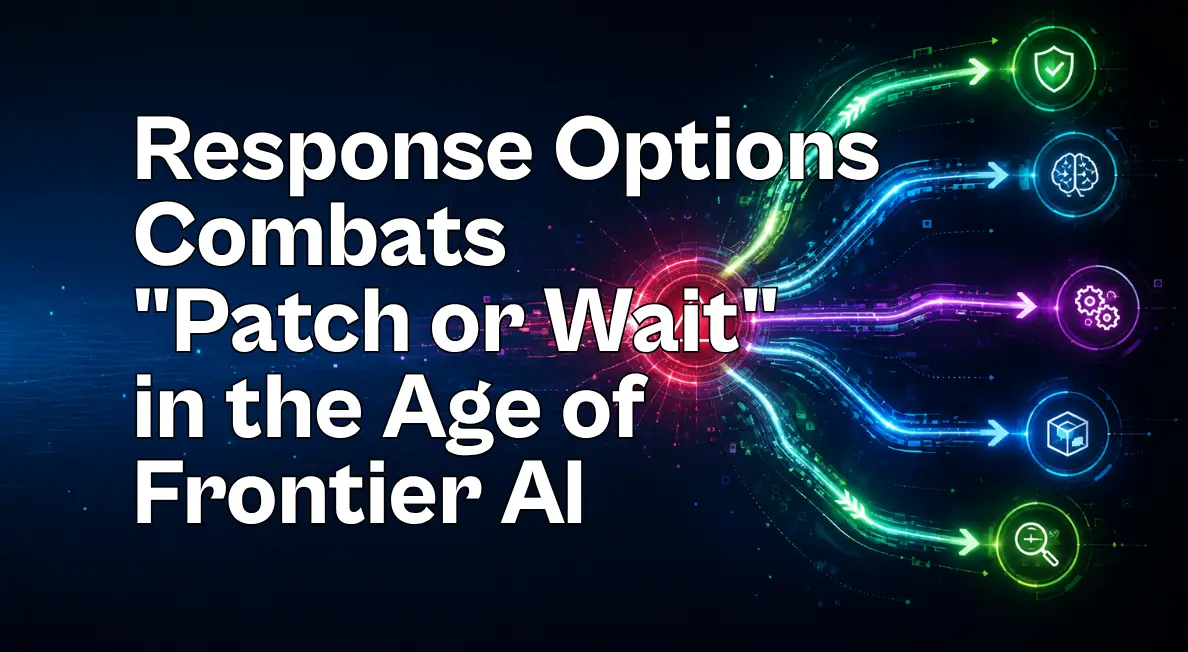
When a vulnerability is urgent but the full fix isn’t immediately safe to deploy, security teams need another way to reduce risk fast. Seemplicity’s Response Options uses AI to identify and rank multiple ways to neutralize a threat – including patches, configuration changes, compensating controls, and network-level mitigations — based on risk reduction, effort, and operational impact. As frontier AI accelerates attacks, security teams need to move beyond “patch or wait” and find the fastest, safest way to eliminate exploitability.
Every CISO has lived this moment: a critical vulnerability drops, the clock starts ticking, and the “fix” on the table is a kernel patch that needs two weeks of regression testing on a production system nobody wants to touch. The threat is real today. The fix is safe in three weeks. That gap, between urgent and deployable, is where breaches happen.
It’s also the gap that a new generation of security tooling, and a new generation of AI reasoning, is finally built to close.
The Fix Isn’t the Only Way to Win
As Ravid Circus, CPO of Seemplicity, put it at Black Hat 2026: security teams need to react far faster than ever before, precisely because the threats themselves are now shaped by frontier AI. But reacting fast has traditionally meant choosing between two bad options: ship the full fix and accept the operational risk, or wait for a safe deployment window and accept the security risk.
Circus’s point is that this is a false choice. A full patch is one way to eliminate a threat, but it’s rarely the only way. Here’s the distinction worth sitting with: response options don’t fix the underlying vulnerability. The finding is still there. What they do is eliminate the vulnerability’s exploitability or reachability, closing off the path an attacker would need to actually use it. You can cut off the route that makes it reachable. You can apply a compensating control that blocks the exploit path without touching the fragile system underneath it. The vulnerability remains on paper, but it’s been rendered unusable in practice. In his words, there are “many ways to remove a threat” beyond the textbook fix, and the organizations that survive the next decade of AI-accelerated attacks will be the ones that know how to find them, fast.
That’s the idea behind response options: rather than presenting a security team with a single binary choice (patch now / patch later), AI analyzes the full landscape of available remediations, patches, yes, but also configuration changes, compensating controls, and network-level mitigations that eliminate exploitability or reachability without eliminating the finding itself. It ranks those options by two variables that used to require a room full of senior engineers to weigh: how much risk does this actually remove, and how much effort and disruption does it take to deploy?
Auto-Remediation Is the Last Mile, Not the First Step
There’s a temptation in security automation to treat auto-remediation as the finish line: the moment when a human is finally removed from the loop. Circus reframes this correctly: auto-remediation isn’t a separate capability bolted onto vulnerability management. It’s the natural output of good response-options analysis, applied only when the math checks out on both axes at once.
The logic is simple once you see it: auto-remediate when a fix is risky enough to matter and safe enough to deploy without a human gatekeeper. If a vulnerability is severe but the fix requires a reboot, heavy testing, or touches a fragile production path, that’s not a candidate for automation; that’s a candidate for a fast, well-informed human decision. Response options exist to make that triage instantaneous and evidence-based, so that the “easy mile” of auto-remediation is reserved for exactly the cases where it’s genuinely safe, and everything else routes to the right human with the right context, immediately.
This is a meaningfully more mature model than “automate everything” or “automate nothing.” It treats automation as an outcome of good reasoning, not a substitute for it.
Why This Matters More Now Than Ever
Here’s the uncomfortable truth underneath all of this: the reason Response Options is arriving now, and not five years ago, is that the threat side of the equation has fundamentally changed. Frontier AI models can now help an attacker find exploitable paths, weaponize a CVE, and probe for reachability faster than most organizations can convene a change-advisory board. The defender’s clock has compressed from weeks to hours, in some cases to minutes.
Matching that pace requires more than faster dashboards; it requires reasoning that’s as sophisticated as the reasoning behind the attacks. This is precisely why the frontier of AI capability matters to security leaders in a way it simply didn’t two years ago. Anthropic’s Mythos-tier models represent that next step up in reasoning depth: the kind of capability needed to weigh dozens of interacting variables (exploitability, reachability, blast radius, operational fragility, testing overhead) simultaneously and produce a ranked, defensible set of options in seconds rather than days. When the threats you’re defending against are themselves produced or accelerated by frontier models, defending with anything less than frontier-grade reasoning is a losing trade.
That’s the real shift Response Options represents. It’s not just a feature; it’s an acknowledgment that vulnerability management has become a reasoning problem, not just a patching problem. And reasoning problems at this speed and complexity are exactly where the newest generation of AI earns its keep.
The Takeaway for Security Leaders
The next time a critical CVE lands on your desk, the question shouldn’t be “when can we patch this?” It should be “what’s the fastest, safest way to eliminate this threat, and does it even require a patch at all?” Organizations that build that second question into their workflow, with AI doing the heavy lifting of surfacing and ranking the options, will close the gap between urgent and deployable that has quietly caused more breaches than any zero-day ever did.
The goal isn’t always full remediation. Neutralizing the ability to exploit the vulnerability is enough. Response Options just make that distinction operational.
View Ravid’s full take here:

Stay updated on Seemplicity blog
Subscribe today to stay informed and get regular updates from Seemplicity.