

/What is risk exposure management?
Risk exposure management is the ongoing practice of identifying every way an organization can be attacked, ranking those exposures by real business risk, and driving the most important ones to remediation. It goes beyond traditional vulnerability management by covering misconfigurations, identity issues, and cloud and code risks, not just CVEs. The goal isn’t a longer list of findings. It’s measurable risk reduction.
Most security teams don’t have a visibility problem anymore. They have a “now what?” problem.
You’ve got scanners for cloud, code, containers, endpoints, and identity. Each one produces findings. Together they produce tens of thousands. And somewhere in that pile are the handful of issues that could actually hurt the business.
That’s the gap risk exposure management is meant to close.
What is Risk Exposure Management?
Risk exposure management is the ongoing practice of finding every way your organization can be attacked, ranking those exposures by real business risk, and getting the most important ones fixed.
The key word is exposure, not vulnerability. A CVE is one kind of exposure. So is a misconfigured S3 bucket, an over-permissioned service account, a leaked API key in a repo, or an internet-facing asset nobody remembers spinning up. Attackers don’t care which category a weakness falls into. They care whether it gets them in.
And the goal isn’t a longer list. It’s less risk, measurably, over time.
How It’s Different From Traditional Vulnerability Management
Traditional vulnerability management usually looks like this: scan, sort by CVSS, send a spreadsheet to IT, repeat next month.
That model breaks down for a few reasons:
- Scope is too narrow. It focuses on software flaws and misses cloud, identity, and code risk.
- Severity isn’t risk. A “critical” CVE on an isolated test box matters less than a “medium” on a crown-jewel system that’s exposed to the internet.
- Success is measured wrong. “Findings closed” says nothing about whether you’re actually safer.
Risk exposure management widens the lens and changes the scorecard. You look at everything, you factor in context (exploitability, asset value, reachability, compensating controls), and you track risk reduction instead of ticket counts.
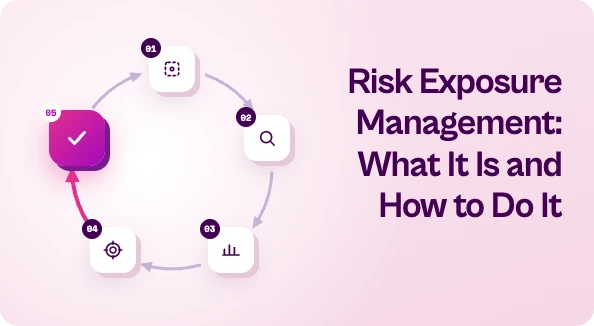
The Risk Exposure Management Cycle
Most mature programs follow something close to Gartner’s Continuous Threat Exposure Management (CTEM) framework. Here’s the practical version.
1. Scope
Decide what matters. Start with business-critical systems, not “everything.” A focused scope you can act on beats a sprawling one you can’t.
2. Discover
Pull in assets and findings from every source you have: vulnerability scanners, cloud security tools, AppSec tools, pen tests, bug bounty reports. Expect duplicates. Expect gaps.
3. Prioritize
This is where risk exposure management earns its name. Layer in context: Is it actively exploited? Is the asset reachable? Does it touch sensitive data? Is there already a control in place? The output should be a short list, not a long one.
4. Validate
Confirm the high-priority exposures are actually exploitable in your environment. Breach and attack simulation, pen testing, and red teaming all help here.
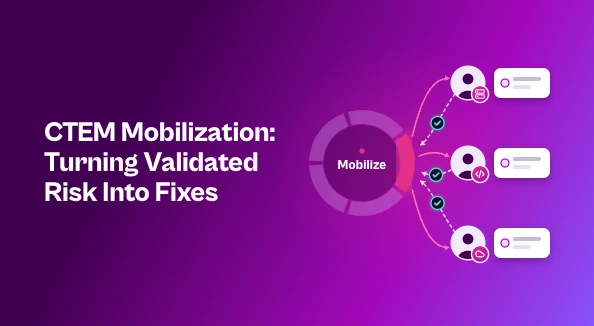
5. Mobilize and remediate
Get the fix done. Find the right owner, give them what they need, track it to closure, and verify it stuck. Simple to say. Hard to do.
Where Risk Exposure Management Programs Stall
Here’s the uncomfortable truth. Steps one through four get most of the attention and budget. Step five is where programs quietly fall apart.
Some common sticking points:
- No clear owner. A finding sits in a queue because nobody knows which team owns the asset.
- Too many tools, too many formats. The same issue shows up five times from five scanners, and each one gets triaged separately.
- Security and engineering speak different languages. Security sends a CVE ID. Engineering wants to know what to change, where, and why it matters this sprint.
- Manual handoffs. Spreadsheets, Slack threads, and copy-pasted Jira tickets don’t scale.
- No feedback loop. Fixes get marked “done” but nobody confirms the exposure is actually gone.
If your mean time to remediate isn’t moving, the problem probably isn’t discovery.
Making Risk Exposure Management Work in Practice
A few things separate programs that reduce risk from ones that just report on it:
Consolidate before you prioritize. Deduplicate and normalize findings across tools first. Otherwise you’re prioritizing noise.
Prioritize with business context. Exploitability data (like CISA’s Known Exploited Vulnerabilities catalog) plus asset criticality beats raw severity scores every time.
Route work to owners automatically. Map assets to teams so findings land with the people who can fix them, in the tools they already use.
Group fixes the way engineers think. One base image update can close hundreds of findings. Package the work that way.
Measure risk reduction, not activity. Track remediation time on high-risk exposures, SLA adherence, and how your exposure on critical assets trends over time.
Where Seemplicity Fits
Seemplicity is built for that last mile of risk exposure management. It doesn’t replace your scanners or validation tools. It pulls findings in from all of them, deduplicates and prioritizes them with context, routes them to the right owners, and tracks them through to fix. Its AI agents take on a lot of the manual triage and coordination work that usually slows remediation down.
The result: fewer findings sitting in limbo and more exposures actually closed.
If your team is great at finding problems but stuck on fixing them, it’s worth a look.

Stay updated on Seemplicity blog
Subscribe today to stay informed and get regular updates from Seemplicity.