
Zero-Day Minus the Scramble: A Better Approach to Vulnerability Risk Management

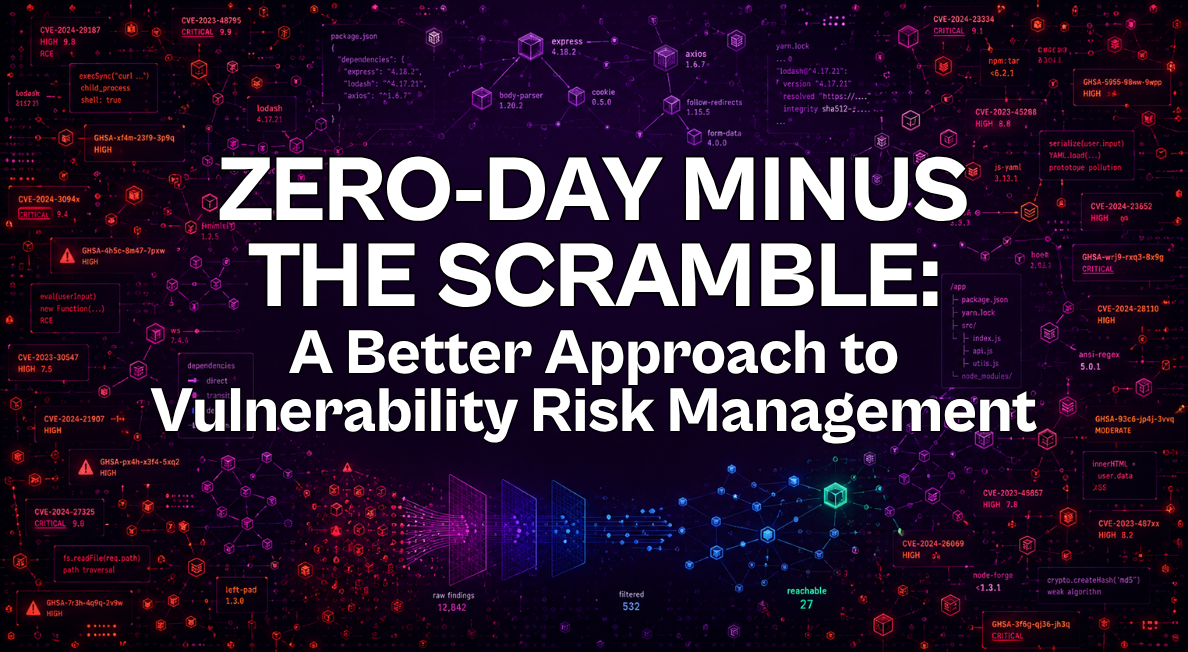
/How do you apply vulnerability risk management to SCA findings and zero-day response?
SCA tools are good at identifying vulnerabilities in your dependencies. They’re not built for the harder part of vulnerability risk management: telling you whether those vulnerabilities are actually reachable in your application, or which assets are running an affected component the moment a zero-day drops. Seemplicity’s SCA Analyst solves both problems inside a single centralized vulnerability management platform.
A zero-day drops, affecting a widely used library. Your scanner hasn’t updated its signatures yet, and you have no easy way to know which assets in your environment are running the affected component. Your team is fielding questions from leadership about exposure while manually combing through inventory that may or may not be current.
Sadly, this is not an edge case. It’s a recurring pattern that exposes how brittle most approaches to vulnerability risk management actually are when the clock is ticking.
The SCA Noise Problem
Third-party library findings are some of the highest-volume, lowest-signal alerts in the vulnerability backlog. A vulnerable dependency appearing in your build chain does not mean the vulnerable function is actually called anywhere in your application. Identifying vulnerabilities in your dependencies is the easy part, whereas confirming whether they represent real risk is what takes time.
Most SCA tools stop at the first part. The result is a vulnerability backlog inflated with findings that sound critical and turn out, on investigation, to be unreachable given how the application actually uses the library. Teams either spend the capacity to investigate each one, or they make judgment calls and hope the ones they deprioritized weren’t actually exploitable.
Neither option scales. Neither builds the kind of confidence a mature vulnerability risk assessment process requires.
Seemplicity is changing how teams approach this. Seemplicity’s AI Analysts are a new class of autonomous agents that run exploitability validation before findings reach your team’s queue. Learn more about Seemplicity’s AI Analysts here.
What the SCA Analyst Does
The SCA Analyst runs two distinct functions, one for steady-state noise reduction and one for zero-day response. Both are built on the same foundation: centralized vulnerability management that works across your full dependency and artifact inventory.
Software composition analysis validation. For every SCA finding, the analyst confirms actual function usage and dependency reachability across the build chain. A vulnerable library that your application imports but never invokes in a real execution path does not make it through as an actionable finding. What reaches your team has already cleared that bar.
SBOM-powered zero-day response. When a zero-day drops, the analyst runs a single query across Artifactory, Aquasec, and GitHub to surface every instance of the affected component across your environment. No waiting on scanner signature updates. No manual inventory cross-referencing. The vulnerability analysis that used to take days happens in seconds, before your scanner even knows the CVE exists.
Two Problems, One Platform
Most organizations treating SCA findings as a volume problem are really dealing with two separate problems that require different responses.
The first is the day-to-day signal problem: too many findings, not enough validation, backlogs that grow faster than teams can work through them. The SCA Analyst addresses this through reachability confirmation that cuts false positives before they consume remediation capacity.
The second is the emergency response problem: a new vulnerability drops and there is no fast way to run a complete vulnerability risk assessment across the estate. The SBOM-powered query capability addresses this directly. When a zero-day drops, the question “which of our assets is running jQuery 1.14?” should take seconds to answer, not days.
These are not separate tools or separate workflows. They run on the same platform, against the same inventory, inside the same remediation process your team already uses.
What You Get on the Other End
A shorter, verified backlog for steady-state work. A seconds-level response capability for zero-day events. And a centralized vulnerability management foundation that covers infrastructure, code, and dependencies from a single platform, without requiring your team to stitch together point solutions or wait on scanner updates when it matters most.
Zero-day response doesn’t have to mean scrambling. Know what’s affected before the scanner does.
The SCA Analyst is available now as part of the Seemplicity platform. We’re excited for customers to start using it as another way to prioritize remediation, protect resources, and save time.
As always, if you have questions or want to learn more, contact us for a more personalized meeting.
Stay updated on Seemplicity blog
Subscribe today to stay informed and get regular updates from Seemplicity.