
/What is a vulnerability management maturity model?
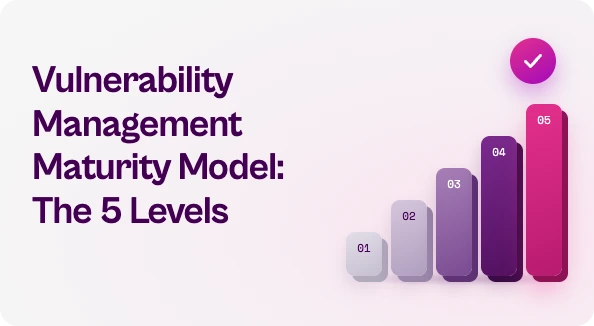
A vulnerability management maturity model is a framework for measuring how developed your VM program is, usually across five levels: Initial, Managed, Defined, Quantitatively Managed, and Optimizing. Lower levels are reactive and scan-driven. Higher levels are risk-based, measured, and automated end to end, with clear ownership and verified remediation. Most organizations get stuck between Levels 2 and 3, where findings pile up faster than teams can route and fix them.
Every security team runs scans. Far fewer can tell you, with numbers, whether their program is actually getting better. That gap is what a vulnerability management maturity model is for.
This guide walks through the five levels, shows the signs of each one, and covers the one transition where most programs get stuck.
What Is a Vulnerability Management Maturity Model?
A vulnerability management maturity model is a framework for grading how developed your VM program is. It’s not about whether you own a scanner. It’s about how reliably findings turn into fixes.
The most widely referenced version comes from SANS. It organizes a VM program around the PIACT process (Prepare, Identify, Analyze, Communicate, Treat) and scores each area across five maturity levels. SANS is pretty upfront that the level names don’t matter much. The point is that programs start at the bottom and climb as they mature.
Other vendors publish their own spins, some starting at Level 0. The shape is always the same: from reactive and manual to measured, risk-driven, and automated.
The 5 Levels of the Vulnerability Management Maturity Model
Level 1: Initial
Nothing is documented. Scans happen when someone remembers to run them or when a scary CVE hits the news. Coverage is spotty, and asset data is scattered across spreadsheets and people’s heads.
Signs you’re here: Nobody can say how many assets you have. Fixes happen through Slack messages and favors.
What moves you up: A written policy, a basic asset inventory, and a regular scan schedule.
Level 2: Managed
Processes exist, but most of them were written after something went wrong. They work well enough for the problem that prompted them and not much else. Scanning is scheduled for some teams. Prioritization is mostly CVSS score.
Signs you’re here: You have a lot of findings and a spreadsheet to track them. “Critical” means whatever the scanner says. SLAs exist on paper.
What moves you up: Defined ownership, a risk-based prioritization approach, and a single view of findings across tools.
Level 3: Defined
Now the process is intentional. Policies are designed up front around how your organization wants to handle vulnerabilities, not patched together after an incident. Assets carry context like owner, criticality, and exposure. Every finding has a clear path to a team that can fix it.
Signs you’re here: Tickets land with the right team the first time. Prioritization factors in exploitability and business impact, not just severity.
What moves you up: Measuring everything. MTTR, SLA adherence, backlog trends, and exception rates.
Level 4: Quantitatively Managed
Your process is tracked well enough that you can review it and improve it with real data. You’re not guessing whether things are getting better. You know.
Signs you’re here: You can show leadership a trend line. You know which teams are slow and why.
What moves you up: Automating the repetitive work and using your data to prevent vulnerabilities, not just close them.
Level 5: Optimizing
Continuous improvement is baked in. Remediation data, recurring patterns, and exception decisions all feed back into how the program runs. Root cause analysis shapes configuration standards and development pipelines.
Signs you’re here: Recurring findings are rare because you fixed the root cause. Your team spends time on strategy, not ticket chasing.
The Level 2 to 3 Wall: Why Most Programs Stall
Getting to Level 2 is mostly about buying tools and setting a schedule. Getting to Level 3 is where things get hard, and it’s rarely a tooling problem. It’s an operations problem.
At Level 2, you’ve usually added more scanners. Cloud, container, AppSec, infrastructure. Each one produces findings in its own format with its own severity scale. The volume goes up, but nobody can fix faster, because every finding still needs a human to dedupe it, figure out who owns it, and write a ticket someone will actually act on.
This isn’t a niche problem. In one recent industry survey, well over half of enterprises said they still work out remediation ownership manually, and more than four in ten described their remediation process as ad hoc.
The fix is to stop treating remediation as a side effect of scanning and start treating it as its own workflow with ownership, context, and accountability.
How to Assess Where You Stand
Be honest and go area by area. Most programs aren’t one level across the board. You might be Level 4 on scanning coverage and Level 2 on ownership. That uneven profile tells you where to invest.
A few questions that cut through quickly:
- Coverage: Do you know what percent of your assets are scanned, and how often?
- Prioritization: Is “critical” based on severity alone, or on exploitability and business context?
- Ownership: When a finding appears, how long until it’s assigned to the right person?
- Remediation: Do you verify that fixes actually worked, or just close tickets?
- Metrics: Can you show MTTR and SLA adherence by team, today, without a week of spreadsheet work?
If you want something more formal, SANS offers a free yes/no self-assessment spreadsheet that maps your answers to a maturity level for each area of its model.
How to Move Up the Vulnerability Management Maturity Model Faster
A few moves pay off at almost every level:
- Unify your findings. You can’t prioritize what you can’t see in one place. Normalize and dedupe across every scanner.
- Fix ownership first. Most delays happen before anyone starts fixing. Automating owner assignment removes a huge amount of back-and-forth.
- Prioritize by real risk. Factor in exploitability, asset criticality, and compensating controls, not just CVSS.
- Give fixers what they need. A ticket with clear context and remediation steps gets fixed. A raw scanner dump gets ignored.
- Measure outcomes, not activity. Tickets opened is not a metric. Time to verified fix is.
Where Seemplicity Fits
Seemplicity isn’t a scanner. It’s the layer that takes findings from the tools you already have and drives them to a fix, which is exactly the work that holds programs back at the Level 2 to 3 wall.
The platform pulls findings from across your security stack into one normalized, risk-based view. From there it dedupes, figures out who owns each issue, and tracks it all the way to a verified fix. AI agents handle the repetitive parts, like building ownership maps from messy scanner tags and giving fixers environment-specific remediation steps right inside the finding.
That’s the stuff that turns a Level 2 backlog into a Level 4 program you can measure.
If your team is great at finding and stuck on fixing, it might be worth a look at how Seemplicity turns findings into fixes.

Stay updated on Seemplicity blog
Subscribe today to stay informed and get regular updates from Seemplicity.