

/how is ai used in application security testing?
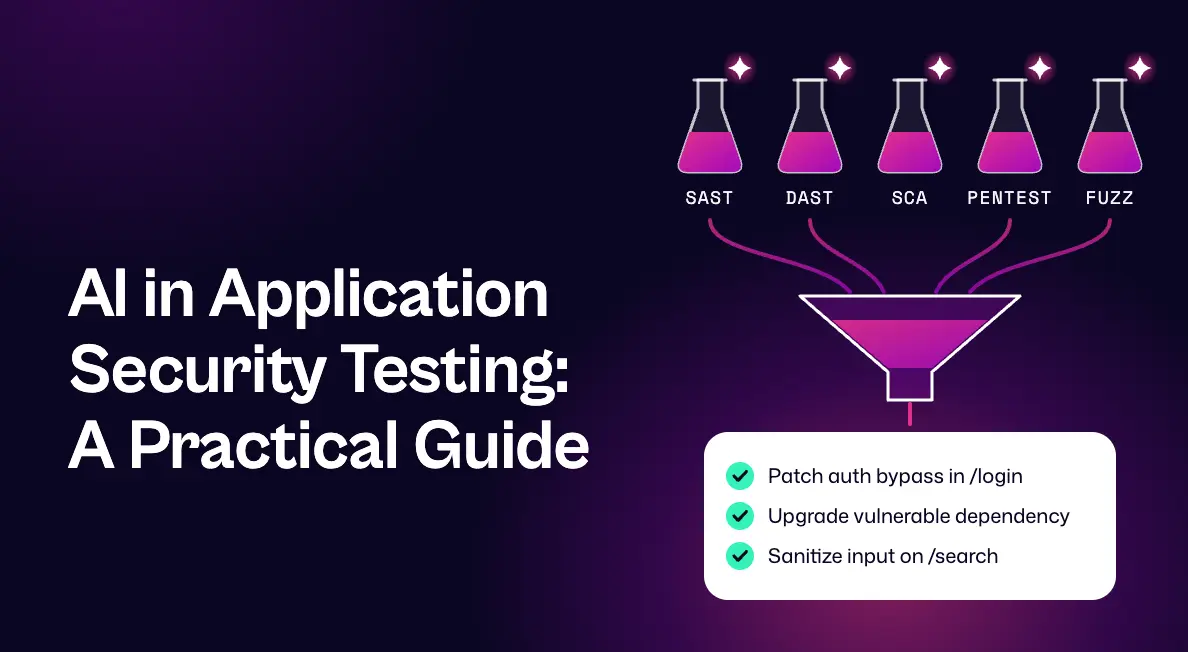
AI in application security testing makes SAST, DAST, SCA, and penetration testing faster and more context-aware, with smarter code analysis, adaptive dynamic testing, dependency reachability checks, and AI-assisted pentesting. It also brings new testing needs, since AI-powered apps must be tested for risks like prompt injection. AI has limits, including inconsistent results and invented findings, so human review still matters. And faster testing produces more findings, so teams need validation and remediation that keep pace.
AI in application security testing is changing how teams find vulnerabilities, from static code analysis to penetration testing. Scanners that once relied entirely on fixed rules and payload lists are adding AI that can reason about code, adapt tests on the fly, and explain what it finds.
The phrase covers two related ideas. The first is using AI to improve security testing of any application. The second is testing applications that are themselves built on AI models and agents. Both matter, and both are growing fast.
This guide looks at how AI is changing each major type of application security testing, how to test AI-powered applications, where AI still falls short, and how to make sure faster testing leads to faster fixes rather than a bigger backlog.
How AI Is Changing Each Type of Application Security Testing
| Testing type | Traditional approach | What AI adds |
|---|---|---|
| SAST | Pattern matching against rules and queries | Semantic understanding of code, context-aware findings, and suggested fixes |
| DAST | Crawlers and predefined payload lists | Smarter crawling of modern apps and APIs, and tests that adapt to responses |
| SCA | Matching dependency versions to known CVEs | Reachability analysis of whether vulnerable functions are actually used |
| Secrets scanning | Regular expressions and entropy checks | Context that separates real credentials from test values |
| Penetration testing | Human-led, periodic engagements | AI-assisted and autonomous testing that runs more often and chains findings |
| Fuzzing | Manually written test harnesses | AI-generated harnesses that expand coverage to more code |
AI in static application security testing (SAST)
Traditional SAST tools flag code that matches known vulnerable patterns, which often produces long lists of findings with limited context. AI-assisted SAST can reason about how data flows through an application, recognize whether input is already sanitized, and explain findings in plain language. Many tools now also propose code changes to fix what they find.
AI in dynamic application security testing (DAST)
Modern applications are full of single-page front ends, complex authentication, and APIs that traditional crawlers struggle to navigate. AI helps DAST tools explore these applications more completely and adjust their test inputs based on how the application responds, uncovering issues that static payload lists miss.
AI in software composition analysis (SCA)
SCA has always been good at detecting vulnerable dependencies and poor at telling you whether they matter. AI can trace whether a vulnerable function in a library is actually imported and called in a real execution path, which dramatically changes how many dependency findings need urgent attention.
AI-assisted penetration testing
AI is extending penetration testing beyond periodic human engagements. AI-assisted tools can run reconnaissance, attempt exploits, and chain weaknesses together on a recurring basis. The same capabilities that make AI dangerous in attackers’ hands make it useful for testing defenses, though human oversight of scope and safety remains critical.
AI in fuzzing
Fuzzing finds bugs by feeding programs unexpected inputs, but it depends on test harnesses that are time-consuming to write. Large language models can generate those harnesses automatically, and Google has reported using LLMs this way to expand fuzzing coverage in its OSS-Fuzz project.
Testing AI-Powered Applications
The second side of AI in application security testing is testing applications built on AI. Gartner now tracks AI security testing as its own market, reflecting how different these applications are from traditional software. Key testing activities include:
- Prompt injection testing: Attempting to override a model’s instructions through direct input or content it retrieves
- Data leakage testing: Checking whether a model can be coaxed into revealing sensitive data from prompts, context, or connected systems
- Agent and tool misuse testing: Confirming that AI agents can’t be tricked into calling tools or accessing systems beyond their intended scope
- Adversarial input testing: Probing whether crafted inputs cause incorrect or unsafe model behavior
- AI component scanning: Reviewing models, libraries, and plugins for known vulnerabilities and supply chain risk
AI-specific testing works best alongside conventional testing, not instead of it. The OWASP AI Exchange makes this point directly: a component such as an MCP server can still be vulnerable to classic flaws like SQL injection or server-side request forgery, so combining AI red teaming with traditional application security testing gives a more complete picture.
Where AI in Application Security Testing Falls Short
AI brings real improvements, but it also introduces new failure modes that teams should plan for:
- Inconsistent results: Because AI models are non-deterministic, the same code can produce different findings across runs, which complicates baselining and trend tracking.
- Invented findings and fixes: AI can report vulnerabilities that don’t exist or propose fixes that break functionality or introduce new flaws.
- Limited context in large codebases: Analysis can miss issues that span many files, services, or repositories.
- Data handling concerns: Sending proprietary code to external AI services raises privacy and compliance questions.
- Over-trust: Confident, well-written explanations can make weak conclusions look authoritative. Every AI verdict needs a visible reasoning trail and human review where the stakes are high.
The Testing Output Problem
There’s a less obvious consequence of AI in application security testing: more testing, done faster, produces more findings. Combine that with AI coding assistants that help developers ship far more code, and AppSec teams face a growing flood of results from multiple tools.
Testing is only valuable if its results get fixed. If findings from SAST, DAST, SCA, and AI-specific testing pile up in separate consoles with no validation, no owners, and no clear fix path, faster testing simply creates a bigger backlog. And with AI shrinking the time it takes attackers to exploit new vulnerabilities, that backlog is more dangerous than ever.
How to Get Real Value From AI-Powered Testing
To make AI in application security testing pay off, focus as much on what happens to results as on how they’re produced:
Benchmark on your own code. Compare AI-powered tools against your current scanners using real repositories, and measure precision, not just the number of findings.
Keep humans in the loop for fixes. Treat AI-generated fixes like any other code change, with review and testing before merge.
Correlate results across tools. Merge duplicates and group findings that share a single fix, such as one dependency upgrade.
Validate reachability before assigning work. Confirm that vulnerable code and dependencies are actually used before pulling developers off other priorities.
Route findings to code owners. Deliver work into the tools developers already use, with clear guidance attached.
Measure outcomes. Track mean time to remediate and backlog age, not how many findings your testing produces.
How Seemplicity Turns Test Results Into Fixes
Seemplicity isn’t a testing tool. It works with the SAST, DAST, SCA, and other application security testing tools you already run, such as Checkmarx, Snyk, and Veracode, and handles what happens after the test. As the only technology that fuses exposure management with autonomous response, it moves every finding through four questions.
What’s going on? Findings from every testing tool are deduplicated and grouped by fix, so one library upgrade that closes dozens of findings becomes a single remediation item. Seema, Seemplicity’s AI assistant, answers plain-language questions about findings, owners, and SLAs.
Is it real? The Code Analyst reads source directly from GitHub or GitLab to confirm whether flagged code is actually reachable, and the SCA Analyst checks whether a vulnerable library function is imported and invoked in a real execution path. Every verdict comes with an expandable reasoning trail, which addresses the over-trust problem directly.
Is it already blocked? For findings on hosts and workloads, EDR Compensating Controls Awareness reads live policy from CrowdStrike or Microsoft Defender to show whether the attack technique is already stopped.
How do we close it? Response Options lay out Fix, Mitigate, or Neutralize choices, with one recommended and a safety rating for each. Work routes to the responsible code owners and team queues, with bi-directional Jira sync keeping status and SLAs aligned.
For a broader look at AI’s role across AppSec, see our guide to AI in application security, or read about choosing ASPM tools.
See Seemplicity in Action
AI in application security testing helps you find more, faster. Seemplicity helps you fix what matters just as fast. Request a demo to see Seemplicity in action for yourself.

Frequently asked questions
Not entirely, at least not yet. AI is increasingly built into SAST and DAST tools, improving context and accuracy, but deterministic rule-based analysis still provides consistency and coverage that pure AI analysis can’t guarantee. Most teams benefit from combining both.
AI-powered penetration testing uses AI to automate parts of a pen test, such as reconnaissance, exploit attempts, and chaining vulnerabilities together. It allows testing to run more frequently than traditional human-led engagements, with humans overseeing scope and results.
Combine conventional application security testing with AI-specific techniques, including prompt injection testing, data leakage testing, agent tool-misuse testing, and adversarial input testing. Resources such as the OWASP Top 10 for LLM Applications and the OWASP AI Exchange provide useful starting points.
It needs the same testing as any code, applied consistently. Pay extra attention to dependencies, since AI assistants can suggest outdated or nonexistent packages, and make sure AI-generated code goes through the same review and scanning gates as human-written code.
Stay updated on Seemplicity blog
Subscribe today to stay informed and get regular updates from Seemplicity.