

/what is the difference between an attack vector and an attack surface?
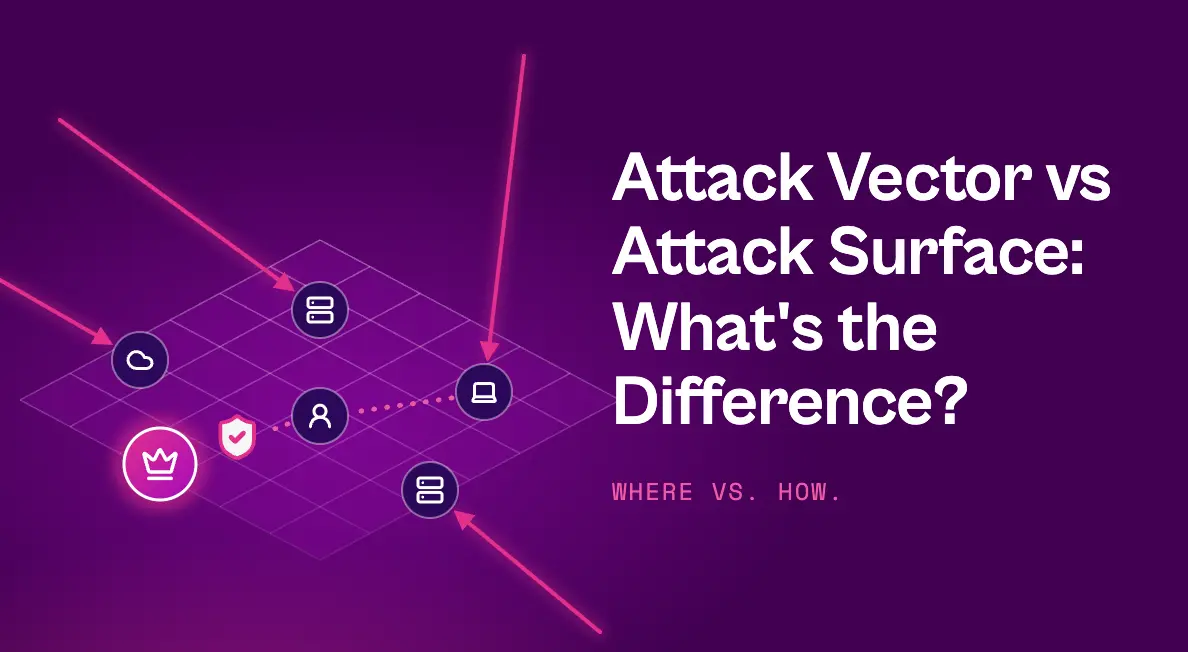
Your attack surface is everything an attacker could target: every device, application, cloud resource, identity, and person that offers a way in. An attack vector is the method used to exploit one of those points, such as phishing, stolen credentials, or an unpatched vulnerability. The surface is where you can be attacked; the vector is how. Chained together, vectors form attack paths. Reducing risk means shrinking the surface, defending against common vectors, and quickly closing the exposures attackers can actually reach.
Attack vector vs attack surface is one of the most common points of confusion in security, partly because the two terms are so often used together. They’re closely related, but they describe different things, and mixing them up leads to fuzzy priorities.
The short version: your attack surface is where you can be attacked, and an attack vector is how. This guide explains each term, compares them side by side, shows how they connect through attack paths, explains what the “attack vector” field in a CVSS score does and doesn’t tell you, and covers how to manage both.
What Is an Attack Surface?
An attack surface is the total set of points where an attacker could try to gain access to, disrupt, or extract data from your organization. It typically spans three areas:
- Digital: Servers, endpoints, applications, APIs, cloud resources, SaaS apps, domains, open ports, and code repositories
- Identity and human: User and service accounts, credentials, and the people who can be deceived or coerced
- Physical: Offices, data centers, devices, and removable media
Attack surfaces grow as organizations adopt cloud services, add SaaS tools, deploy AI features, and extend access to partners. For practical ways to shrink yours, see our guide on how to reduce attack surface.
What Is an Attack Vector?
An attack vector is the specific method or pathway an attacker uses to exploit a weakness in your attack surface. Common attack vectors include:
- Phishing and social engineering
- Compromised or weak credentials
- Exploitation of unpatched vulnerabilities
- Cloud and system misconfigurations
- Software supply chain compromise
- Malicious insiders
- Brute-force and credential-stuffing attacks
- Prompt injection against AI-powered applications
Attack vectors evolve quickly as attackers develop new techniques. AI is accelerating that evolution, making it faster and cheaper to turn a newly disclosed vulnerability into a working exploit.
Attack Vector vs Attack Surface: Key Differences
Use this model to benchmark your current AI AppSec program and plan next steps:
| Attack surface | Attack vector | |
|---|---|---|
| Question it answers | Where could we be attacked? | How could we be attacked? |
| Scope | Broad: every possible entry point | Specific: one method of exploitation |
| What changes it | New assets, services, accounts, and integrations | New attacker techniques and newly disclosed vulnerabilities |
| How you reduce it | Remove, restrict, and harden what’s exposed | Block, detect, and patch against specific techniques |
| Typical owners | IT, infrastructure, cloud, and architecture teams | Security operations, threat intelligence, and vulnerability teams |
| How you measure it | Asset counts, internet-facing exposure, coverage gaps | Exploitable exposures, detection coverage, time to remediate |
Understanding attack vector vs attack surface isn’t just a matter of vocabulary. The distinction determines which teams act, which controls apply, and how progress gets measured.
How They Connect: Vulnerabilities, Exposures, and Attack Paths
Several related terms sit between the surface and the vector:
| Term | Meaning |
|---|---|
| Vulnerability | A specific weakness, such as a software flaw or misconfiguration, on part of the attack surface |
| Exposure | A weakness an attacker could actually reach and use in your environment |
| Threat vector | Usually used interchangeably with attack vector |
| Attack path | A sequence of attack vectors chained together to move from initial access to a valuable target |
Here’s how they fit together in a hypothetical breach:
- Attack surface: An internet-facing VPN appliance.
- Vulnerability: The appliance is missing a critical security patch.
- First attack vector: The attacker exploits the unpatched vulnerability to gain a foothold.
- Second attack vector: Using credentials harvested from the compromised system, the attacker logs in to internal servers.
- Attack path: Those steps chain together into a route from the internet to a database holding customer data.
Breaking any link in that chain stops the attack. That’s why the most effective defenses focus on the exposures that attackers can actually reach and use, not just on the size of the surface or the number of possible vectors.
The “Attack Vector” in CVSS Scores
The term also appears in vulnerability scoring. The Common Vulnerability Scoring System (CVSS) includes an Attack Vector metric that describes how remotely a vulnerability can be exploited:
- Network: Exploitable remotely, potentially across the internet
- Adjacent: Requires access to the same local network segment
- Local: Requires local access to the system, often through an existing foothold
- Physical: Requires physically touching the device
Network-exploitable vulnerabilities generally receive higher scores, which makes sense in the abstract. But the CVSS Attack Vector describes the vulnerability, not your environment. A “Network” rating doesn’t tell you whether the affected asset is actually reachable once security groups and segmentation are applied, whether the exploit’s prerequisites are met on that specific system, or whether endpoint protection already blocks the technique. Those are the questions that decide real risk.
How to Manage Both Your Attack Surface and Attack Vectors
Shrink the surface
Maintain a complete asset inventory, decommission what you don’t need, close unnecessary ports and services, remove stale accounts, and harden configurations. Every element you remove eliminates the vectors that could have targeted it.
Defend against common vectors
Deploy multi-factor authentication, email security, and endpoint protection, train people to recognize social engineering, and keep software patched. These controls target the methods attackers use most.
Close what connects them
Focus remediation on exposures that are reachable, exploitable, and not already contained. This is where the attack vector vs attack surface distinction becomes practical: the surface defines what could be targeted, but only validated exposures form real attack paths. For more on how discovery and remediation programs fit together, see attack surface management vs vulnerability management.
How Seemplicity Helps Close Real Attack Paths
Seemplicity is the only technology that fuses exposure management with autonomous response. It works with the scanners and security tools you already run, such as Tenable, Qualys, Rapid7, and Wiz, and focuses on the exposures that turn attack vectors into real risk:
- What’s going on? Findings across your attack surface are deduplicated, enriched with EDR coverage, threat intelligence, and KEV data, and grouped by fix. Seema, Seemplicity’s AI assistant, answers plain-language questions about findings and SLAs.
- Is it real? AI Analysts go beyond the CVSS Attack Vector rating, checking exploit prerequisites against each asset’s live configuration and assessing network reachability using signals like security groups, public IP presence, and active connections.
- Is it already blocked? EDR Compensating Controls Awareness reads live policy from CrowdStrike or Microsoft Defender and traces the chain from CVE to whether the attack technique is already stopped.
- How do we close it? Response Options lay out Fix, Mitigate, or Neutralize, with one recommended and a safety rating for each, and work routes automatically to the right owners with bi-directional Jira and ServiceNow sync.
See Seemplicity in Action
Knowing the difference between an attack vector vs attack surface helps you frame risk. Closing the exposures attackers can actually reach is what reduces it. Request a demo to see Seemplicity in action for yourself.

Frequently asked questions
Phishing is an attack vector, meaning it’s a method of attack. The people and email accounts it targets are part of your attack surface.
In practice, the terms are usually used interchangeably. Both describe the method or pathway an attacker uses to gain access or cause harm.
An attack path is a sequence of attack vectors that an attacker chains together to move from initial access to a valuable target, such as sensitive data or critical systems.
It eliminates the vectors that targeted whatever you removed. Other vectors remain for the assets you keep, which is why surface reduction needs to be paired with patching, strong controls, and fast remediation of exploitable exposures.
Neither on its own. Shrinking the attack surface limits what can be targeted, and defending against common attack vectors blocks the methods attackers use most. The highest-impact work sits where they meet: finding the specific exposures that are reachable, exploitable, and uncontained, and fixing those first.
Stay updated on Seemplicity blog
Subscribe today to stay informed and get regular updates from Seemplicity.