/what is enterprise vulnerability management and why is it harder at scale?
Enterprise vulnerability management is the continuous process of finding, prioritizing, assigning and fixing vulnerabilities across a large, distributed environment. At enterprise scale, the hard part is operational rather than detection: large volumes of findings, tool sprawl, unclear ownership and inconsistent governance across business units. Programs that work rely on a single risk model, centralized and normalized data, automated routing to the right owners, risk-tiered SLAs, and remediation organized around fixes rather than individual findings.
Every organization manages vulnerabilities in roughly the same way: find them, decide which ones matter, fix them, and confirm the fix. At enterprise scale, the steps stay the same but the work around them changes. There are more tools, more assets, more teams and more stakeholders. The hard part is no longer finding vulnerabilities. It’s coordinating everything that has to happen after they’re found.
This post covers what enterprise vulnerability management involves, why it gets harder at scale, and what a program that works at that size looks like.
What Is Enterprise Vulnerability Management?
Enterprise vulnerability management is the continuous process of identifying, prioritizing, assigning and remediating security weaknesses across a large, distributed technology environment. That environment usually spans on-prem infrastructure, multiple cloud providers, containers, applications and third-party software. It is often split across several business units, each with its own teams, tools and change processes.
Enterprise vulnerability management is not the same as running scans. Scanning produces findings. Without asset context, clear ownership and defined remediation timelines, those findings sit in dashboards and backlogs while risk stays where it was.
Why Vulnerability Management Gets Harder at Enterprise Scale
A few problems tend to appear together once an organization reaches a certain size:
- Volume outpaces capacity. Large environments generate hundreds of thousands, or millions, of findings. Even well-staffed teams can’t triage them manually, and backlogs grow faster than they shrink.
- Tool sprawl fragments the picture. Infrastructure scanners, cloud security tools, SAST, SCA and pen test reports each score severity differently. The same vulnerability can appear several times under different names and ratings, so there’s no common risk language.
- Ownership is unclear. With thousands of assets spread across many teams, finding the person responsible for a fix often takes longer than the fix itself.
- Governance varies by business unit. Different BUs work with different SLAs, change windows and tolerance for risk, which makes consistent enforcement difficult.
- Reporting serves many audiences. The board wants risk trends, auditors want evidence, and BU leaders want to know what their teams owe. One spreadsheet can’t serve all three.
None of these is a scanning problem. They are operational problems, and they’re where enterprise programs most often stall.
Core Components of an Enterprise Vulnerability Management Program
A program that holds up at enterprise scale is built on a few foundations.
An asset inventory with business context.
You can’t prioritize what you can’t see, and you can’t prioritize well without knowing what an asset does. An accurate asset inventory records each asset’s criticality, exposure and the sensitivity of the data it handles, not just its IP address.
Centralized aggregation and normalization.
Findings from every tool need to land in one place, be deduplicated, and be translated into a consistent format. Normalization is what lets a vulnerability from a cloud scanner and the same issue from an infrastructure scanner be recognized as one problem.
Risk-based prioritization.
CVSS alone measures technical severity, not real-world risk. Effective vulnerability prioritization combines severity with exploitation data, such as EPSS scores and known exploited vulnerabilities, plus asset context. A medium-severity flaw on an internet-facing system with customer data can outrank a critical one on an isolated internal server.
Ownership mapping and routing.
Each finding needs an owner, and that owner needs to receive it in the tools they already use, such as Jira or ServiceNow. Manual handoffs don’t scale.
Risk-tiered SLAs and an exception process.
Remediation timelines should reflect risk, not a single blanket deadline. Some vulnerabilities can’t be fixed on time, so a formal process for risk acceptance and exceptions, documented in a vulnerability management policy, keeps those decisions visible and auditable.
Alignment with control frameworks.
Most enterprises must show auditors that vulnerability management is in place. ISO/IEC 27001 (control A.8.8), CIS Controls v8 (Control 7) and the NIST Cybersecurity Framework all address it, and mapping the program to these early simplifies audits later.
Best Practices for Running Vulnerability Management Across the Enterprise
With the foundations in place, these practices are what keep a large program moving:
- Standardize one risk model. Every business unit and every tool should feed the same prioritization logic. Otherwise “critical” means something different in each part of the organization.
- Automate the operational middle. Triage, deduplication, ticket creation, assignment and SLA escalation are repetitive work that automation handles better than people do at volume. That frees analysts for decisions that need judgment.
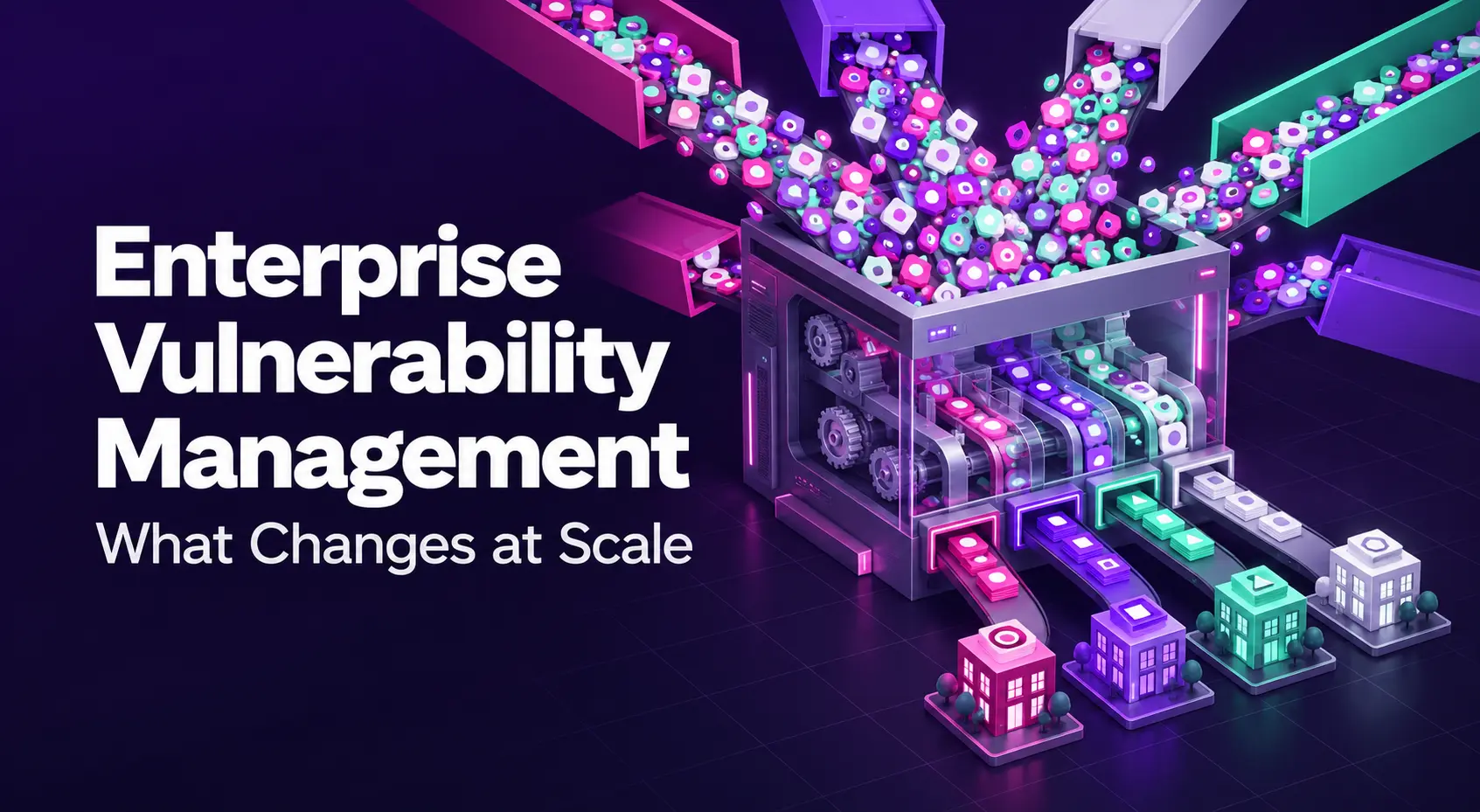
- Group findings into fixes. Many findings share a single root cause. One package upgrade or base image update can resolve hundreds of findings at once. Organizing work around fixes rather than individual findings cuts ticket volume and makes remediation easier for engineering teams to absorb.
- Look beyond patching. Change windows, legacy systems and stability concerns sometimes mean a patch can’t go out on schedule. Compensating controls, configuration changes and segmentation can reduce exposure in the meantime.
- Measure outcomes, not activity. Counting findings closed says little about risk. Useful vulnerability management metrics include mean time to remediate by risk tier, SLA adherence by team, and the trend in exploitable exposure over time.
How Seemplicity Supports Enterprise Vulnerability Management
Seemplicity is built for the operational side of enterprise vulnerability management: the work between detection and resolution.
It aggregates findings from scanners across infrastructure, cloud and application security, then normalizes and deduplicates them into one unified view. It applies a consistent risk-based prioritization model across the whole organization, using exploitability and business context. Ownership is attributed automatically, and fixes are grouped and routed into the workflows teams already use. Seemplicity’s AI agents take on the manual coordination that slows large programs down, and reporting by business unit, team and SLA gives leadership and auditors the views they need.
Making Enterprise Vulnerability Management Work at Scale
At enterprise scale, the limiting factor is rarely visibility. Most large organizations already have more findings than they can act on. What separates programs that reduce risk from those that only report on it is execution: one risk model, clear ownership, automated workflows, and remediation organized around fixes rather than findings. When prioritization, ownership and remediation operate as one connected system, enterprise vulnerability management stops being a backlog and becomes a process that shrinks risk over time.

Stay updated on Seemplicity blog
Subscribe today to stay informed and get regular updates from Seemplicity.