

/Why Isn’t Vulnerability Prioritization Enough to Reduce Risk?
Vulnerability prioritization helps security teams identify what matters most, but it doesn’t actually resolve exposures. Even with better visibility, deduplication, and risk-based context, vulnerabilities remain unresolved until teams investigate, remediate, and verify the fixes. Real risk reduction isn’t about how efficiently you organize your backlog. It’s about how quickly you take action to shrink it.
Security teams have never been better equipped to understand their exposure landscape.
Findings from multiple tools are consolidated into a single view. Duplicates are eliminated. Vulnerabilities are enriched with threat intelligence and business context, then ranked according to risk. What was once an overwhelming collection of disconnected findings becomes a structured, prioritized list.
That’s significant progress. But there’s an uncomfortable truth hiding behind all that efficiency:
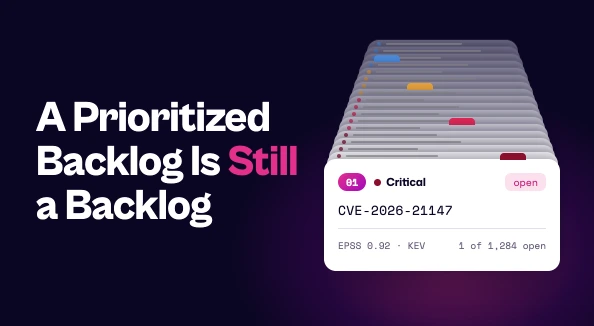
A prioritized backlog is still a backlog.
You might know exactly which exposures matter most, which assets are affected, and which vulnerabilities deserve immediate attention. But until someone takes action, the underlying risk hasn’t changed.
We’ve Gotten Really Good at Organizing Risk
For years, one of cybersecurity’s biggest challenges was simply making sense of the sheer volume of findings generated by security tools.
Different scanners reported the same vulnerabilities. Findings lacked context. Teams struggled to distinguish genuinely urgent exposures from the thousands of lower-priority issues competing for attention.
Aggregation, deduplication, enrichment, and prioritization have helped address these challenges.
By consolidating findings, eliminating redundant alerts, and applying risk-based context, security teams can focus their attention where it matters most. Instead of treating every vulnerability as equally urgent, they can make informed decisions about what needs attention first.
These capabilities aren’t just useful. They’re essential.
But making a backlog more manageable doesn’t necessarily make it smaller.
A thousand findings organized into neat categories are still a thousand findings. And a critical vulnerability doesn’t become any less dangerous simply because it’s been correctly identified as critical.
The Gap Between Knowing and Doing
Consider what happens when a vulnerability reaches the top of a prioritized list.
Someone still needs to determine whether it’s actually exploitable in their environment. Someone needs to identify who owns the affected asset, understand the potential business impact, decide on the appropriate response, and coordinate the necessary changes.
And, crucially, someone needs to make sure those changes actually happen.
This is where progress can slow down.
Even when the priorities are clear, the work required to address them often spans multiple teams, tools, and workflows. Security identifies the problem, but IT or engineering may need to implement the fix. Ownership isn’t always obvious, remediation can introduce operational concerns, and competing priorities can delay action.
Meanwhile, the exposure remains.
The problem isn’t necessarily a lack of visibility or an inability to identify what matters. It’s the gap between that knowledge and the action required to address it.
Knowing what to fix is not the same as getting it fixed.
Are We Measuring Progress or Just Activity?
There’s another challenge worth considering: how security teams measure success.
It’s easy to point to improvements in operational efficiency. Fewer duplicate findings. Better risk scores. More accurate prioritization. Cleaner dashboards.
All of these are valuable indicators of a more effective security operation. But none, on their own, proves that risk has been reduced.
A vulnerability that moves from an unprioritized list to the top of a critical queue is still unresolved. A remediation ticket that’s been assigned but never acted upon doesn’t mean the exposure is addressed. Even a ticket marked complete doesn’t necessarily mean the fix was successful.
If the objective is risk reduction, the metrics need to reflect outcomes, not just activity.
That means looking beyond how efficiently findings are processed and asking more meaningful questions:
- How quickly are critical exposures actually addressed?
- How much time passes between identifying a risk and taking effective action?
- Are remediation efforts resulting in verified risk reduction?
- Is the backlog genuinely shrinking, or simply becoming better organized?
Ultimately, the measure of progress isn’t how well you understand your backlog. It’s what you’re doing about it.
Prioritization Should Be the Starting Point, Not the Finish Line
None of this is an argument against prioritization. Quite the opposite.
Without visibility, context, and accurate prioritization, teams risk wasting valuable resources on vulnerabilities that pose little real danger while more pressing exposures remain unresolved.
But these capabilities should enable the next stage of the process, not represent its final destination.
The goal shouldn’t simply be to produce a better list of problems. It should be to make it easier to move from identifying those problems to resolving them.
That requires looking at the entire journey, from discovery and prioritization through investigation, remediation, and verification, and ensuring that the process doesn’t lose momentum once the priorities are established.
Because at the end of the day, attackers don’t care how well your vulnerabilities are organized.
They care whether those vulnerabilities can still be exploited.
A prioritized backlog is still a backlog. Until something gets done about it.

Stay updated on Seemplicity blog
Subscribe today to stay informed and get regular updates from Seemplicity.