

/What are the key findings of the SANS 2026 Exposure Management Survey?
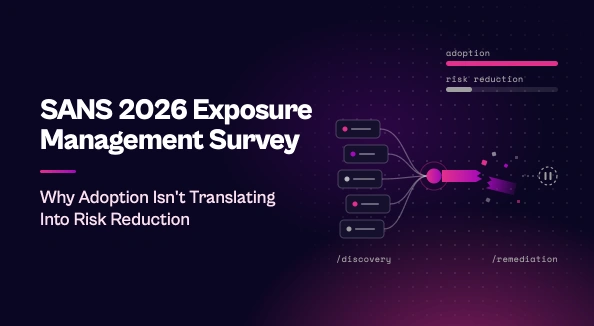
The SANS 2026 Exposure Management Survey reveals a significant gap between adoption and effectiveness. While 91% of organizations have implemented exposure management, only 7% operate continuously, and just 15% report significant risk reduction. The biggest challenges aren’t a lack of security tools, but fragmented exposure data, incomplete asset visibility, unclear remediation ownership, and manual workflows. Despite progress in risk-based prioritization, organizations still struggle to turn findings into fixes. The report highlights why better integration, automation, and cross-team accountability are essential to achieving measurable risk reduction.
91% of organizations have adopted exposure management. Only 7% are doing it continuously. So what’s standing in the way?
Exposure management has gone mainstream. Organizations are investing in tools, expanding visibility across their environments, and adopting more risk-based approaches to prioritization.
But is all that progress translating into meaningful risk reduction?
According to the SANS 2026 Exposure Management Survey, sponsored by Seemplicity, not nearly as much as it should.
The report reveals a significant disconnect between implementing exposure management and making it operationally effective.
While 91% of respondents report having some form of exposure management in place, only 15% have achieved significant risk reduction over the past year. Meanwhile, 38% report minimal or no measurable improvement.
The problem isn’t necessarily a lack of tools or security expertise. It’s what happens between discovering an exposure and actually getting it fixed.
Here are some of the key findings.
1. Exposure Management Adoption Is High. Maturity Is Another Story.
There’s no question that exposure management has gained traction. But having a program in place doesn’t mean it’s operating as a continuous, coordinated process.
The survey found that:
- 91% of organizations have implemented exposure management.
- 7% describe their approach as truly continuous, combining integration, automation, and ongoing measurement.
- 15% report significant exposure risk reduction over the past 12 months.
- 15% are very confident they’re prioritizing the right exposures first.
That gap matters.
Exposure management is intended to be an ongoing cycle of discovering, prioritizing, validating, and addressing risk. Yet many organizations are still operating through disconnected activities rather than a unified process.
Finding more exposures isn’t necessarily progress if those findings never translate into action.
2. More Visibility Tools Don’t Necessarily Mean Better Visibility
Most organizations aren’t short on security tools. In fact, 92% of respondents use vulnerability scanners to discover exposures.
Yet visibility remains a persistent challenge.
Nearly half (48%) identify unmanaged or unknown assets as one of their largest visibility gaps. And 46% cite unreliable or incomplete asset inventories as a leading obstacle to effective prioritization.
The issue goes beyond simply knowing that an asset exists.
To make an informed remediation decision, security teams need to understand what that asset supports, how critical it is to the business, and who is responsible for it.
Without that context, even the most sophisticated discovery capabilities can leave organizations struggling to determine which findings deserve attention.
3. Exposure Data Is Everywhere. A Unified Picture of Risk Isn’t.
Security teams are collecting exposure findings from an increasingly complex ecosystem of tools.
According to the survey, 44% of organizations receive findings from six or more systems, while only 16% have fully centralized their exposure data.
That fragmentation creates challenges at multiple stages of exposure management.
When findings sit across disconnected platforms, teams struggle to correlate related exposures, eliminate duplicate information, and establish consistent priorities.
And the consequences extend beyond analysis.
The survey found that 41% cite fragmented exposure data as a barrier to prioritization, while 32% identify tool fragmentation as a barrier to remediation.
In other words, disconnected data doesn’t just make it harder to decide what needs fixing. It also makes it harder to get the fixing done.
The report makes an important distinction: organizations don’t necessarily have a data shortage. They have a problem turning the data they already collect into coordinated decisions and actions.
4. The Biggest Remediation Barriers Aren’t Technical
Perhaps the most revealing findings concern what happens after an exposure has been identified and prioritized.
The leading remediation barriers are:
- 44%: Responsibility spread across multiple teams
- 39%: Risk of operational disruption
- 39%: Competing business priorities
- 37%: Unclear system ownership
Notice what’s missing from the top of that list: the technical ability to fix the problem.
Instead, organizations are struggling with the coordination required to turn security priorities into operational work.
Security teams may identify the risk and determine its urgency, but remediation typically depends on IT, cloud, development, or other operational teams with their own responsibilities and competing priorities.
That handoff is still largely manual.
32% of organizations rely on security analysts manually creating and assigning remediation tickets, compared with just 24% using automated workflows.
As the report emphasizes, remediation is primarily a coordination gap, not a capability gap.
Without clear ownership, accountability, and workflows that connect security to the teams responsible for taking action, even well-prioritized exposures can remain unresolved.
5. The Good News? Prioritization Is Moving in the Right Direction.
Not every finding points to a gap.
The survey also highlights meaningful progress in how organizations evaluate exposure risk.
Asset criticality and business impact, along with known exploit availability, are now among the most influential prioritization factors, each cited by 44% of respondents. Both are effectively tied with traditional CVSS severity scores at 43%.
Meanwhile, 36% describe their overall approach as risk-based, compared with 20% relying primarily on severity.
Organizations are also incorporating external threat intelligence into their decisions, with 91% using at least one external threat signal.
This reflects a welcome shift away from treating every critical-severity vulnerability as equally urgent.
Security teams increasingly recognize that effective prioritization requires understanding real-world exploitability and business impact.
But the survey also exposes the limitation of better prioritization alone: knowing what matters most doesn’t guarantee that anything gets done about it.
From Exposure Management Adoption to Exposure Management Outcomes
The overarching message of the SANS 2026 Exposure Management Survey is clear: the industry has made considerable progress in identifying and prioritizing exposures, but the operational processes required to resolve them haven’t kept pace.
Organizations have the tools. They’re collecting the data. They’re increasingly making risk-informed decisions.
What remains missing is the connection between those capabilities.
The report points to three priorities for closing that gap: consolidating fragmented exposure data, establishing clear remediation ownership and accountability, and integrating automation into the workflows that move exposures toward resolution.
Ultimately, exposure management success shouldn’t be measured by how many tools an organization has deployed, how many findings it has collected, or even how accurately it prioritizes them.
It should be measured by whether those efforts produce meaningful, measurable risk reduction.
Want the full picture? Download the SANS 2026 Exposure Management Survey (no form fill required) for a deeper look at the findings, expert analysis, and recommendations for building a more effective exposure management program.

Stay updated on Seemplicity blog
Subscribe today to stay informed and get regular updates from Seemplicity.