

/What is a remote code execution vulnerability?
A remote code execution (RCE) vulnerability is a flaw that lets an attacker run their own code on a target system over a network, often without credentials or user interaction. Common causes include injection flaws, insecure deserialization, unrestricted file uploads, memory corruption, and vulnerable third-party components. RCEs are among the most severe vulnerabilities because they can hand attackers full control of a system, and some spread automatically from host to host. Reduce the risk with secure coding, layered testing, least privilege, a smaller exposed footprint, and a current dependency inventory, and prioritize RCEs by real-world exploitability, not CVSS alone.
Few disclosures get security teams moving as fast as a remote code execution vulnerability in a widely used component. It can mean that anyone on the internet is able to run commands on your systems, often without logging in.
This guide explains what an RCE vulnerability is, what causes one, why they’re rated so severely, and how to reduce the chances one is exploited in your environment.
What Is a Remote Code Execution Vulnerability?
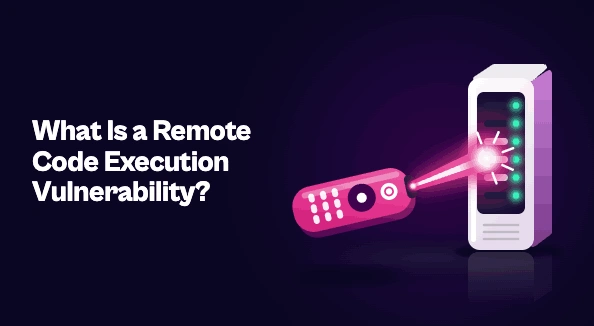
A remote code execution (RCE) vulnerability is a flaw that lets an attacker run code of their choosing on a target system over a network. The attacker doesn’t need physical access, and in many cases doesn’t need valid credentials either.
RCE vulnerabilities can live almost anywhere software accepts input from the outside: web applications, APIs, network services like SSH or SMB, operating system components, and the open-source libraries bundled inside all of them.
Two related terms often get used interchangeably:
- Arbitrary code execution (ACE) is the broader category. It covers any flaw that lets an attacker run code they choose, whether locally or remotely. RCE is the remote subset of ACE.
- Remote command execution usually describes flaws where an attacker can run operating system commands rather than inject their own program code. The outcome is often the same, so the two are commonly grouped together.
How RCE Vulnerabilities Happen
Most RCE vulnerabilities share one root cause: the system treats attacker-controlled input as something to execute. The most common ways that happens:
- Injection flaws. User input is passed to a shell, interpreter, or functions like eval() without proper validation, so the attacker’s input runs as code or commands.
- Insecure deserialization. An application rebuilds objects from untrusted data, and a crafted payload triggers code execution during that process. Java, PHP, and .NET applications have all been hit hard by this class.
- Unrestricted file uploads. The server accepts an executable file, such as a web shell, and stores it somewhere it can be run.
- Server-side template injection. User input is embedded directly into a template that the template engine then evaluates.
- Memory corruption. Buffer overflows and use-after-free bugs in languages like C and C++ let attackers hijack a program’s execution flow.
- Vulnerable third-party components. Many RCEs aren’t in your own code at all, but in a library or framework your application depends on.
Several of these, injection in particular, are long-standing application security vulnerabilities that still show up in production code every year.
Why RCE Vulnerabilities Are So Severe
RCE sits at the top of most severity rankings because of what it hands an attacker. Code usually runs with the privileges of the vulnerable process, which is often root or SYSTEM on a server. From there, an attacker can steal data, deploy ransomware, or install backdoors for later.
Many RCEs are also exploitable without authentication or user interaction. If the vulnerable service is internet-facing, it’s part of your attack surface and anyone who finds it can try to exploit it.
Some RCEs are wormable, meaning an exploit can spread from host to host on its own. And even a limited RCE gives an attacker the initial foothold they need to move laterally toward more valuable systems.
How RCE Vulnerabilities Are Classified and Scored
RCE describes an outcome, not a single weakness type, so RCE vulnerabilities map to several CWE categories. The most common are CWE-94 (code injection), CWE-78 (OS command injection), and CWE-502 (deserialization of untrusted data), along with memory-safety weaknesses like CWE-787 (out-of-bounds write).
On the CVSS side, RCEs tend to score high or critical because they hit the most severe values on several metrics at once: a network attack vector, no privileges required, no user interaction, and high impact on confidentiality, integrity, and availability. An RCE with low attack complexity and all of those traits lands at 9.8.
Severity isn’t the same as risk, though. regreSSHion, an unauthenticated RCE in OpenSSH, scored 8.1 because exploitation was complex, yet the potential impact was enormous. Plenty of critical-rated RCEs, meanwhile, are never exploited at all.
That’s why effective vulnerability prioritization looks beyond the score. Signals like public exploit code, a listing in the CISA Known Exploited Vulnerabilities catalog, and whether the vulnerable code is reachable all say more about real-world exploitability than CVSS alone.
Real-World Remote Code Execution Vulnerability Examples
Log4Shell (CVE-2021-44228). Disclosed in December 2021, this flaw in Apache Log4j 2 let attackers trigger code execution just by getting a crafted string written to a log. It earned a CVSS score of 10. What made it so disruptive was reach: Log4j sat inside countless Java applications, often as a dependency of a dependency that teams didn’t know they had.
EternalBlue (CVE-2017-0144). A flaw in Microsoft’s SMBv1 protocol, EternalBlue powered the WannaCry ransomware outbreak in May 2017, which spread to hundreds of thousands of machines worldwide. Microsoft had released a patch two months earlier. The machines that were hit were the ones that hadn’t applied it.
ProxyShell (Microsoft Exchange). In 2021, researchers showed how three separate Exchange vulnerabilities (CVE-2021-34473, CVE-2021-34523, and CVE-2021-31207) could be chained into unauthenticated RCE. None of the three told the full story on its own, which is a reminder that RCE risk sometimes only appears when flaws are combined.
How to Reduce RCE Risk
No single control eliminates RCE, but a few practices close off most of the common paths:
- Write code that never executes input. Validate and sanitize all input, use parameterized calls instead of building commands from strings, and avoid deserializing untrusted data.
- Layer your testing. SAST catches risky patterns in source code, DAST tests running applications, SCA flags vulnerable dependencies, and pen testing finds chained issues automated tools miss.
- Limit the blast radius. Run services with least privilege and use sandboxing or containers, so a successful exploit doesn’t automatically mean full control.
- Reduce what’s exposed. Disable services you don’t use, and keep admin interfaces and management ports off the public internet.
- Know your dependencies. Keep an up-to-date inventory of third-party components, so when the next Log4Shell drops you can tell within hours whether you’re affected.
How Seemplicity Helps
A single RCE in a common library can surface as hundreds of separate findings across SCA, container, cloud, and infrastructure scanners. Seemplicity consolidates and deduplicates those findings into one view, so teams see the actual scope of the problem rather than the noise.
From there, Seemplicity prioritizes each exposure by exploitability, internet exposure, and business context, then routes fixes to the right owners and tracks them through to vulnerability remediation. The result is a clear path from “we’re affected” to “it’s fixed.”
Why RCE Belongs at the Top of Your List
A remote code execution vulnerability gives an attacker the most direct route to taking over a system, and new ones are disclosed every year in software nearly every organization runs. Understanding how they happen, from injection and deserialization to vulnerable dependencies, makes them easier to prevent in code you write and easier to spot in code you inherit.
Just as important is judging them by real-world risk rather than score alone. Teams that know their exposure and their dependencies are the ones that can act quickly when the next critical RCE lands.

Stay updated on Seemplicity blog
Subscribe today to stay informed and get regular updates from Seemplicity.