
Vulnerability Risk Management: How to Decide Whether to Fix, Mitigate, or Accept

/what is vulnerability risk management?
Vulnerability risk management is the practice of handling vulnerabilities based on the risk they pose to the business, not on severity scores alone. Teams assess each finding by how likely it is to be exploited (active exploitation, EPSS, reachability, exposure) and how much damage it could cause (asset criticality and data sensitivity). They then decide whether to remediate, mitigate, accept, or avoid it. The goal isn’t to fix everything. It’s to make sure every significant vulnerability ends in a deliberate decision, with a named owner, an expiry date for any accepted risk, and metrics that track real risk reduction.
Most security teams can tell you which vulnerabilities rank highest. Fewer can tell you what they decided to do about the rest, or who made that call. That gap is where vulnerability risk management either works or quietly falls apart.
What Is Vulnerability Risk Management?
Vulnerability risk management is the practice of handling vulnerabilities based on the risk they pose to the business, not on technical severity alone. It covers three things: how you assess that risk, how you decide what to do about each finding, and how you track those decisions over time.
Traditional vulnerability management usually measures activity: scans run, patches deployed, tickets closed. Vulnerability risk management measures whether the organization is actually less exposed. Consider a critical CVE on an isolated test server and a medium-severity flaw on an internet-facing payment system. They are not equal problems, even if their scores suggest otherwise.
The difference shows up in what the program produces. A ranked list is only the starting point. The real output is a decision for every significant finding, with an owner and a date attached.
How Vulnerability Risk Is Assessed
Risk comes down to two questions. How likely is this vulnerability to be exploited? And how much damage would it cause if it were?
Likelihood signals include:
- Active exploitation, such as a listing in the CISA Known Exploited Vulnerabilities catalog
- Predicted exploitation, such as EPSS (Exploit Prediction Scoring System) scores
- Public exploit code that lowers the bar for attackers
- Reachability, meaning whether the vulnerable code or service can actually be reached in your environment
- Exposure, meaning whether the asset is internet-facing or internal
Impact depends on the asset itself: what it does, what data it touches, and what breaks if it’s compromised. Existing compensating controls can lower the effective risk of an otherwise serious finding.
Combine these signals and you get vulnerability prioritization based on real-world risk rather than CVSS bands. Prioritization tells you the order to work in. It doesn’t tell you what to do with each item.
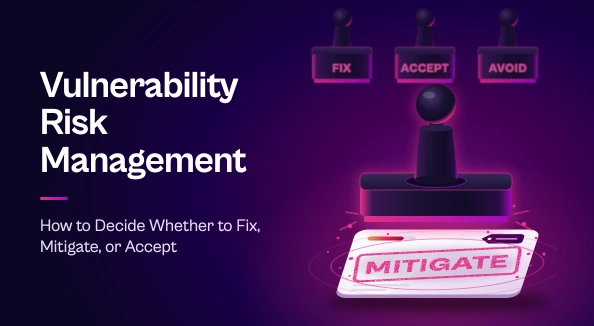
The Four Risk Treatment Options
Every prioritized vulnerability should end up with one of four treatments.
Remediate.
Remove the vulnerability by patching, upgrading the component, or changing the configuration. Vulnerability remediation is the default for high-risk findings, and it’s the only option that eliminates the risk instead of managing it.
Mitigate.
Reduce the likelihood or impact without fixing the flaw itself. Examples include a WAF rule, network segmentation, disabling the vulnerable feature, or tightening an EDR policy. This is the right call when no fix exists yet or when the fix can’t be deployed safely. Vulnerability mitigation buys time, but it doesn’t close the issue.
Accept.
Formally decide that the risk is within the organization’s appetite and leave the vulnerability in place. Acceptance is legitimate for low-likelihood, low-impact findings, or when the cost of fixing clearly outweighs the risk. It has to be documented, owned, and time-limited.
Avoid.
Remove the exposure by removing what’s exposed: decommission the legacy server, retire the unused feature, or take the asset offline. Teams often overlook this option, yet it is sometimes the cheapest one available.
How to Choose the Right Option
A few questions settle most treatment decisions:
- Is a fix available? If not, the choice is between mitigating and accepting.
- What will the fix disrupt? If the patch needs downtime or breaks a dependency, mitigate until a change window opens.
- How does the risk compare with your risk appetite? Findings that fall clearly below the threshold are candidates for acceptance.
- How long will the fix take, and how exposed are you in the meantime? An actively exploited, internet-facing vulnerability whose fix is weeks away calls for mitigating now and remediating in parallel.
- Is the asset still needed? If not, avoid the risk by retiring the asset.
Urgent issues often need more than one treatment. A common pattern is to mitigate within hours and remediate within days. Write your thresholds and default treatments into your vulnerability management policy so decisions stay consistent across teams and analysts.
Governing Risk Acceptance and Exceptions
Acceptance is where most programs drift, so it needs the tightest guardrails:
- Name a risk owner. This should be the business owner of the asset, not whichever security analyst happened to triage the finding.
- Set an expiry date. Every acceptance should lapse and come back for review, rather than standing indefinitely.
- Define re-review triggers. Reopen the decision early if the CVE is added to KEV, a public exploit appears, the EPSS score jumps, or the asset becomes internet-facing.
- Keep an audit trail. Record why the risk was accepted, which controls are in place, and who approved it. Auditors will ask, and so will whoever inherits the decision.
Without these, the exception register turns into a graveyard of permanent decisions that nobody remembers making.
Common Vulnerability Risk Management Pitfalls
- Treating severity as risk. CVSS describes how bad a vulnerability could be in theory. It says nothing about your environment.
- Silent acceptance. A finding sitting 200 days past its SLA has effectively been accepted, even though nobody decided to accept it.
- Set-and-forget mitigations. A WAF rule meant to cover a vulnerability until the patch arrives can easily become permanent.
- Unclear ownership. Without an owner, nothing gets fixed and nothing gets accepted, so the finding stays open.
- Measuring the wrong things. Track vulnerability management metrics that reflect risk. Good examples are time to remediate high-risk findings, SLA adherence, and the number of expired exceptions still open.
How Seemplicity Supports Vulnerability Risk Management
Seemplicity works on top of the scanners and security tools you already use. It helps turn their findings into owned, tracked decisions:
- One view of findings. It aggregates, normalizes, and deduplicates findings from across your tools.
- Risk context. It enriches each finding with KEV status, EPSS, and business context, so priorities reflect real-world risk.
- Validation. Seemplicity’s AI Analysts check whether findings are actually exploitable in your environment before they reach your team.
- Response options. Teams can reduce risk while a full fix isn’t yet possible.
- Ownership and tracking. Each fix is routed to the right owner and tracked through to closure.
Making Every Vulnerability a Deliberate Decision
Effective vulnerability risk management doesn’t mean fixing everything. It means that every significant finding ends in a deliberate choice to remediate, mitigate, accept, or avoid, with an owner and a review date behind it. Get that right, and your backlog becomes a record of decisions instead of a pile of risk nobody chose to carry.
Stay updated on Seemplicity blog
Subscribe today to stay informed and get regular updates from Seemplicity.