

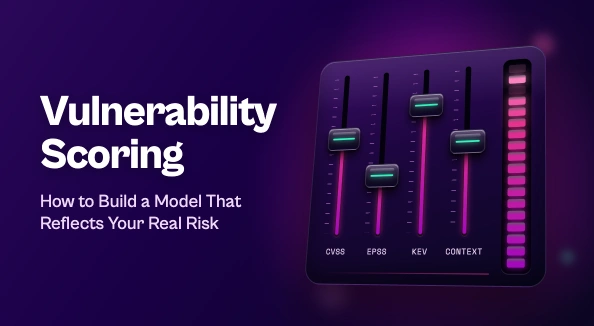
Vulnerability Scoring: How to Build a Model That Reflects Your Real Risk

/how does vulnerability scoring work?
Vulnerability scoring assigns a value to each vulnerability so security teams can decide what to fix first. Public systems each cover one piece of the picture: CVSS rates technical severity, EPSS predicts how likely exploitation is in the next 30 days, CISA KEV flags vulnerabilities already being exploited, and SSVC recommends an action. None of them accounts for your environment, though. An effective scoring model layers these signals with asset criticality, exposure, compensating controls and real exploitability, then ties each score band to a remediation SLA so the score actually drives fixes.
Security teams tend to lack a reliable way to decide what to fix first. Public scoring systems help, but each one answers a narrow question, and none of them knows anything about your environment. The teams that prioritize well take those public scores and build a scoring model of their own on top of them.
What Is Vulnerability Scoring?
Vulnerability scoring assigns a value to each vulnerability so teams can rank what to remediate first. It’s the foundation of vulnerability prioritization. Scanners routinely surface thousands of findings, and no team has the capacity to fix them all at once.
It’s worth separating two ideas early on:
- Severity: how damaging a vulnerability could be if someone exploited it.
- Risk: how much that vulnerability actually matters in your organization, given where it sits, what it touches and whether attackers are using it.
Most public scores measure severity. Your scoring model needs to measure risk.
The Scoring Systems You’ll Build On
CVSS (Common Vulnerability Scoring System) is the industry baseline. It rates technical severity from 0 to 10 and maps scores to Low, Medium, High and Critical bands. CVSS v4.0 organizes metrics into Base, Threat, Environmental and Supplemental groups. In practice, most teams only ever use the Base score.
EPSS (Exploit Prediction Scoring System) estimates the probability that a vulnerability will be exploited in the wild within the next 30 days. It’s maintained by FIRST and updated daily, so it reflects current attacker activity in a way CVSS doesn’t.
CISA KEV: The CISA Known Exploited Vulnerabilities catalog lists vulnerabilities with confirmed exploitation in the wild. It’s a yes-or-no signal rather than a score, and that makes it one of the strongest inputs available.
SSVC (Stakeholder-Specific Vulnerability Categorization) skips the number entirely. It walks through a decision tree covering factors such as exploitation status, technical impact and mission impact. The outcome is an action: Track, Track*, Attend or Act.
On top of these, scanner and platform vendors publish proprietary scores such as Tenable’s VPR and Qualys TruRisk. There’s also a growing field of AI-powered vulnerability risk scoring vendors, each weighting these signals in its own way.
Why No Single Score Is Enough
Each system answers a different question:
- CVSS: how bad could this be?
- EPSS: how likely is exploitation soon?
- KEV: is it being exploited right now?
- SSVC: what should we do about it?
None of them knows whether the affected asset is a production payment server or a forgotten test VM. A CVSS 9.8 on an isolated internal machine can matter less than a CVSS 6.5 on an internet-facing system that holds customer data. Context is the missing layer, and only your organization can supply it.
How to Build a Vulnerability Scoring Model
A practical model layers public signals with your own context. Here’s a straightforward way to structure it.
1. Start with severity. Use the CVSS Base score as your starting point. It’s universally available and gives every finding a consistent baseline.
2. Add a threat layer. Treat KEV inclusion as an override that moves a finding straight to the top tier. Use EPSS to raise findings above a set probability threshold and lower those with very low exploitation likelihood.
3. Add asset context. Weight findings by asset criticality, internet exposure and the sensitivity of the data involved. This step depends on an accurate asset inventory. If you don’t know what an asset does or who owns it, you can’t score its risk.
4. Account for real-world conditions. Lower the score when compensating controls such as EDR, WAF rules or network segmentation reduce exposure. Raise it when the vulnerable component is reachable and actively in use. Exploitability on your specific asset matters more than exploitability in theory.
5. Map score bands to actions. A score is only useful if it triggers something. For example:
- Critical: fix within 7 days
- High: fix within 30 days
- Medium: fix within 90 days
- Low: track and review
6. Keep it transparent. Document the logic and weightings. When an engineering team asks why a ticket is urgent, you should be able to show exactly how the score was built.
Common Vulnerability Scoring Mistakes
- Sorting by CVSS alone. The result is a long list of “criticals” that may never be exploited, while real risk sits lower in the queue.
- Reading EPSS as a severity score. EPSS measures likelihood, not impact. A high EPSS score on a low-impact vulnerability still needs context.
- Black-box weighting. If nobody can explain why a finding scored a 92, nobody will trust the score.
- Scoring CVEs instead of findings. The same CVE carries very different risk on different assets, so score each instance.
- Stopping at the score. Ranking a backlog doesn’t shrink it.
How Seemplicity Fits In
Seemplicity doesn’t replace your scanners. It sits on top of them and gets their output fixed. Findings from across your security stack are aggregated and automatically enriched with CVSS, EPSS, CISA KEV and VulnCheck data.
From there, white-box prioritization lets teams apply their own scoring logic, such as asset type, data classification, exploitability or custom rules, with no engineering work required. Seemplicity’s AI Analysts then check whether a finding is actually exploitable on the specific asset. They look at runtime configuration, network reachability and compensating controls.
Scored findings are grouped into single fixes and routed to the right owners in Jira, ServiceNow or Slack. SLA tracking and exception workflows keep remediation timelines visible from start to finish.
Make Your Score Drive the Fix
The best vulnerability scoring model isn’t the most sophisticated one. It’s the one that consistently changes what gets fixed and when. Build on public signals, layer in your own context, tie every score band to an action, and revisit the weightings as your environment and the threat landscape change. A score that moves work into vulnerability remediation is the only kind worth keeping.
Stay updated on Seemplicity blog
Subscribe today to stay informed and get regular updates from Seemplicity.