

/what is cve?
CVE (Common Vulnerabilities and Exposures) is a public catalog that gives each publicly disclosed security vulnerability a unique ID, such as CVE-2024-3094, so every tool, vendor and advisory refers to the same flaw the same way. CVE IDs are assigned by CVE Numbering Authorities (CNAs), and the program is run by MITRE and sponsored by CISA. A CVE is an identifier, not a severity score or a fix. It doesn’t tell you whether the flaw is in your environment, whether attackers can reach it, or who needs to fix it, and that context is what determines real risk.
Almost every security tool, advisory and patch note references CVE IDs. Scanners tag findings with them, vendors cite them in release notes, and major flaws are often known by their CVE number. But CVEs are easy to misread. A CVE is a name. It isn’t a risk rating, and it isn’t a fix. Here’s how the CVE system works, how to read a CVE ID, and where CVE data stops being useful.
What Is CVE?
CVE stands for Common Vulnerabilities and Exposures. It’s a public catalog that gives each publicly disclosed security vulnerability a unique identifier, so everyone refers to the same flaw the same way.
Before CVE launched in 1999, vendors and security tools each used their own names for flaws. One issue could appear under several names, which made it hard to tell whether two reports described the same problem. A shared ID fixed that. Today a scanner finding, a vendor advisory and a threat intelligence report can all point to one CVE ID and mean exactly the same thing.
The CVE Program is governed by the CVE Board, run by MITRE and sponsored by CISA. The catalog is free to search and use. Despite the “Exposures” in the name, modern CVE records almost all describe software and hardware vulnerabilities.
How to Read a CVE ID
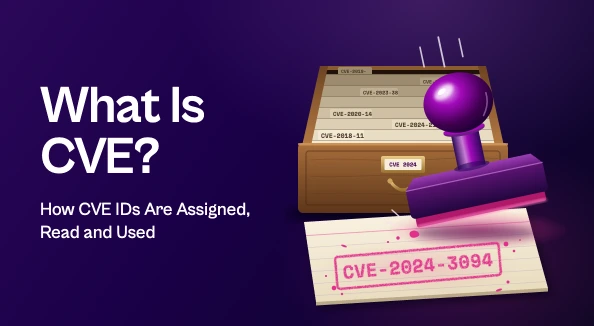
Every CVE ID follows the same format: CVE-YYYY-NNNNN. For example, CVE-2024-3094 is the backdoor discovered in the XZ Utils compression library in 2024.
- Prefix: Every ID starts with “CVE.”
- Year: The year the ID was reserved or the vulnerability was made public. It isn’t the year the flaw was discovered or introduced. A bug that has been in the code for a decade can still get a current-year ID.
- Sequence number: At least four digits, with no upper limit. It says nothing about severity, and a lower number doesn’t mean the flaw was found earlier. Blocks of numbers are handed to different assigning organizations, so the numbers aren’t strictly in sequence.
What Qualifies for a CVE
Not every security flaw gets a CVE. To be assigned an ID, a flaw generally has to have a real security impact. It also has to be confirmed by the affected vendor or documented in a vulnerability report, and be fixable on its own. One CVE covers one distinct vulnerability. Separate flaws get separate IDs, even when they’re disclosed together.
Some issues usually never get a CVE:
- Misconfigurations in your own environment, such as a public storage bucket or an unnecessarily open port
- Flaws in custom internal code that isn’t distributed to anyone else
- Many cloud-side issues that the provider fixes on its end with no customer action needed
- Zero-days, which exist before anyone has reported them
This matters because CVEs only cover part of your real risk. A count of CVEs in your environment doesn’t include everything an attacker could use.
How a CVE Gets Assigned
CVE IDs are assigned by CVE Numbering Authorities (CNAs). These are hundreds of authorized organizations, including software vendors, open-source projects, CERTs and security research firms. Each CNA covers a defined scope, usually its own products, and MITRE handles flaws that fall outside the other CNAs’ scopes.
A typical CVE moves through these stages:
- Report: A researcher, vendor or user finds a flaw and reports it to the right CNA.
- Reservation: The CNA reserves a CVE ID, often well before any details are public. At this stage the record exists but contains no information.
- Publication: When the flaw is disclosed, usually alongside a patch or advisory, the CNA publishes the full record.
- Updates or rejection: Records are updated as more information comes in. A record can be rejected if it turns out to be a duplicate or not a vulnerability, and it can be marked as disputed if the vendor disagrees with it.
The volume is significant. More than 40,000 CVEs were published in 2024 alone.
What’s Inside a CVE Record
A published CVE record contains a short set of core fields:
- The CVE ID
- A description of the vulnerability
- Affected products and versions
- References, such as vendor advisories, patches and research write-ups
CNAs can also add a severity score and a weakness classification. The National Vulnerability Database (NVD), run by NIST, then enriches records with its own analysis, standardized product identifiers and CVSS scores. That enrichment has lagged behind since 2024, though, so many records go out without full analysis. A CVE being published doesn’t mean it has been scored.
CVE vs. CVSS vs. CWE vs. NVD
These terms often get used interchangeably, but each one answers a different question:
| Term | What It Is | Question It Answers |
|---|---|---|
| CVE | A unique ID for one known vulnerability | Which flaw is this? |
| CWE | A catalog of weakness categories | What kind of flaw is it? |
| CVSS | A 0–10 severity scoring standard | How severe could it be in theory? |
| NVD | NIST’s database that enriches CVE records | What are the details and score? |
| KEV | CISA’s list of flaws exploited in the wild | Is anyone actually using it? |
CVE is the identifier that ties the others together. For confirmed exploitation, see our guide to the CISA Known Exploited Vulnerabilities Catalog.
What a CVE Doesn’t Tell You
A CVE record describes a flaw in general terms. It knows nothing about your environment, so it can’t tell you:
- Whether you’re affected. That depends on what’s running in your environment, which vulnerability scans help you find out.
- Whether attackers can reach it. A vulnerable component that’s never loaded, or that sits behind segmentation, carries far less risk. That gap is what exploitability describes.
- How urgent it is compared with everything else. Effective vulnerability prioritization weighs exploitation, reachability and business impact, not just the score attached to the CVE.
- Who needs to fix it. The record names the affected product, not the team that owns the asset. It also won’t tell you that a single library upgrade might close dozens of CVEs at once.
How Seemplicity Fits In
Seemplicity pulls in CVE-tagged findings from the security tools you already use and consolidates duplicates when several tools report the same CVE on the same asset. It then enriches each finding with the context a CVE record can’t provide, such as known exploitation, reachability and asset criticality. Findings that share a fix are grouped together, so one upgrade becomes one task instead of dozens. Each task is routed to the right owner and tracked through to closure.
From CVE ID to Closed Risk
CVE gives the industry a common language for vulnerabilities, and that alone makes modern security tooling possible. But a CVE ID is where the work starts. The value comes from knowing which CVEs actually exist in your environment, which ones matter, and who owns the fix. Risk only drops when that last step, vulnerability remediation, is done.

Stay updated on Seemplicity blog
Subscribe today to stay informed and get regular updates from Seemplicity.