



/what is devsecops?
DevSecOps integrates security into every stage of the software development lifecycle (SDLC) – not as a final gate before release, but as an automated, continuous part of the pipeline. It combines shared ownership across development, security, and operations with tooling like SAST, DAST, SCA, and IaC scanning built directly into CI/CD. Success is measured by MTTR and the four DORA metrics, and the biggest barriers to adoption are cultural (breaking down silos), not technical.
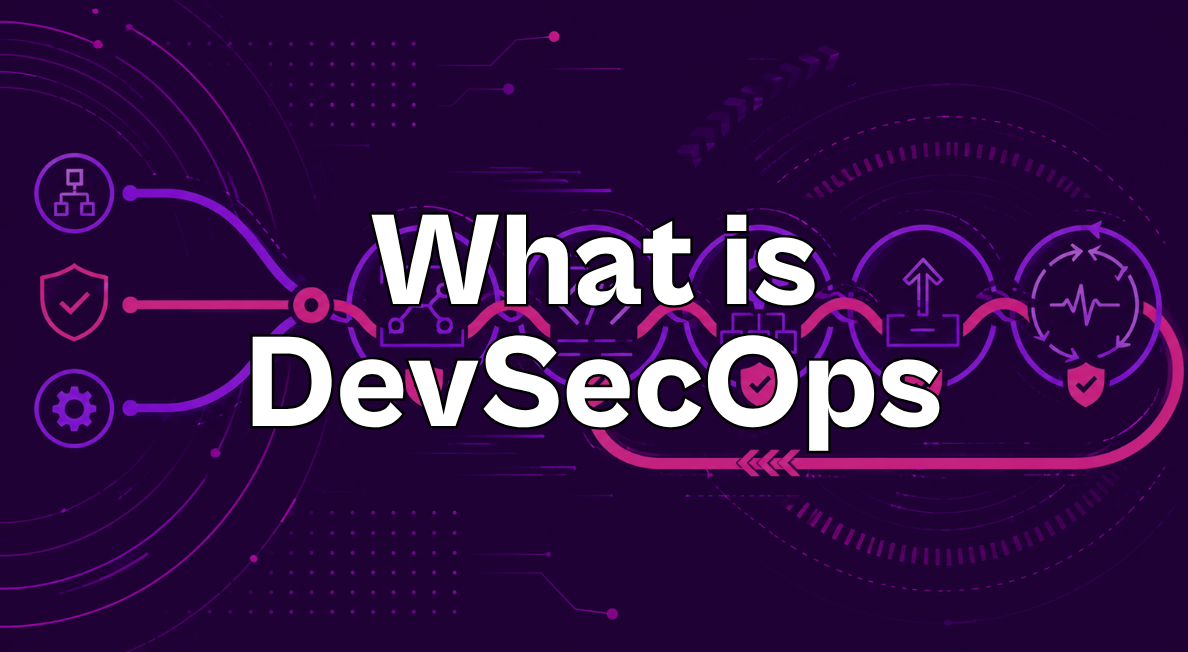
DevSecOps is the practice of integrating security into every stage of the software development lifecycle (SDLC), rather than treating it as a separate phase that happens after code is written or before it ships. The term combines Development, Security, and Operations – three functions that traditionally worked in silos with different priorities (speed, risk, stability) and now share joint ownership of secure, reliable software delivery.
In practice, DevSecOps means security testing, vulnerability scanning, and compliance checks run continuously and automatically alongside development and deployment, instead of as a manual gate at the end. The goal is to catch and fix security issues as early and cheaply as possible, without slowing down the pace of releases.
DevSecOps vs. DevOps: What’s the Difference?
DevOps focuses on breaking down silos between development and operations teams to ship software faster and more reliably, using practices like CI/CD, infrastructure as code, and automated testing. DevSecOps takes that same model and adds security as a first-class, automated part of the pipeline, not a bolt-on review at the end.
The practical difference shows up in when security gets involved. In a DevOps-only model, security teams often review code or infrastructure right before release, creating a bottleneck and adversarial dynamic. In DevSecOps, security tooling (SAST, DAST, SCA, IaC scanning) runs inside the same pipeline developers already use, and security findings are treated like any other engineering work item – triaged, prioritized, and routed to the right owner with the same urgency as a bug or outage.
How does DevSecOps align with broader Governance, Risk, and Compliance strategies?
DevSecOps closely supports Governance, Risk, and Compliance (GRC) strategies by embedding security monitoring, inspection and other considerations throughout the SDLC, ensuring risks are identified and mitigated early. In a GRC framework, the goal is to implement policies, procedures, and controls that protect critical systems, data, and infrastructure while ensuring compliance with regulatory and industry standards. DevSecOps supports this by promoting continuous monitoring, automated testing, and collaborative workflows between development, operations, and security teams, which help detect and address vulnerabilities as early as possible.
By integrating security into agile development methodologies, DevSecOps enhances an organization’s ability to adapt to evolving threats while maintaining compliance with required standards. This proactive approach minimizes potential disruptions, supports incident response planning, and provides actionable insights for informed decision-making, making it an essential component of a holistic GRC strategy. Organizations adopting DevSecOps can better scale their security processes in alignment with business growth, ensuring that GRC objectives remain robust, actionable and aligned with strategic priorities.
What Are the Main Challenges in Transitioning to a DevSecOps Culture?
Transitioning to DevSecOps is primarily a cultural and organizational challenge, not a tooling one. The biggest hurdle is breaking down silos between development, security, and operations teams that have historically operated independently with conflicting priorities, with development optimizing for speed, security for risk reduction, operations for stability. Bridging that gap requires leadership alignment and a shared definition of success: shipping secure, reliable software quickly.
Resistance to new tools and workflows is the second major obstacle. Automating repetitive work, such as vulnerability prioritization, ownership assignment, ticket routing, removes much of the manual burden that drives that resistance, making the cultural shift easier to sustain in practice rather than just on paper.
What Are the First Steps to Implementing DevSecOps?
There are 5 key steps organizations should take when implementing DevSecOps for the first time:
Foster a culture of collaboration and shared responsibility
Because DevSecOps has a strong work culture component, organizations should begin by aligning development, security, and operations teams. Leadership must clearly communicate the importance of working together when integrating security into every stage of the software development lifecycle (SDLC) and establish buy-in from all stakeholders. This cultural shift is foundational, as the success of DevSecOps relies on team alignment and collective ownership of security outcomes.
Start small with a pilot project
Identify a specific application or workflow to serve as a test case for implementing DevSecOps practices. This allows teams to experiment, refine processes, and address challenges in a controlled environment before scaling efforts organization-wide.
Integrate automated security testing tools early
Integrate automated application security testing tools into the development pipeline, such as static and dynamic application security testing (SAST and DAST), to identify vulnerabilities as early as possible.
Evaluate existing processes and identify inefficiencies
Conduct an audit of existing processes to identify bottlenecks and inefficiencies that could hinder DevSecOps adoption and scalability. Streamlining these processes and workflows will make the transition smoother and more effective.
Provide training and support to build confidence
Provide training for team members on security best practices, new tools and collaborative workflows. By equipping team members with the skills needed to succeed in a DevSecOps environment, organizations can ensure that teams are not only capable but also confident in adopting the new approach.
How Do You Measure the Success of a DevSecOps Implementation?
Key quantitative metrics to measure the success of a DevSecOps implementation include the reduction in vulnerabilities identified in production, the frequency and speed of deployments, a reduction in the time taken to detect and remediate security issues (i.e., Mean Time to Remediate (MTTR)), and internal service level agreement (SLA) compliance. These indicators demonstrate how effectively security is integrated into the software development lifecycle (SDLC) without hindering agility or innovation.
Qualitative measures to validate how well development, security, and operations are integrated include improved developer satisfaction with security tools, fewer delays caused by unplanned fixes, and better alignment between security goals and business priorities.
Beyond MTTR, mature DevSecOps programs typically track the four DORA metrics – deployment frequency, lead time for changes, change failure rate, and time to restore service – alongside security-specific measures like vulnerability escape rate (how many issues reach production despite pipeline scanning) and mean time to detect (MTTD). Tracking these together shows whether security controls are keeping pace with delivery velocity, rather than just measuring each in isolation.
Ultimately, success in DevSecOps is reflected in the organization’s ability to deliver secure, high-quality software rapidly and consistently.
What Strategies Encourage Cross-Functional Team Collaboration in DevSecOps?
Cross-functional collaboration starts with transparency: a shared understanding of goals and responsibilities across development, security, and operations, reinforced by regular standups, cross-department retrospectives, and shared dashboards that give every team visibility into priorities and blockers.
An agentic exposure action platform is a practical way to operationalize that transparency – integrating data from disparate tools into one shared view of metrics, workflows, and progress, so security tasks stay visible and actionable rather than siloed in security-only tooling. By using AI Agents to automate routine routing and give remediation tasks clear ownership and context, this kind of platform removes the back-and-forth that typically causes friction between teams, and lets each team see its own impact on shared goals like reducing remediation timelines or closing out critical vulnerabilities.
How Can Organizations Implement Continuous Monitoring and Feedback Loops in DevSecOps?
Three steps matter most for effective continuous monitoring in DevSecOps:
- Integrate automated testing and monitoring into every CI/CD stage. Embedding SAST/DAST and configuration monitoring directly into the pipeline catches vulnerabilities and compliance issues as they emerge, with real-time insight and minimal manual intervention.
- Turn collected data into actionable insight. With multiple tools generating findings, a system that aggregates, deduplicates, and prioritizes is essential to cut noise and surface what actually matters. An agentic exposure action platform is built for exactly this, using AI Agents to route prioritized requests to the right teams with full context.
- Build a culture of collaboration and transparency. Acting on feedback requires visibility into ownership and progress across teams, plus shared goals and regular communication to keep feedback loops closing efficiently rather than stalling.
How Do You Ensure Security Findings Are Actionable for Remediation Teams?
Findings need to be clear, prioritized, and context-rich – deduplicated and grouped by common fix so teams aren’t buried in redundant tasks. Prioritization should weigh risk severity, exploitability, business impact, and the criticality of the affected system, paired with concrete remediation guidance (specific patches, configuration changes, code fixes) rather than a vague problem statement.
Routing matters as much as prioritization: findings need to reach the right team with relevant context, such as affected assets, dependencies, deadlines, ideally inside the work management systems teams already use, so remediation fits into existing workflows instead of creating a new one. Ongoing feedback on progress, SLA compliance, and outcomes closes the loop and keeps teams accountable over time.
How Can Organizations Manage Tool Sprawl in DevSecOps?
Managing tool sprawl in DevSecOps implementations requires a focus on reducing inefficiencies and ensuring that teams can work effectively across a complex ecosystem of tools. One of the biggest challenges of tool sprawl is dealing with duplicated findings and conflicting results from multiple sources, which can overwhelm teams and slow down remediation efforts.
To address this, organizations can implement solutions that aggregate and normalize data across their existing tools, helping to identify and remove duplicates and false positives. These solutions work within the existing DevSecOps pipeline to streamline workflows and consolidate insights into a single, actionable view. By enabling teams to prioritize critical issues without being bogged down by redundant or irrelevant findings, such solutions enhance efficiency without adding unnecessary complexity.
Interoperability is also essential for managing tool sprawl. Ensuring that tools can share data seamlessly and integrate into centralized systems reduces the need for manual intervention and minimizes inefficiencies. Regular reviews of tool usage and configuration further ensure that the ecosystem remains optimized for evolving requirements.
By leveraging technology that complements the existing toolset while resolving key pain points like duplication and noise, organizations can mitigate the challenges of tool sprawl and maintain an efficient, scalable DevSecOps framework.
What Role Does Automation Play in Scaling DevSecOps Pipelines?
Automation plays a pivotal role in scaling DevSecOps pipelines by streamlining workflows, ensuring consistency, and enabling teams to handle increasing complexity without compromising security. By automating repetitive and resource-intensive tasks, organizations can ensure that security is integrated seamlessly into the software development lifecycle (SDLC) without slowing down delivery. Automation also helps reduce human error and improves consistency across pipelines.
To achieve this, organizations can automate various aspects of the DevSecOps process:
- Automate repetitive tasksLeverage tools to automate code analysis and vulnerability scanning during CI/CD pipeline stages. This integration ensures security processes are embedded seamlessly into development workflows, reducing manual effort and errors.
- Prioritize vulnerabilities effectivelyUse automated prioritization systems to assess findings based on risk severity, exploitability, and business impact. This ensures teams focus on remediating the most critical issues first, preventing wasted effort on low-risk vulnerabilities.
- Streamline remediation workflowsImplement automation to deduplicate findings, group related issues, and route prioritized remediation requests to the appropriate teams. This process minimizes delays and ensures tasks are tailored to each team’s expertise, enhancing efficiency.
- Enable continuous feedback loopsAutomate alerts and generate dynamic dashboards that provide teams with immediate insights into vulnerabilities, configuration issues, and code defects. This ensures teams can address problems early in the lifecycle, reducing downstream risks.
- Scale monitoring and reportingUse automation to track progress, SLA compliance, and remediation outcomes across pipelines. Automatically generated reports provide visibility to all stakeholders, fostering accountability and continuous improvement.
By automating these processes, organizations can scale DevSecOps pipelines efficiently, ensuring security practices evolve in tandem with business growth while maintaining agility and collaboration.
How Does “Shifting Left” Improve Security Outcomes in DevSecOps?
The principle of “shifting left” in DevSecOps involves integrating security practices early in the software development lifecycle (SDLC), starting at the planning and design stages rather than treating security as a final checkpoint before deployment. This proactive approach significantly improves security outcomes by identifying and mitigating vulnerabilities before they are embedded deeper into the codebase or deployed into production, where they become more costly and time-consuming to address.
By incorporating application security testing directly into development workflows, teams can detect issues as code is written. This allows developers to fix vulnerabilities while they are still fresh in their minds, reducing the likelihood of errors or overlooked issues. Additionally, shifting left encourages collaboration between development and security teams, fostering a culture where security is seen as a shared responsibility rather than a bottleneck.
This approach not only reduces the risk of security incidents but also enhances efficiency by preventing rework and minimizing delays. By embedding security considerations throughout the development process, shifting left ensures that security is an integral part of DevSecOps, leading to more resilient and secure software.
How Does Seemplicity Support DevSecOps Teams?
Much of what makes DevSecOps challenging in practice – tool sprawl, noisy findings, unclear ownership, slow handoffs to engineering – isn’t a detection problem. It’s a remediation problem. Seemplicity’s agentic Exposure Action Platform™ is built specifically for that gap: a system of purpose-built AI Agents (Validation, Context, Strategy, and Remediation) that takes findings from across your DevSecOps toolchain and turns them into prioritized, actionable, owned work.
In a DevSecOps context, that means Validation Agents confirm which findings are actually exploitable before they ever reach a developer’s backlog, Strategy Agents collapse hundreds of redundant alerts into a single root-cause campaign, and Remediation Agents route the fix to the right owner – with environment-specific instructions – inside the tools engineering teams already use. The result is fewer tickets, less back-and-forth between security and engineering, and a measurable drop in MTTR.
Learn more about how Seemplicity facilitates DevSecOps practices by ensuring security resolution is embedded directly into the SDLC.

Stay updated on Seemplicity blog
Subscribe today to stay informed and get regular updates from Seemplicity.