



/What is adversarial exposure validation?
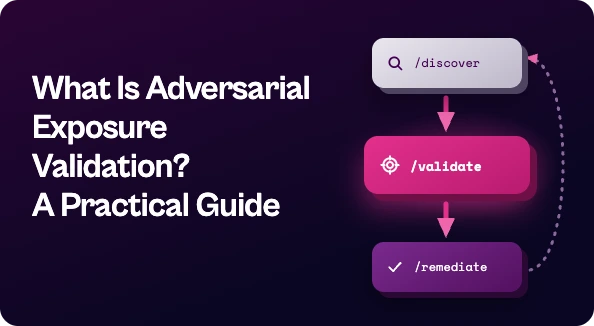
Adversarial exposure validation (AEV) is a category of security tools that safely emulates real attacks to prove whether an exposure can actually be exploited in your environment. Gartner uses the term to cover what used to be two separate markets: breach and attack simulation (BAS) and automated penetration testing. AEV sits in the validation stage of CTEM, and its value depends on what happens after: getting the validated exposures fixed.
Your scanners found 40,000 vulnerabilities last quarter. How many of them could an attacker actually use to get into your environment?
Most teams can’t answer that. Adversarial exposure validation is how you find out.
What is Adversarial Exposure Validation?
Adversarial exposure validation (AEV) means safely running real attack techniques against your own environment to prove which exposures can actually be exploited. It doesn’t stop at “this CVE exists on this host.” It asks whether an attacker can reach that host, get past your controls, and do damage.
Gartner made AEV its own category in its Market Guide, and the 2026 edition came out in March. Gartner describes AEV as technology that gives you consistent, continuous, automated evidence that an attack is feasible. The important part is the word “evidence.” You get proof, not another severity score.
AEV Absorbed Two Older Categories
If AEV sounds familiar, that’s because a lot of it already existed under other names. Gartner’s AEV category brings together two markets that used to be tracked separately:
- Breach and attack simulation (BAS). Runs known adversary techniques against your defenses to see whether your controls detect or block them. If you run BAS today, you already have an AEV capability.
- Automated penetration testing. Chains together weaknesses the way a real attacker would, looking for attack paths through your environment.
Red teaming is related but isn’t the same thing. A red team is people running unscripted, goal-driven attacks. AEV is automated and repeatable. You still need both, but AEV lets you validate constantly between red team engagements instead of once or twice a year.
Where Adversarial Exposure Validation Fits in CTEM
Continuous threat exposure management (CTEM) has five stages: scoping, discovery, prioritization, validation, and mobilization. AEV lives in the validation stage.
That position is what makes it useful. Discovery and prioritization leave you with a long list of things that might matter. Validation cuts that list down to the things that do matter because you’ve shown they’re exploitable. Gartner expects about 60% of organizations to be running structured exposure validation as part of CTEM by 2029.
What AEV is Actually Food For
The 2026 Market Guide groups AEV around three main use cases:
- Tuning your defensive controls. Find out whether your EDR, firewall, and email security actually stop the techniques you think they stop.
- Prioritizing exposures. Move the exploitable findings to the top and stop spending cycles on ones an attacker can’t reach.
- Scaling offensive testing. Get pentest-style coverage without a pentest-sized team. Agentic AI is speeding this up by automating attack scenario creation.
The vendor field is crowded. Pentera, Picus, Cymulate, SafeBreach, BreachLock, and Hadrian all position themselves in the AEV space, each coming from a slightly different starting point (BAS, automated pentesting, or offensive security testing).
Two Ways to Validate an Exposure
Adversarial exposure validation tools prove exploitability by attacking. They emulate real techniques and show you what gets through.
You can also validate by investigating. Look at the finding in its real context and ask: is the vulnerable service actually running? Can anything reach it over the network? Does the application ever call the vulnerable code? Is there a compensating control in place, like EDR, that would stop an exploit?
The two approaches work well together. Attack emulation is great at testing your controls and finding attack paths. Context-based validation is great at getting through thousands of scanner findings quickly and explaining why each one is or isn’t a real risk.
The Part Everyone Skips: What Happens After Validation
Knowing which exposures are real is only half the job. Someone still has to find who owns each asset, open the ticket in the right system, group related findings so engineers don’t get 50 tickets for one root cause, and follow up until the fix ships. That’s the mobilization stage of CTEM, and it’s where a lot of programs stall.
Validation without mobilization is just a nicer report.
Where Seemplicity Fits
Seemplicity handles both validation and mobilization in one flow. Its AI Analysts investigate each finding in your actual environment. The Host Analyst checks runtime configuration, exploit prerequisites, and network reachability. The Code Analyst reads your repositories to confirm whether the vulnerable code can be reached. The SCA Analyst checks whether a dependency is actually used. Each verdict comes with an evidence trail you can audit, so your team can see how the decision was made.
From there, the Agentic Exposure Action Platform does the rest. It pulls in findings from your scanners and other security tools (AEV results included), removes duplicates, assigns owners, and sends the real risks to the teams who can fix them.
If you want to stop triaging by CVSS score and start fixing what’s exploitable, see how Seemplicity’s AI Analysts can help.

Stay updated on Seemplicity blog
Subscribe today to stay informed and get regular updates from Seemplicity.