

/How do I build a business case for ASPM software?
Start with what the current backlog already costs: analyst hours spent on triage, developer time lost to duplicate tickets, slow MTTR, and manual reporting. Then tie each benefit of ASPM software to one of those costs, such as fewer tickets per fix or faster remediation. Compare pricing models on your real numbers, including integration upkeep, and propose a measurable pilot on five to ten high-value applications.
Most AppSec teams don’t need to be sold on ASPM software. They already live with the problem it solves: several scanners, overlapping findings, and a backlog that grows faster than developers can close it. The people who need convincing are the ones holding the budget.
That’s where many requests stall. A pitch built on features (a unified view, risk-based prioritization) asks leadership to buy a capability. A pitch built on cost shows them what the current backlog is already costing, and what changes once it’s under control.
This guide walks through how to build the second kind of case: what to measure, where ASPM software pays off, how pricing typically works, and what to bring to leadership.
What ASPM Software Does (and Doesn’t Replace)
Application security posture management (ASPM) software sits above the scanners you already run. It pulls in findings from SAST, SCA, DAST, IaC, secrets, and API testing tools, removes duplicates, adds context, and routes each issue to the team that owns the fix.
What it doesn’t do is scan. Most ASPM tools don’t replace your testing stack, so the business case shouldn’t promise scanner savings it can’t deliver.
That framing matters for the budget conversation. You’re not asking for another tool that produces findings. You’re asking for something that reduces the work those findings create.
The Cost of Running AppSec Without ASPM Software
The strongest business cases start with the status quo, because that cost is already being paid. It just isn’t on anyone’s budget line. Look for it in four places.
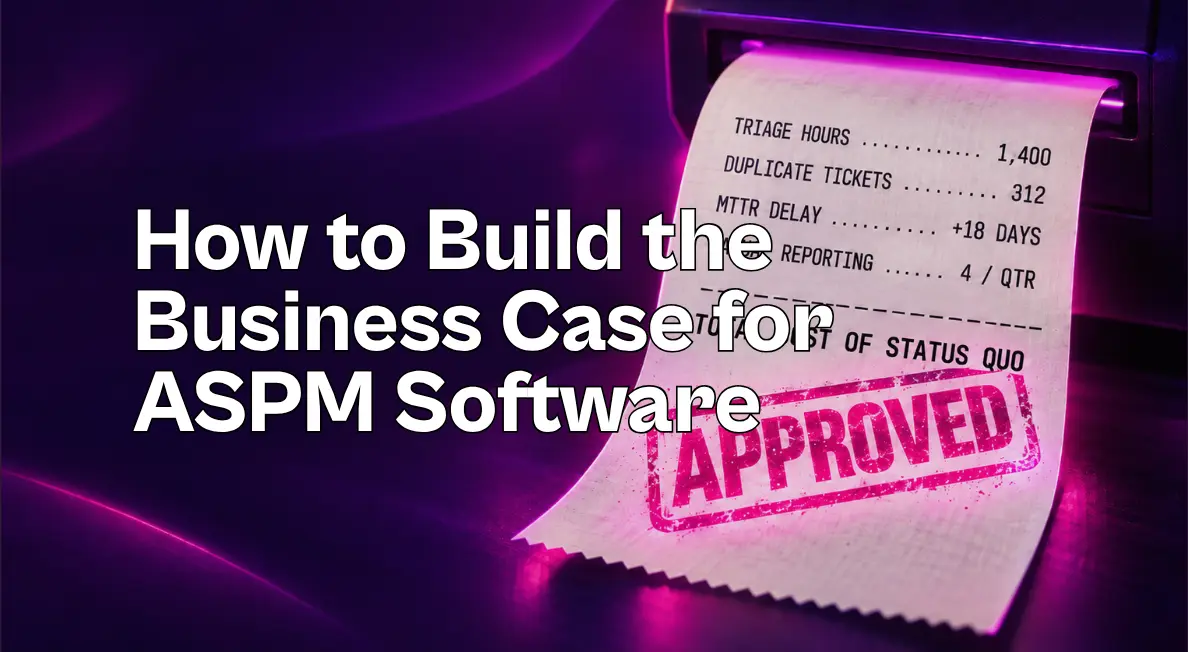
Triage hours. Analysts reconcile findings across consoles, chase duplicates, and decide by hand where each issue goes. That time rarely gets tracked, but it’s easy to estimate. If two analysts each spend a third of their week on triage, that’s roughly 1,400 hours a year spent sorting work rather than reducing risk.
Developer time. One vulnerable library flagged by three scanners across 20 repositories can turn into dozens of tickets for a single upgrade. Every duplicate costs a developer time to read, investigate, and close, and it erodes their trust in what security sends next.
Exposure time. When findings sit in a queue waiting to be sorted or assigned, mean time to remediate (MTTR) stretches. Every extra day is a day an exploitable issue stays open in production.
Reporting overhead. Board updates and audits that require exporting from several tools and reconciling the results by hand add up quickly, especially when they happen every quarter.
Where ASPM Software Pays Off
Each of those costs maps to a return you can measure. Tie every claim in the case to one of them.
- Fewer tickets per real issue. Grouping findings by the fix that resolves them turns dozens of tickets into one remediation task. Track tickets created per unique fix before and after.
- Less time on triage. Context-driven vulnerability prioritization filters out findings that aren’t reachable or internet-facing before they reach anyone’s queue. Confirming exploitability up front means analysts review a short list instead of the full backlog.
- Faster MTTR. Automatic routing to code owners removes the wait between detection and assignment, which is often where findings lose the most time.
- A clearer view of your scanner stack. Seeing every tool’s output side by side shows where coverage overlaps. That can inform renewal decisions, but treat it as upside, not the core of the case.
- Reporting without the spreadsheet. MTTR, SLA adherence, and backlog trends by team and application come out of the platform, so audit prep stops being a project.
How ASPM Software Is Typically Priced
Most ASPM software is sold as an annual subscription. Vendors usually price on one of three units:
- Per application: cost scales with the number of apps or services under management.
- Per contributing developer: cost scales with the engineers committing code, common with vendors that started in AppSec testing.
- Per asset: cost scales with repositories, images, or other monitored assets.
The right model depends on your shape. A small team running many microservices may pay less per developer, while a large engineering org with a few core apps may prefer per-application pricing. Ask each vendor to quote on your real numbers, not a sample tier.
Factor in the costs that don’t appear on the quote, too. Integrations need maintaining as scanners and ticketing tools change. Open source options such as DefectDojo carry no license fee, but someone on your team will own the setup, custom integrations, and upkeep. Count those hours in the comparison.
What to Bring to Leadership
A business case lands when it’s short, specific, and easy to check later. Bring four things.
- A baseline. Open findings across all tools, MTTR by severity, SLA adherence, and an estimate of weekly triage hours. If you can’t produce a single open-findings number without a spreadsheet, say so. That gap is part of the case.
- Projected outcomes against that baseline. Use the same metrics, with realistic targets for the first two quarters. Conservative numbers you hit beat ambitious ones you miss.
- A scoped pilot. Start with five to ten high-value applications, define what success looks like before it begins, and set a date to review results.
- A version for engineering. Engineering leads care less about posture scores and more about interruptions. Show them fewer tickets, clearer fix guidance, and work that arrives in Jira rather than another console. Their support often decides whether the purchase sticks.
Where Seemplicity Fits
Seemplicity is built to make the numbers in that case move, and to prove it afterward.
- No rip and replace. Seemplicity is vendor-agnostic and works with the AppSec scanners you already pay for, such as Checkmarx, Snyk, and Veracode.
- Fewer tickets, less triage. Findings are deduplicated and grouped by fix, and Seemplicity’s AI Analysts, including the Code Analyst and SCA Analyst, confirm whether vulnerable code and dependencies are reachable before work reaches developers.
- ROI you can report. MTTR, SLA adherence, and risk reduction by team and application are tracked automatically, with bi-directional Jira and ServiceNow sync keeping status accurate.
- One platform to fund. Application findings sit alongside cloud and infrastructure exposures, so AppSec becomes part of a broader exposure management program rather than another budget line.
Put a Number on the Backlog
Leadership rarely says no to reducing risk. They say no to vague requests. The case for ASPM software gets approved when it shows, in hours and days, what the current backlog already costs and how the investment will bring those numbers down.
Baseline the cost, tie each benefit to a metric, and start with a pilot you can measure. Get that right, and ASPM becomes a funded part of your application security program, not a line item that gets cut next year.
See how Seemplicity turns AppSec findings into shipped fixes. Book a demo.

Stay updated on Seemplicity blog
Subscribe today to stay informed and get regular updates from Seemplicity.