

/how do you build reliable ai agents for cybersecurity
Building reliable AI agents for cybersecurity requires more than powerful language models. It involves solving three interconnected engineering challenges: scalability, trust, and safe execution. By combining frontier models with cost-efficient alternatives, caching, and prompt optimization, organizations can make large-scale security investigations economically sustainable. Specialized agents, structured outputs, and evidence-based reasoning help ensure accurate, auditable conclusions while acknowledging uncertainty. Translating those conclusions into action requires responses that account for organizational policies, operational impact, and business continuity, with verification that the exposure has actually been reduced. Together, these principles make autonomous exposure response practical, reliable, and scalable.
Building an AI agent that can analyze a vulnerability is one thing. Building one that can do it reliably, accurately, and economically across a large organization is an entirely different engineering challenge.
The amount of software being generated is increasing due to usage of coding agents. As a result, vulnerability volumes continue to grow rapidly, while the window between disclosure and exploitation keeps shrinking. Security teams are under increasing pressure to respond faster, The window to respond has effectively closed. Google’s M-Trends 2026 report puts the mean time-to-exploit at an estimated minus seven days. Exploitation now routinely happens before a patch exists. But speed alone isn’t enough. Before committing resources to remediation, security teams need to identify which vulnerabilities demand immediate attention, understand their actual exploitability and potential impact, determine the right owner, and select a response that is both safe and effective.
At the same time, autonomous AI agents are becoming increasingly capable. Those systems that can investigate complex security problems, make informed decisions, and take action.
That shift raises the stakes considerably.
When an AI system is evaluating exploitability or influencing a remediation decision, an inaccurate answer can have operational consequences. Equally, if the cost of running these agents is too high or unpredictable, even the most accurate AI system becomes impractical to deploy at scale.
The challenge, then, isn’t simply making an AI Analyst. It’s engineering one that can be trusted to operate in the real world.
At Seemplicity, building AI Response Analysts capable of moving from investigation to action has meant tackling three interconnected engineering challenges: operating at scale, producing trustworthy conclusions, and translating those conclusions into safe, effective responses..
1. Scale: Running Frontier AI Models Without Breaking the Economics
One of the first challenges in building AI-powered security analysis is surprisingly practical: how do you make the economics work?
Enterprise security environments can generate enormous amounts of findings, each potentially requiring investigation into exploitability, reachability, environmental context, and available remediation options.
Doing that well requires sophisticated reasoning. Frontier AI models are particularly valuable when an investigation involves ambiguous evidence, multiple dependencies, or complex decisions that can’t be resolved through straightforward rules.
But running the most capable, expensive model on every finding, at every stage of every investigation, quickly becomes unsustainable – in terms of time and tokens. And simply switching to cheaper models isn’t a satisfactory solution if it compromises the quality of security decisions.
Cost predictability is equally important. The number of tokens an AI agent consumes can vary significantly between investigations, depending on the complexity of the finding, the evidence it needs to collect, and the reasoning required to reach a conclusion. When operating across thousands of findings, organizations need to be able to estimate the cost of an investigation before it runs, rather than discovering it after the fact. Making AI-powered security analysis economically viable at scale therefore requires not only reducing costs, but also making them predictable.
The challenge is to preserve high quality results while keeping costs both manageable and predictable, using sophisticated reasoning where it’s needed without paying for it where it isn’t. We’ve approached this through several architectural decisions.
Match model capability to task complexity
Not every step of a security investigation requires the same level of intelligence. Some tasks involve structured information extraction or straightforward analysis. Others require interpreting conflicting signals, reasoning through complex dependencies, or making nuanced judgments about exploitability.
Rather than treating every task equally, we reserve frontier models for the decisions that benefit most from their reasoning capabilities, while using more cost-efficient models for less demanding operations. This allows us to allocate computational resources based on the complexity of the problem, rather than the volume of findings alone.
Don’t pay twice for the same research
Security investigations frequently involve overlapping information. Multiple findings may require the same contextual research, and repeated investigations may encounter identical inputs.
When an agent’s inputs are fully known, we can cache its results and reuse them when those same inputs appear again. This sounds straightforward, but it introduces an important engineering consideration: knowing when a result is genuinely reusable and when it stops being relevant.
For example, when the same CVE is identified across hundreds of machines, the underlying exploitation mechanism and the conditions required for exploitation can be researched once by an agent. That research can then be cached and reused by each agent assessing exploitability on an individual machine. Rather than repeating the same vulnerability research hundreds of times, each agent can focus on determining whether those conditions are present in its specific environment.
Caching is valuable only when the underlying conditions support it. Reusing an answer that depends on changed environmental context could introduce exactly the kind of inaccuracy we’re trying to avoid. The objective isn’t to cache everything. It’s to identify where reuse is both safe and economically valuable.
Treat prompt design as an infrastructure decision
Prompt engineering is often discussed in terms of improving the quality of AI responses. But at scale, prompt structure also has a direct impact on cost.
With prompt caching, the way information is organized within a prompt determines how much computation can be reused across calls. By carefully structuring prompts to maximize reusable content, we can reduce unnecessary processing without changing the underlying analytical objective.
These optimizations may seem incremental in isolation. Across thousands of findings and multiple stages of investigation, however, their cumulative impact becomes significant.
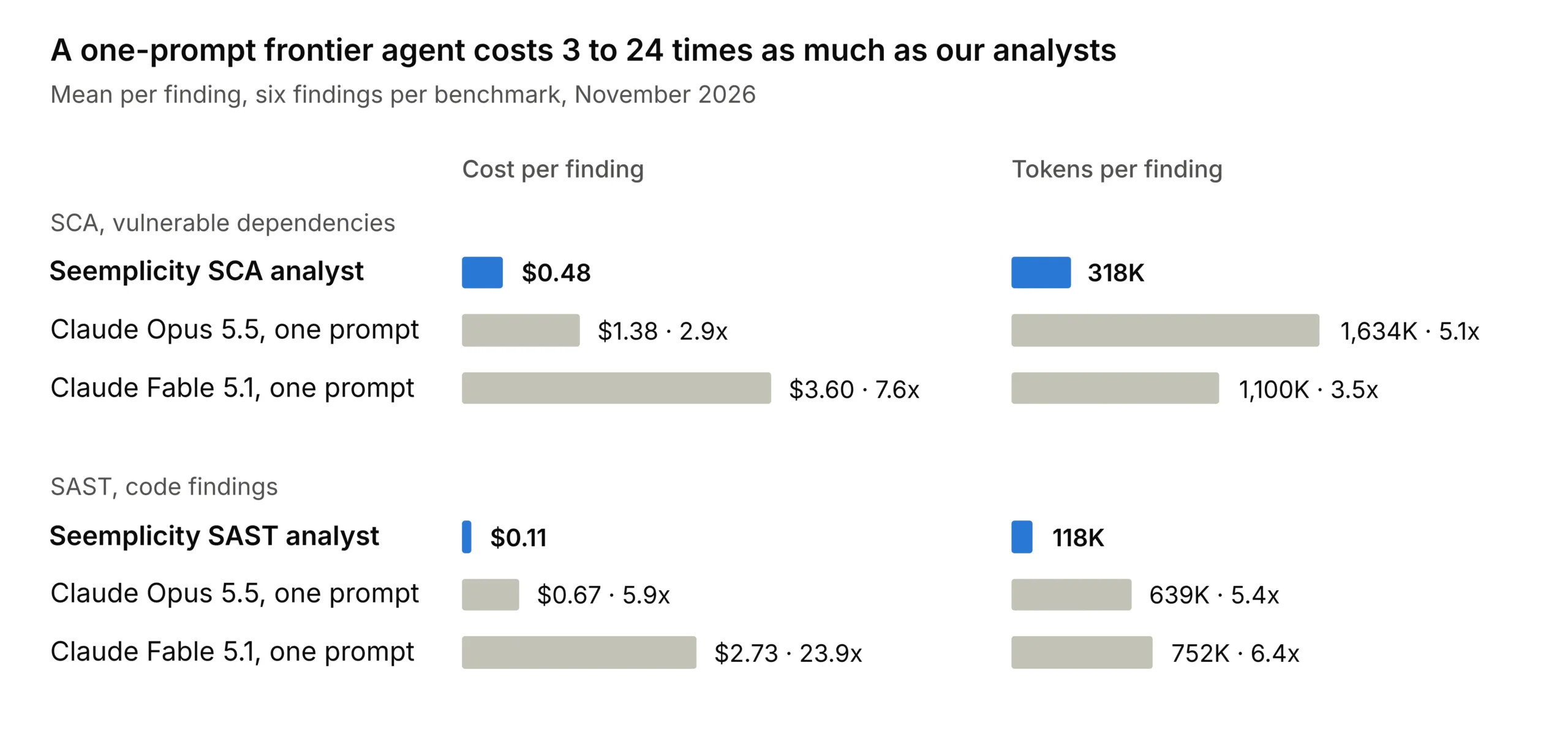
In two internal benchmarks conducted in November 2026, our SAST and SCA AI Analysts investigated findings at an average cost of $0.11 and $0.48, respectively. Frontier coding agents given the same findings and access to the same resources cost between 2.9 and 23.9 times as much. In the SCA benchmark, one frontier agent was actually cheaper per token but consumed 5.1 times as many tokens. This illustrates why the economics of AI agents depend as much on how the system is engineered as on which models it uses.
The broader lesson is that AI scalability isn’t just about choosing the right model. It’s about designing an architecture that uses intelligence efficiently.
2. Trust: Why a Security AI Analyst Can’t Just Be a Chatbot
Large language models are remarkably good at producing convincing explanations. Unfortunately, producing a convincing explanation and reaching a correct conclusion are two very different things. In security, that distinction matters enormously.
Consider an AI Analyst assessing whether a vulnerability is exploitable in a particular environment. A general-purpose model might recognize the CVE, understand the affected technology, and produce a plausible assessment based on its knowledge of the vulnerability. But that doesn’t mean it has established whether the vulnerable component is actually present, reachable, or exploitable in that specific environment, with that specific configuration. A confident conclusion built on assumptions is not a reliable security assessment.
When building our AI Analysts, one of the most important lessons was that the system needs to be as good at recognizing what it doesn’t know as it is at finding answers. That requires a fundamentally different approach from a conventional chatbot.
Break complex investigations into specialized tasks
Rather than relying on a single general-purpose agent to investigate a finding and produce a final verdict, we divide the investigation into narrower tasks handled by specialized agents. Each agent has a defined responsibility and is required to return its conclusions in a fixed, structured format. This makes the investigation easier to inspect, validate, debug and, later on, evaluate any drifts of any step.
Instead of receiving a single free-form explanation, we can examine individual components of the analysis and understand how they contribute to the overall conclusion. It also helps us identify where something went wrong. If an assessment is incorrect, we need to know whether the issue originated in evidence collection, interpretation, or the reasoning that connected the two.
Evidence must come before conclusions
A security analyst shouldn’t declare something exploitable simply because the vulnerability description suggests that it might be. The conclusion needs to be grounded in evidence the system actually collected. That evidence might include a dependency tree demonstrating where an affected library is used, a relevant code path, or information about the environment in which the vulnerable component exists and is running.
The important distinction is between what the model can infer from general knowledge and what the investigation has actually established. Our approach requires the analyst to support its conclusions with collected evidence, making the reasoning behind a verdict auditable rather than asking users to accept it at face value.
“Unknown” is a valid answer
This was one of the most important design principles we had to reinforce. AI models are naturally inclined to provide an answer, even when the available information is incomplete. In our experience, confident guesses were among the most common failure modes we encountered.
But in security analysis, uncertainty isn’t necessarily a failure. If the available evidence doesn’t establish whether a vulnerability is exploitable, the correct outcome may be “unknown.” That’s preferable to manufacturing certainty that could lead a security team to dismiss a real risk or spend valuable resources addressing the wrong problem.
Teaching an AI Analyst to acknowledge the limits of its evidence is essential to making its conclusions trustworthy. And as AI moves beyond investigation into recommending or executing responses, that discipline becomes even more important.
3. From Analysis to Action: Engineering AI That Can Safely Respond
Determining whether a vulnerability is exploitable is an important step. But even a perfectly accurate assessment doesn’t reduce the exposure on its own.
The next challenge is turning that intelligence into action.
And this is where the engineering requirements change significantly. An AI Analyst that produces an incorrect assessment can misdirect security teams. An AI Analyst that executes an inappropriate change can directly affect production systems.
Moving from analysis to action requires more than intelligent decision-making. It requires an architecture that can translate those decisions into safe, controlled, and verifiable responses.
The right response isn’t always the obvious one
Patching may be the most complete way to address a vulnerability, but it isn’t necessarily the fastest or safest immediate response.
A configuration change might eliminate the attack path. A compensating control might reduce exposure while a permanent fix is prepared. And in some cases, full remediation may be the most appropriate option from the outset.
The same vulnerability can be mitigated by different responses depending on the environment, affected assets, available controls, and potential operational impact.
The AI Analysts evaluate all different available options together with the organization’s safety and risk policies, and determine which approach best addresses the actual risk.
The objective isn’t simply to recommend a technically valid fix. It’s to identify a response that meaningfully reduces exposure while accounting for the realities of the environment and business continuity, taking into account update cycles and rollback options.
For example, in the recent Java4Shell vulnerability (CVE-2026-114938), some will choose to update their Java runtime, while others will opt for a faster or lower-risk change, such as disabling the Base64 intrinsics or AVX-512 in the JVM, or settle for partial coverage from IPS/WAF rules.
Execution isn’t the finish line
Even when an AI Analyst selects and executes the appropriate response, there’s one more question to answer: did it actually work?
Successfully applying a configuration change or completing a remediation task doesn’t necessarily mean the intended security outcome has been achieved.
The response needs to be verified against the original exposure, with evidence that demonstrates what changed and whether the risk was addressed.
That distinction matters because the objective isn’t to automate security tasks for their own sake. It’s to reduce exposure.
Production-Ready AI Requires More Than Intelligence
The move toward autonomous exposure response represents an important shift in how security teams can operate. For years, much of the industry’s investment has focused on discovering vulnerabilities, consolidating findings, and determining which risks deserve attention first.
Those capabilities remain essential. But prioritization alone doesn’t solve the response problem. As exploitation windows continue to shrink, security teams need to respond at machine speed. AI creates an opportunity to go further: investigating exposures, validating exploitability, determining appropriate responses, and turning security decisions into action.
Realizing that opportunity takes more than access to increasingly capable models. It requires an architecture that can apply sophisticated intelligence economically across millions of findings. It requires evidence-based reasoning, transparent outputs, and the ability to acknowledge uncertainty. And it requires a rigorous evaluation process that continuously tests whether the system is delivering better results.
These aren’t three separate engineering concerns. They’re interconnected requirements for making AI-powered exposure response practical.
As AI becomes more deeply integrated into security operations, the differentiator won’t simply be who can produce the most impressive AI-generated answer. It will be who can turn that intelligence into reliable, repeatable action.

Stay updated on Seemplicity blog
Subscribe today to stay informed and get regular updates from Seemplicity.