/TL;DR
Modern exposure management has evolved beyond vulnerability scanning and alert volume into a discipline focused on measurable risk reduction. As the exposure management market matures, security leaders are adopting cyber exposure management platforms that unify signals across vulnerability, cloud, application, and attack surface tools to prioritize what truly matters. This blog explores how exposure management cybersecurity is shifting toward outcomes-driven decision-making, faster remediation, and clearer business alignment, helping organizations move from fragmented findings to effective exposure and risk management.
When people search for “the PHP vulnerability” right now, they usually mean one of two things: PHP2Shell, a pair of critical flaws patched on October 21, 2026, or the batch of seven critical flaws PHP fixed on November 19. Both affect PHP itself, not a single framework or plugin, which is why the blast radius is so large.
PHP runs a huge share of the web, from WordPress and Drupal sites to internal tools and the admin panels of network appliances. When the engine underneath all of that has a flaw, every application built on it inherits the risk. Most of these flaws can lead to remote code execution, meaning an attacker could run their own code on your web server.
PHP2Shell is already being exploited in the wild, so this isn’t a theoretical exercise.
PHP2Shell: Where It Started
PHP2Shell is the name given to two CVEs, CVE-2026-109618 and CVE-2026-109619. Both are rated 9.2 (Critical) under CVSS 4.0 and allow unauthenticated remote code execution.
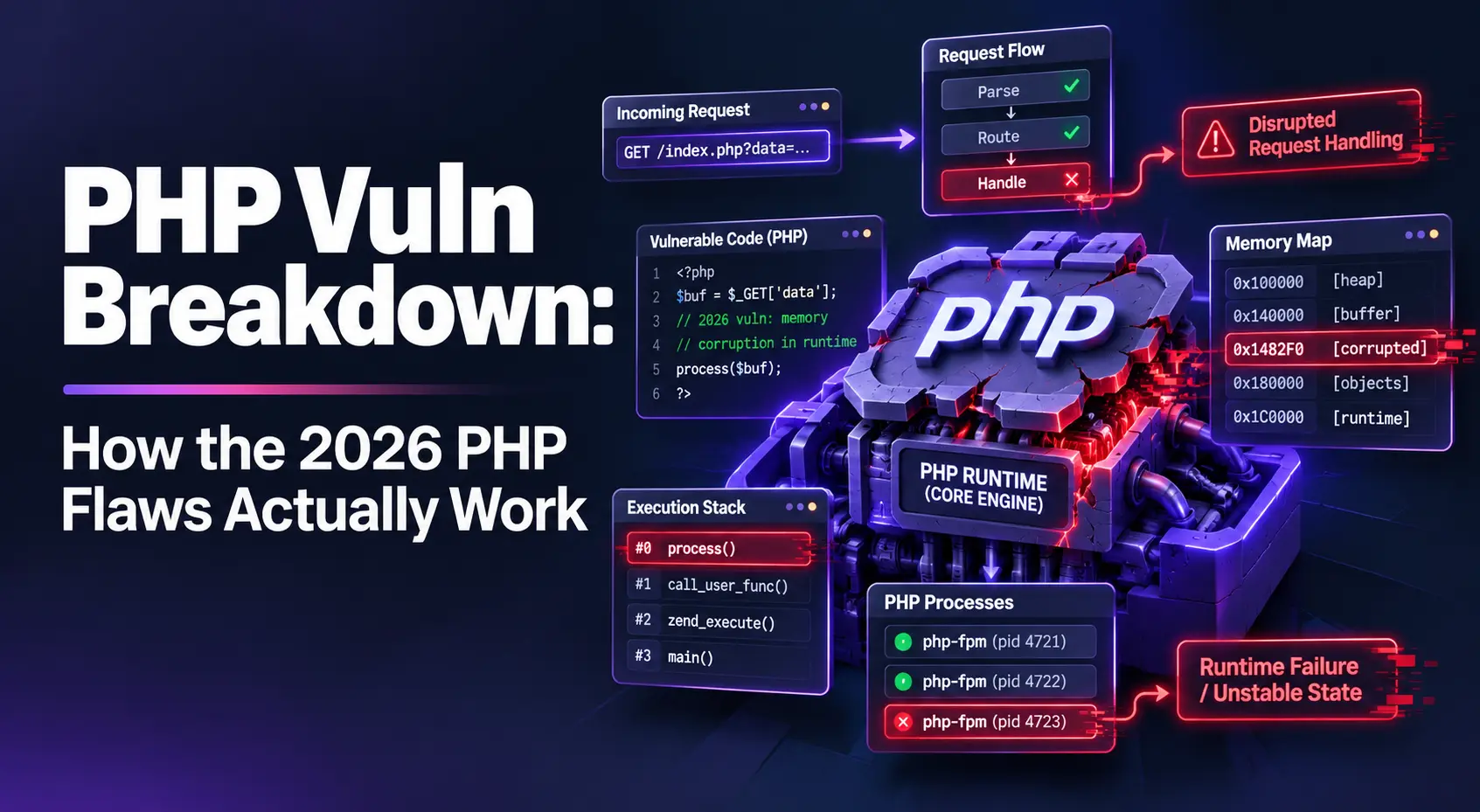
Both bugs come from how PHP cleans up after a request fails badly. CVE-2026-109618 is triggered by out-of-memory errors that leave request memory uninitialized. CVE-2026-109619 leaves global state pointing at memory that has already been freed, which a later request can then read or act on.
What made PHP2Shell especially dangerous was the timeline:
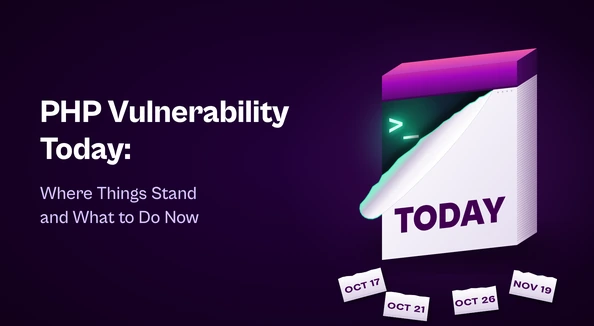
- October 17: Amazon Threat Intelligence observed an exploitation attempt, four days before the flaws were public.
- October 21: Technical details and proof-of-concept exploits leaked hours before PHP shipped patches in 8.5.12, 8.4.27, 8.3.36 and 8.2.35.
- October 26: CISA added both flaws to its Known Exploited Vulnerabilities catalog, confirming active exploitation.
The vulnerable code dates back to PHP 5.4, released in 2012. That means a decade of PHP versions is affected, including many that no longer receive updates.
The November 19 Security Release
Less than a month later, on November 19, PHP shipped a larger security release across every supported branch. It fixed seven critical vulnerabilities, all rated 9.2, plus a high-severity local privilege escalation flaw and several medium-severity bugs. Full details are in PHP’s security advisories.
| CVE | Where the flaw is | Possible impact | Branches affected |
|---|---|---|---|
| CVE-2026-129289 | PHP-FPM / LSAPI request handling (request smuggling) | Attacker-controlled PHP code execution | 8.2–8.5 |
| CVE-2026-115560 | Session upload progress | Remote code execution, session corruption, denial of service | 8.2–8.5 |
| CVE-2026-126714 (“phpAfterShell”) | File-based session handling | Code execution as the PHP worker | 8.2–8.5 |
| CVE-2026-129496 | Date extension timezone cache | Worker crash or code execution | 8.2–8.5 |
| CVE-2026-129481 | Session cleanup | Memory corruption, possible remote code execution | 8.3–8.5 |
| CVE-2026-129182 | Memory handling (use-after-free) | Memory corruption, possible remote code execution | 8.5 |
| CVE-2026-129474 | Memory handling (use-after-free) | Remote code execution | 8.5 |
The important nuance is that each flaw has its own preconditions. CVE-2026-129289, for example, only applies when the web server keeps FastCGI connections open between requests, such as nginx with fastcgi_keep_conn on. CVE-2026-126714 needs file-based sessions, which happen to be PHP’s default. A server can be exposed to one of these flaws and not another, but the fix for all of them is the same release.
Who Is Affected
If you run PHP to serve web requests, assume you’re in scope until you’ve checked. That includes PHP-FPM, Apache with mod_php, php-cgi, FrankenPHP and LiteSpeed.
The less obvious exposure is where teams get caught out:
- End-of-life PHP versions. PHP2Shell reaches back to 5.4, but official patches only cover supported branches. Anything older stays vulnerable unless you upgrade or use a commercial extended-support build.
- Third-party software. CMSs, ecommerce platforms and SaaS tools you host yourself often bundle their own PHP runtime.
- Appliances and embedded systems. Firewalls, VPN gateways and admin consoles frequently run PHP under the hood. Researchers have already seen attackers chain a PHP2Shell exploit with a Linux kernel flaw to get root on perimeter firewalls.
- Containers and old images. A patched host doesn’t help if your base images still pull a vulnerable PHP version.
In practice, your PHP exposure is a slice of your wider attack surface that many teams have never mapped on its own.
How to Fix It
- Upgrade to the latest release. Move to PHP 8.5.13, 8.4.28, 8.3.37 or 8.2.36 (or 8.6.0). These include the PHP2Shell fixes from October, so one upgrade covers both waves.
- Restart PHP after upgrading. Long-running PHP-FPM or Apache workers keep the old code in memory until they restart. Restart the master process and its workers, not just the web server.
- Apply interim mitigations where you can’t patch yet. Setting session.upload_progress.enabled = 0 blocks several of the session-based attack paths. A web application firewall with updated rules can add a layer of protection, but it doesn’t replace the patch.
- Find every PHP runtime you own. Check servers, containers, base images, vendor-managed systems and appliances. An up-to-date asset inventory makes this hours of work instead of weeks.
- Look for signs of compromise. PHP2Shell was exploited before patches existed. On internet-facing servers, check for unfamiliar PHP files (webshells), unexpected worker crashes and unusual outbound connections.
Patch First, Then Find What You Missed
The PHP vulnerability wave isn’t a single bug with a single fix date. It’s a run of critical flaws in a runtime that sits under a large part of your estate, with active exploitation already confirmed and follow-on advisories still appearing.
Patching your known PHP servers is the urgent first step. The harder part is everything else: the forgotten app server, the vendor appliance, the container image nobody has rebuilt. Good vulnerability prioritization puts internet-facing, exploitable PHP instances at the top of the list, and disciplined vulnerability remediation makes sure each one is actually fixed, restarted and verified, not just ticketed.

Stay updated on Seemplicity blog
Subscribe today to stay informed and get regular updates from Seemplicity.