/TL;DR
Modern exposure management has evolved beyond vulnerability scanning and alert volume into a discipline focused on measurable risk reduction. As the exposure management market matures, security leaders are adopting cyber exposure management platforms that unify signals across vulnerability, cloud, application, and attack surface tools to prioritize what truly matters. This blog explores how exposure management cybersecurity is shifting toward outcomes-driven decision-making, faster remediation, and clearer business alignment, helping organizations move from fragmented findings to effective exposure and risk management.
When security teams talk about “the PHP vuln” right now, they mean a cluster of flaws in PHP’s core engine disclosed in late 2026. The headline is PHP2Shell (CVE-2026-109618 and CVE-2026-109619), patched on October 21 and actively exploited. It was followed by seven more critical flaws fixed on November 19.
What makes them serious is where they live. These aren’t bugs in a plugin or framework. They’re in the PHP runtime itself, so every application running on a vulnerable version is exposed, whatever it’s built with.
The status today is straightforward. PHP2Shell is in CISA’s Known Exploited Vulnerabilities catalog, and patches exist for every flaw covered here. For the full overview of the PHP vulnerability and its timeline, see our main guide. This post explains how the flaws actually work.
How PHP2Shell Works
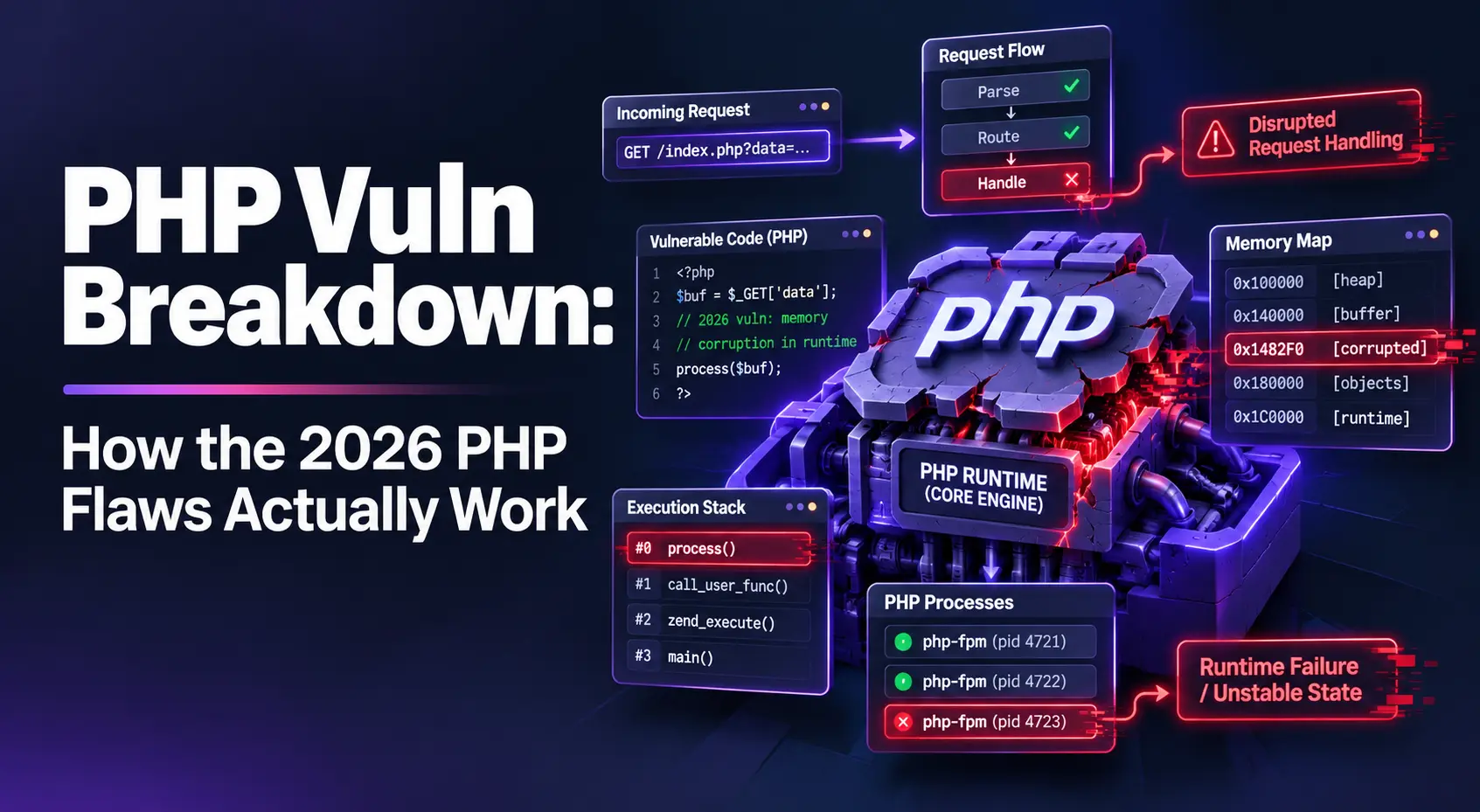
Both PHP2Shell flaws come from the same place: what PHP does when a request fails badly. When PHP hits an out-of-memory condition or a fatal error, it jumps straight to its cleanup code (using a mechanism called longjmp) instead of unwinding normally. That cleanup assumes everything is in a consistent state. Sometimes it isn’t.
- CVE-2026-109618 (out-of-memory bailout). An attacker sends a request designed to make PHP run out of memory at a precise point. PHP bails out and leaves part of the request’s memory uninitialized, and that leftover data can later be treated as valid.
- CVE-2026-109619 (stale global state). PHP keeps a few pieces of global state, such as the session ID and, in PHP 8.5, the fatal-error backtrace, that briefly point into per-request memory. If a fatal error hits at the wrong moment, those pointers outlive the memory they reference. A later request can then read or act on freed memory.
Either condition gives an attacker a memory-corruption primitive. By carefully shaping requests, often through PHP’s session upload progress feature, attackers can turn that into unauthenticated RCE, running their own code with the web server’s privileges.
The vulnerable code dates back to PHP 5.4, released in 2012. That’s why the exposure is so wide, and why session.upload_progress.enabled = 0 became the go-to mitigation while teams patched.
How the November PHP Vulns Work
The November 19 release came largely out of researchers digging into the PHP2Shell fix. Its seven critical flaws work in different ways, but most share one trait: they only bite under specific conditions.
phpAfterShell (CVE-2026-126714). PHP’s default file-based session handler doesn’t write session files atomically. If a session write is interrupted partway through, the file can end up with the start of the new session and the tail of the old one. With carefully chosen data, an attacker can make PHP read leftover bytes as serialized objects the next time the session loads. Chained with a suitable deserialization gadget, that becomes code execution.
Request smuggling in PHP-FPM (CVE-2026-129289). When a web server keeps FastCGI connections to PHP-FPM open between requests, and the app opens php://input without reading it fully, PHP can misjudge where one request ends and the next begins. An attacker can then slip in a forged request and run their own PHP code.
Memory and session bugs. The rest are memory-safety and session-handling flaws: a session serializer mismatch in upload progress handling (CVE-2026-115560), use-after-free bugs in session cleanup (CVE-2026-129481), the date extension’s timezone cache (CVE-2026-129496) and magic method backtraces (CVE-2026-129474), plus a further PHP 8.5 use-after-free (CVE-2026-129182).
| Flaw | Key precondition |
|---|---|
| CVE-2026-126714 | File-based sessions (the default) and an interrupted session write |
| CVE-2026-129289 | Persistent FastCGI connections, e.g. nginx fastcgi_keep_conn on or Apache enablereuse=on |
| CVE-2026-115560 | Session upload progress on, plus mismatched session serializers |
| CVE-2026-129496 | A startup warning written to a file-based error log, in a non-thread-safe build |
| CVE-2026-129474 | PHP 8.5, with a reachable magic method and a fatal error at the right point |
Those preconditions are why vulnerability exploitability varies so much between servers. Two machines on the same PHP version can have very different real-world risk.
Are You Exposed? A Quick Check
You don’t need a full audit to know whether this PHP vuln affects you. Three checks will tell you most of what you need.
- Version. Anything older than 8.5.13, 8.4.28, 8.3.37 or 8.2.36 is exposed to at least one of the critical flaws. PHP 8.1 and earlier are end-of-life and stay vulnerable to PHP2Shell unless you upgrade or use an extended-support build. Remember that distro packages may carry backported fixes under an older version number.
- Configuration. Check whether you use file-based sessions (session.save_handler = files), whether session upload progress is on (it is by default), and whether your web server keeps persistent FastCGI connections to PHP-FPM. Each one opens a specific path from the table above.
- Exposure. Internet-facing servers come first, especially admin panels and appliances. PHP2Shell is already being used against firewall and VPN management interfaces.
If you can’t answer the first question quickly, your asset inventory is missing PHP runtimes. Containers, vendor appliances and bundled apps are the usual blind spots.
Closing the PHP Vuln Gap
Understanding how these flaws work is useful, but the fix doesn’t depend on it. Every flaw above is closed by the same upgrade.
- Patch. Move to PHP 8.5.13, 8.4.28, 8.3.37, 8.2.36 or 8.6.0. These releases include the October PHP2Shell fixes too.
- Restart. Restart PHP-FPM or Apache so the workers load the patched code. Until they do, the old version is still running.
- Verify. Confirm the version your web server is actually using, then rescan.
- Mitigate where you can’t patch yet. Disable session upload progress and persistent FastCGI connections. This kind of vulnerability mitigation narrows the attack paths but doesn’t replace the upgrade.
The deeper lesson from this PHP vuln is about speed. PHP2Shell was exploited before its patch existed, so vulnerability remediation for runtime flaws like this needs to be measured in days, starting with whatever is exposed to the internet.

Stay updated on Seemplicity blog
Subscribe today to stay informed and get regular updates from Seemplicity.