

/how do you respond to an RCE vulnerability?
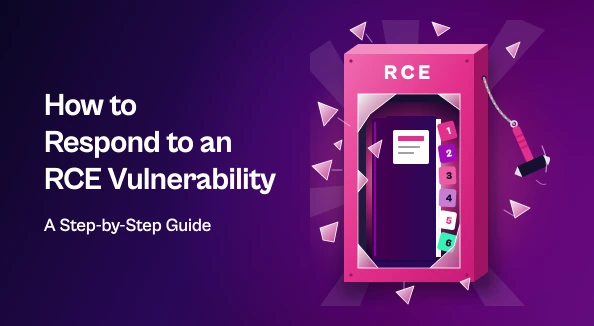
Responding to an RCE vulnerability takes six steps. First, confirm you’re affected by checking deployed versions and transitive dependencies. Second, triage by real-world risk: exploit availability, active exploitation, reachability and business criticality. Third, contain exposed systems with workarounds, WAF rules, network restrictions and compensating controls until you can patch. Fourth, remediate by patching, rebuilding container images and upgrading libraries, with every fix assigned to an owner. Fifth, check for signs of compromise from before the patch. Sixth, verify the fix landed everywhere before removing temporary mitigations. The teams that respond fastest already know what they run and who owns it.
A remote code execution vulnerability lets an attacker run their own code on a target system over a network, often without credentials or user interaction. When a critical one is disclosed in software you run, the clock starts right away.
This guide walks through how to respond to an RCE vulnerability, from confirming you’re affected to verifying the fix is in place everywhere.
Why RCE Response Needs a Playbook
For high-profile RCEs, the gap between public disclosure and the first exploitation attempts can be measured in hours. With Log4Shell, mass scanning began almost as soon as the details went public.
Without a defined process, those first hours go to questions that should already have answers. Which systems run the affected software? Who owns them? Who can approve an emergency change?
Response also means more than patching. A complete response covers scoping, containment, remediation, and checking whether anyone got in before you closed the door.
Step 1: Confirm Whether You’re Affected
Start by matching the advisory against your asset inventory and dependency data.
- Check transitive dependencies. Vulnerable libraries often sit several layers deep, inside a dependency of a dependency that no one on the team chose directly.
- Confirm what’s actually deployed. A manifest may list a vulnerable version that never ships, while a container image built months ago may run an older version than the repository suggests.
- Flag internet-facing systems. Anything exposed on your external attack surface goes to the front of the queue.
The output of this step should be a list of affected assets, each with a named owner.
Step 2: Triage by Real-World Risk
Not every affected asset needs the same urgency. A CVSS score tells you how bad an RCE could be, not how likely it is to be exploited in your environment.
The signals that matter most:
- Public exploit code or a working proof of concept
- Evidence of active exploitation, including a listing in the CISA Known Exploited Vulnerabilities catalog
- Reachability, meaning whether the vulnerable code path is actually called and exposed
- Business criticality of the affected system and the data it can reach
Weighing exploitability and exposure together is the core of effective vulnerability prioritization. An exposed, exploitable RCE on a production server outranks a theoretical one on an isolated test box, whatever their scores say.
Step 3: Contain Before You Can Patch
Patches aren’t always available on day one, and even when they are, rolling them out across production takes time. Containment buys you that time.
- Apply vendor workarounds, such as a configuration change that disables the vulnerable feature.
- Add WAF or IPS rules to block known exploit patterns. Attackers often find ways around signature-based rules, so treat these as a stopgap.
- Restrict network access by taking the service off the internet or limiting it to known IP ranges.
- Lean on compensating controls like EDR and network segmentation to limit what an attacker could do with a foothold.
Document every temporary change as you make it. You’ll need that list to roll them back later.
Step 4: Remediate
With the most exposed assets contained, move to permanent fixes.
- Patch or upgrade, starting with internet-facing and business-critical systems.
- Rebuild container images from an updated base and redeploy them. Patching a running container doesn’t survive a restart.
- Upgrade vulnerable libraries and redeploy the applications that use them. If the fixed version changes the library’s API, budget time for code changes.
- Assign every fix to an owner with a deadline. Fixes without a clear owner are the ones that stall.
Step 5: Check for Signs of Compromise
If the vulnerability was exploitable before you patched it, patching won’t remove an attacker who already got in.
- Review logs for exploitation attempts, going back to before the disclosure date in case the flaw was exploited as a zero-day.
- Look for web shells, new accounts, unexpected processes or scheduled tasks, and unusual outbound connections.
- If you find evidence of compromise, escalate to incident response. At that point, it’s no longer just a vulnerability ticket.
Step 6: Verify and Close Out
A fix isn’t done until you’ve confirmed it.
- Rescan affected assets to confirm the fix landed everywhere. Partial rollouts are common, especially across large or fast-changing environments.
- Remove temporary mitigations only after the permanent fix is verified.
- Capture lessons learned. Where did your inventory fall short? How long did it take to find owners? What slowed down approvals? Each answer makes the next response faster.
How Seemplicity Fits In
A new RCE in a widely used library can show up as hundreds of separate findings across SCA, container, cloud, and infrastructure scanners. Seemplicity consolidates and deduplicates those findings into one view, so scoping your exposure takes minutes rather than days.
From there, Seemplicity prioritizes affected assets by exploitability, exposure, and business context, and supports mitigation alongside patching when a fix isn’t immediately possible. It routes each fix to the right owner and tracks it through to verified vulnerability remediation.
Fast RCE Response Starts Before the Disclosure
The teams that respond fastest to an RCE vulnerability aren’t improvising. They already know what they run, who owns it, and how emergency fixes get approved.
Every new RCE is a test of that process. Treat each one as a chance to find the gaps and close them before the next one lands.

Stay updated on Seemplicity blog
Subscribe today to stay informed and get regular updates from Seemplicity.