



/What is CTEM as a service?
CTEM as a service is a managed offering where a security provider runs some or all of the five stages of Continuous Threat Exposure Management (scoping, discovery, prioritization, validation, and mobilization) on your behalf. It gives lean teams continuous coverage without building a full program in house. The catch is mobilization: fixes still happen inside your own teams, so you need a way to route findings to the right owners and track them to closure.
Most security teams like the idea of Continuous Threat Exposure Management. Far fewer have the staff to run it. That’s why CTEM as a service keeps showing up in vendor catalogs and MSSP pitch decks.
The pitch is simple. Someone else runs the continuous part, and you get the results. But CTEM isn’t one tool or one report. It’s a program with five stages, and some of those stages are much easier to outsource than others.
Here’s what CTEM as a service covers, and the part you can’t hand off.
What is CTEM as a Service?
CTEM as a service is a managed offering where a security provider runs some or all of the CTEM program for you. That provider is usually an MSSP, a consultancy, or a vendor with a services arm.
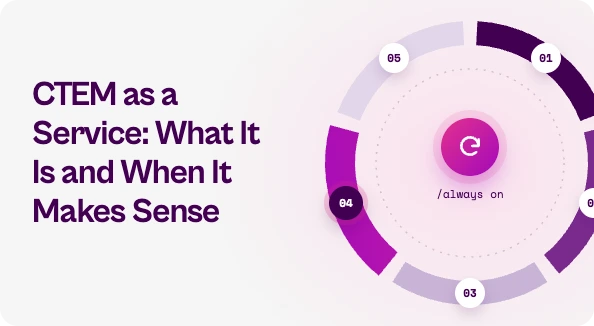
A quick refresher on the framework. Gartner splits CTEM into five stages:
- Scoping. Decide which parts of the business and attack surface matter most right now.
- Discovery. Find the assets, vulnerabilities, misconfigurations, and identity issues in that scope.
- Prioritization. Figure out which exposures actually matter, based on how exploitable they are and what they’d mean for the business.
- Validation. Test whether attackers could really use those exposures, through pentesting, BAS, or red teaming.
- Mobilization. Get the right people to fix the right things, and confirm they got fixed.
Providers can bundle any mix of these. Integrity360 sells a packaged CTEM as a service offering. CrowdStrike and HCLTech have expanded their partnership to deliver AI-powered CTEM services. Plenty of MSSPs now put CTEM language on top of their existing vuln scanning and pentest work, so it’s worth asking what’s actually included.
Why Teams are Looking at CTEM as a Service
It mostly comes down to headcount. A real CTEM program needs people who can scope against business priorities, run and tune scanners across cloud, on-prem, and apps, interpret the results, and run validation exercises. Most teams can’t staff all of that.
A few other drivers:
Continuous is hard. Quarterly pentests and monthly scans aren’t CTEM. Keeping the loop running takes steady effort.
Validation skills are scarce. Good offensive testers are expensive and in demand.
Faster time to value. A provider can stand up discovery and prioritization in weeks instead of quarters.
Board pressure. Leadership has heard of CTEM and wants to know if you’re doing it.
What a Provider Can Run, and What Stays With You
This is the part most CTEM as a service pitches skip.
Here’s how the five stages usually split:
- Scoping: Partly. The provider needs your input on business priorities.
- Discovery: Yes, a provider can run this.
- Prioritization: Yes, and it works better when you share business context.
- Validation: Yes, a provider can run this.
- Mobilization: No. They can advise, but your teams do the fixing.
Mobilization is the odd one out because the fix always happens inside your company. A provider can’t patch your servers, change your cloud configs, or push a code fix into your repos. Your IT, cloud, DevOps, and app teams do that. And those teams already have their own backlogs, ticketing systems, and priorities.
So the usual result looks like this. The provider sends a clean, prioritized, validated list of exposures. It lands in a spreadsheet or a PDF. Then someone on your team has to work out who owns each item, open tickets in the right places, chase people, and check whether anything got fixed. That’s where most CTEM programs stall, managed or not.
Questions to Ask a CTEM as a Service Provider
If you’re comparing providers, these questions cut through the marketing fast:
- Which of the five stages do you actually run? Get specifics. “CTEM” sometimes just means scanning plus a report.
- How often does the loop run? Continuous should mean more than a quarterly deliverable.
- Which tools do you use, and do we keep the data? You don’t want to lose your own exposure history if you switch providers.
- How do findings reach our remediation teams? A PDF isn’t an answer. Ask about ticketing integrations and ownership mapping.
- How do you measure success? Look for metrics like mean time to remediate and exposure reduction, not just the number of findings.
Making CTEM as a Service Actually Lead to Fixes
The teams that get the most out of CTEM as a service treat the provider as one input and keep a strong mobilization layer on their side. That means:
- One place for all findings. Provider output, your own scanners, cloud security tools, and pentest results in one view, with duplicates removed.
- Automatic ownership. Each exposure goes to the team that owns the asset, without anyone sorting it by hand.
- Fixes delivered in the tools teams already use. Tickets go into Jira, ServiceNow, or wherever the work actually happens, grouped in a way that makes sense to the people doing it.
- Closed-loop tracking. You can see what’s fixed, what’s stuck, and what’s overdue, and report on it.
This is where Seemplicity fits. Seemplicity is an Agentic Exposure Action Platform. It doesn’t replace your CTEM provider’s discovery or validation work. It takes findings from the provider and the rest of your security stack, removes duplicates, adds context, maps each one to the right owner, and drives remediation through to closure. It’s the mobilization piece that CTEM as a service can’t do from the outside.
The Bottom Line
CTEM as a service is a solid way to get continuous discovery, prioritization, and validation without building everything yourself. Just go in knowing that the provider tells you what needs fixing. Actually getting it fixed is still up to your teams, and that’s the stage that decides whether the program works.
If your CTEM findings keep piling up without getting fixed, Seemplicity can help you get them moving.

Stay updated on Seemplicity blog
Subscribe today to stay informed and get regular updates from Seemplicity.