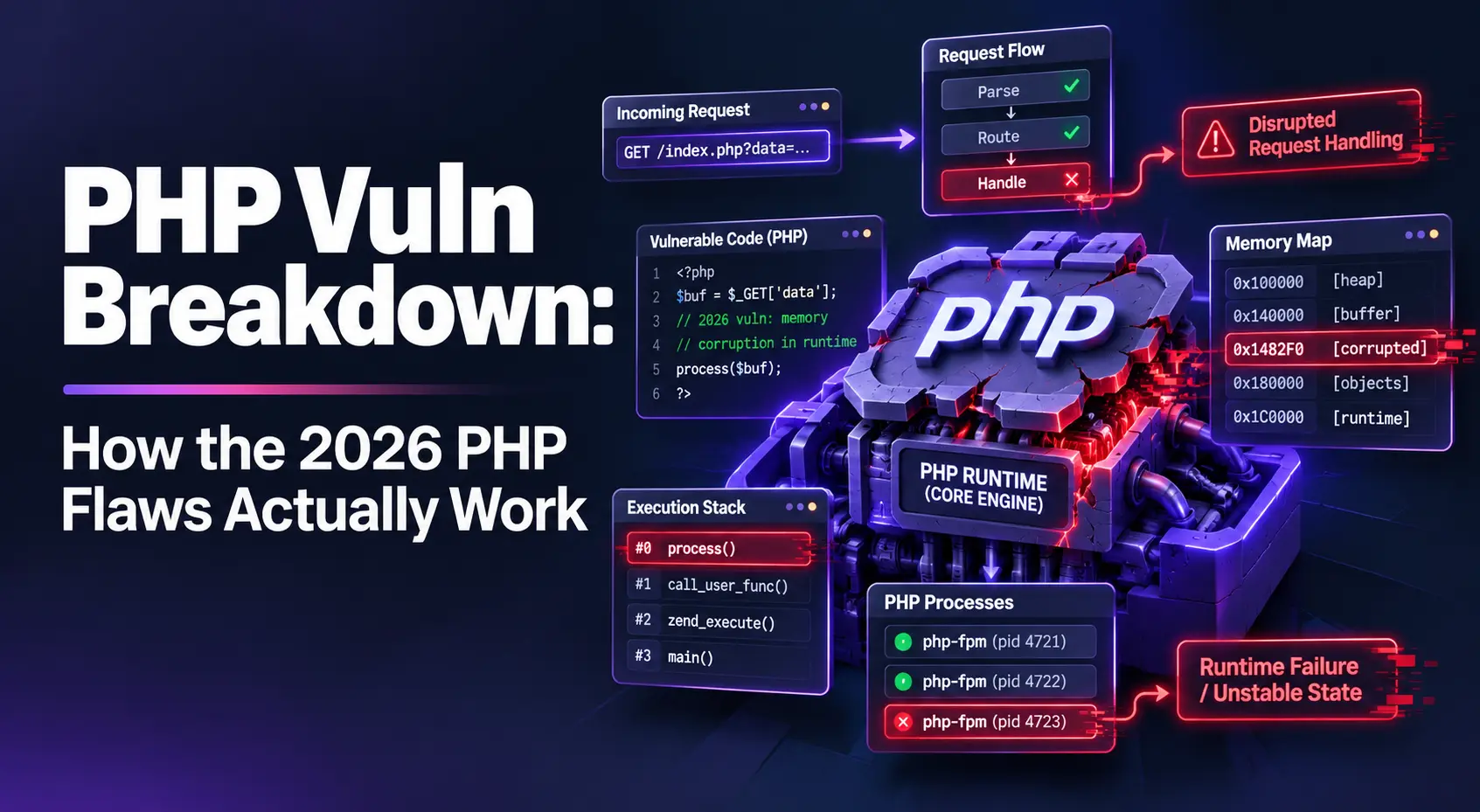
/what Is the PHP Critical Vulnerability in 2026, and How Can You Respond?
Multiple critical PHP vulnerabilities disclosed in 2026, including remote code execution flaws, have put PHP-based applications and servers at risk. Organizations should identify affected PHP versions, assess exploitability and exposure, apply the latest security patches, and verify remediation. Understanding which systems are actually at risk helps security teams prioritize their response and reduce exposure more effectively.
PHP has faced several critical security vulnerabilities in 2026, raising concerns for organizations running PHP-based websites, applications, and services.
In October, two critical PHP vulnerabilities were disclosed that could allow unauthenticated remote code execution (RCE). A further round of security updates followed on November 19, addressing additional weaknesses across supported PHP versions, including flaws affecting session handling, request processing, and other runtime components.
For security teams, the challenge goes beyond identifying vulnerable PHP installations. It’s understanding which systems are actually exposed, how attackers could exploit them, and what needs to happen to reduce risk.
What Is the PHP Critical Vulnerability
The term “PHP critical vulnerability” refers to severe security flaws affecting the PHP runtime that could allow attackers to compromise systems under certain conditions.
Two of the most significant vulnerabilities disclosed in October 2026 were:
- CVE-2026-109618: An out-of-memory handling flaw that can corrupt internal request data, potentially leading to remote code execution.
- CVE-2026-109619: A vulnerability involving stale internal state and freed memory, which can also create opportunities for remote code execution.
Both received critical CVSS v4.0 scores of 9.2. Particularly concerning was the potential for exploitation through unauthenticated web requests, without requiring attackers to compromise an application account first.
The November 19 security releases addressed further vulnerabilities, including weaknesses in PHP’s session handling and memory management that could lead to remote code execution in affected configurations. Unlike the October issues, some of these critical flaws require non-default configurations or uncommon deployment conditions.
Together, these disclosures highlight how vulnerabilities within the PHP runtime itself can introduce security risks even when application code follows secure development practices.
2026+2
Which PHP Versions and Systems Are Affected?
The October vulnerabilities affected supported PHP 8.2, 8.3, 8.4, and 8.5 branches before their respective security fixes.
PHP released the following patched versions on October 21:
- PHP 8.2.35
- PHP 8.3.36
- PHP 8.4.27
- PHP 8.5.12
Additional security releases on November 19 mean organizations should now reference the latest applicable patched version rather than relying on the October updates alone.
Exposure also depends on how PHP is deployed. Web-facing environments using PHP-FPM, Apache mod_php, PHP-CGI, and other execution models may be affected differently depending on the vulnerability.
Organizations should inventory their PHP installations, identify the versions running across production systems, and assess their configurations against the relevant security advisories. Older, unsupported PHP versions require particular attention because they may not receive security fixes.
As of November 22, the latest security releases are PHP 8.2.36, 8.3.37, 8.4.28, and 8.5.13.
2026+1
What Are the Security Risks of Critical PHP Vulnerabilities?
The impact of a critical PHP vulnerability depends on the underlying flaw and the environment in which it exists.
Potential consequences include:
- Remote code execution: Attackers may be able to execute malicious code on vulnerable servers.
- Unauthorized access: Successful exploitation could provide access to sensitive systems or application data.
- Service disruption: Memory corruption and other runtime failures can cause applications or services to crash.
- Further compromise: An exploited server could provide attackers with a foothold for additional malicious activity.
However, a critical severity rating does not automatically mean every affected PHP installation is equally vulnerable to attack.
Actual risk depends on factors such as the server’s configuration, network accessibility, available attack paths, and the importance of the affected asset. Understanding vulnerability exploitability is therefore essential when determining which systems require the most urgent attention.
How to Detect and Respond to a PHP Critical Vulnerability
Organizations should take a structured approach to identifying affected systems and reducing their exposure.
- Identify vulnerable installations. Inventory PHP versions across servers, applications, containers, and other environments, including dependencies and managed infrastructure.
- Assess exposure and exploitability. Determine whether vulnerable components are reachable, whether the necessary exploitation conditions exist, and which business-critical systems are affected.
- Prioritize the response. Use vulnerability prioritization to establish which affected assets need immediate attention based on exploitability, exposure, and business impact.
- Apply security updates. Upgrade affected PHP installations to the latest patched versions. Where updates cannot be deployed immediately, consider temporary vulnerability mitigation measures to reduce exposure, while recognizing that compensating controls may not eliminate the underlying risk.
- Verify remediation. Confirm that patched versions are running, vulnerable configurations have been addressed, and the exposure is no longer present.
For the October PHP vulnerabilities specifically, the PHP security team emphasized that no complete mitigations were available and that updating was the only safe choice.
Moving Beyond Detection to Exposure Response
The 2026 PHP vulnerabilities demonstrate why identifying critical security findings is only part of the challenge.
Security teams need to establish which vulnerabilities are exploitable in their environment, determine the appropriate response, coordinate remediation, and verify that the risk has been addressed.
Seemplicity’s AI Exposure Response Skills help organizations move beyond detection and prioritization by using AI to investigate exposures, validate exploitability and reachability, identify appropriate response options, and take action through existing tools and workflows.
Rather than leaving teams with another prioritized list, Seemplicity helps turn critical vulnerability findings into verified responses that reduce actual exposure.

Stay updated on Seemplicity blog
Subscribe today to stay informed and get regular updates from Seemplicity.