
/Who are the top providers of CTEM platforms?
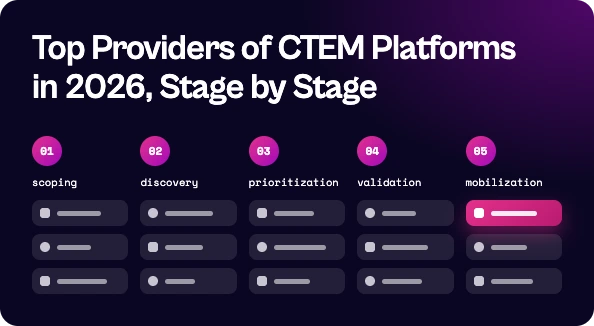
The top providers of CTEM platforms in 2026 include Tenable, Rapid7, Qualys, CrowdStrike, Microsoft, and Palo Alto Networks for broad exposure assessment, XM Cyber for attack path analysis, Pentera, Cymulate, and Picus for validation, and Seemplicity for exploitability validation and mobilization. No single platform covers all five CTEM stages equally well, so most teams combine a discovery and assessment platform with dedicated validation and mobilization tools.
Quick answer: The top providers of CTEM platforms in 2026 include Tenable, Rapid7, Qualys, CrowdStrike, Microsoft, and Palo Alto Networks for broad exposure assessment, XM Cyber for attack path analysis, Pentera, Cymulate, and Picus for validation, and Seemplicity for exploitability validation and mobilization. No single vendor covers all five CTEM stages equally well, so most teams combine two or three.
Most “top CTEM vendors” lists rank platforms against each other as if they all do the same job. They don’t. CTEM is a five-stage program, and each vendor is strongest at different stages. This guide sorts the top providers of CTEM platforms by the stage where they’re strongest, so you can see where your gaps are.
The Five CTEM Stages, in One Line Each
Gartner’s continuous threat exposure management framework runs in a loop:
- Scoping: decide which parts of the business the program covers.
- Discovery: find the assets, vulnerabilities, misconfigurations, and identity risks inside that scope.
- Prioritization: rank exposures by business impact and attack paths, not just CVSS.
- Validation: prove which exposures are actually exploitable.
- Mobilization: get the right people to fix them, and track it to closure.
Gartner’s original prediction was that organizations prioritizing security spend through a CTEM program would be three times less likely to suffer a breach by 2026. Nobody has independently measured that, but it explains why so many vendors now call themselves CTEM platforms.
Top Providers of CTEM Platforms At a Glance
- Tenable One: best for broad coverage across IT, cloud, OT, and identity. Strongest at discovery and prioritization.
- Rapid7 Exposure Command: best for teams already using Rapid7 for VM or SOC. Strongest at discovery and prioritization.
- Qualys Enterprise TruRisk Management: best for risk scoring and quantifying risk. Strongest at discovery and prioritization.
- CrowdStrike Falcon Exposure Management: best for endpoint-heavy environments on Falcon. Strongest at discovery and prioritization.
- Microsoft Security Exposure Management: best for Microsoft-centric environments. Strongest at discovery and prioritization.
- Palo Alto Networks Cortex Exposure Management: best for Cortex and XSIAM customers. Strongest at discovery and prioritization.
- Armis: best for asset visibility, including OT and IoT. Strongest at scoping and discovery.
- IONIX: best for the external attack surface and supply chain. Strongest at scoping and discovery.
- XM Cyber: best for attack path analysis. Strongest at prioritization.
- Pentera, Cymulate, Picus: best for attack-based validation. Strongest at validation.
- Seemplicity: best for exploitability validation and mobilization. Strongest at validation and mobilization.
Best for Scoping and Discovery
Best for broad exposure coverage: Tenable One. Tenable was named a Leader in Gartner’s first Magic Quadrant for Exposure Assessment Platforms (November 2025). It covers cloud, identity, IT, OT, and IoT from one place and includes attack path analysis.
Best for Rapid7 customers: Rapid7 Exposure Command. Also a Leader in the 2025 Exposure Assessment Platforms Magic Quadrant. It’s the natural pick if your vulnerability management or SOC already runs on Rapid7, since it connects vulnerability, cloud, and threat data across hybrid environments.
Best for risk scoring: Qualys Enterprise TruRisk Management. The third vendor named a Leader in the 2025 Magic Quadrant. Qualys is known for its TruRisk scoring, which helps teams express exposure as a business risk.
Best for asset visibility, including OT and IoT: Armis. A good fit for scoping when you don’t yet know everything connected to your network, especially in manufacturing, healthcare, or other environments with lots of unmanaged devices.
Best for the external attack surface: IONIX. Focuses on finding internet-facing assets, including ones managed by third parties and your software supply chain.
Best for Platform-Native Exposure Management
Best for endpoint-heavy environments: CrowdStrike Falcon Exposure Management. If the Falcon agent is already on most of your endpoints, you get exposure data without deploying another agent.
Best for Microsoft environments: Microsoft Security Exposure Management. Pulls exposure data together across the Microsoft security stack. It’s a sensible starting point if most of your controls are already Microsoft.
Best for Cortex customers: Palo Alto Networks Cortex Exposure Management. Brings exposure management into Palo Alto’s Cortex platform, so SecOps and exposure teams work from the same data.
Best for Prioritization
Best for attack path analysis: XM Cyber. Builds attack graphs across hybrid cloud and on-prem environments to show which exposures actually lead to critical assets. It was named a Challenger in the 2025 Exposure Assessment Platforms Magic Quadrant.
Best for Validation
Best for automated penetration testing: Pentera. Runs automated attacks that chain weaknesses together to prove real attack paths inside your environment.
Best for continuous control testing: Cymulate. Runs safe attack scenarios on an ongoing basis to show whether your security controls hold up.
Best for breach and attack simulation with exposure scoring: Picus Security. Pairs attack simulation with scoring so you can see which exposures your controls don’t stop.
These three sit in what Gartner now calls adversarial exposure validation. Its 2026 Market Guide treats that as one category covering both breach and attack simulation and automated pentesting.
Best for Validation and Mobilization
Best for turning exposures into fixes: Seemplicity. Most CTEM programs stall at mobilization, and that’s where Seemplicity focuses. It pulls in findings from the assessment, validation, and AppSec tools you already use. Its AI Analysts then check whether each finding is actually exploitable in your environment by looking at runtime configuration, network reachability, code reachability, and compensating controls like EDR, and each verdict comes with an evidence trail you can audit. From there, the platform groups findings by root cause, finds the right owner, sends tickets into the tools your teams already work in, and tracks each one until it’s closed. When a full fix isn’t possible yet, Response Options suggests alternatives such as configuration changes or compensating controls.
How to Build Your CTEM Stack
Since no single vendor does everything, think in combinations. Three common patterns:
- Assessment platform + mobilization layer. For example, Tenable, Rapid7, or Qualys for discovery and prioritization, with Seemplicity for validation and getting fixes done. Good for teams with a mature VM program and a remediation backlog.
- Assessment platform + attack validation + mobilization layer. Add Pentera, Cymulate, or Picus when you need to test your controls against real attack techniques, not just check whether findings are exploitable.
- Platform-native exposure management + mobilization layer. CrowdStrike, Microsoft, or Palo Alto for teams consolidating around one security vendor, with a mobilization layer so fixes still reach the teams that own them.
Whichever you pick, ask each vendor the same question: which CTEM stages does this platform cover on its own, and which ones depend on another tool?

Frequently asked questions
A CTEM platform is software that supports one or more stages of a continuous threat exposure management program: scoping, discovery, prioritization, validation, and mobilization. Most platforms are strongest in one or two stages rather than all five.
Leading providers include Tenable, Rapid7, and Qualys, which were named Leaders in Gartner’s 2025 Magic Quadrant for Exposure Assessment Platforms. Other major providers are CrowdStrike, Microsoft, Palo Alto Networks, and XM Cyber for assessment and prioritization, Pentera, Cymulate, and Picus for validation, and Seemplicity for validation and mobilization.
Not equally well. Assessment platforms are strongest at discovery and prioritization, validation tools focus on proving exploitability, and mobilization platforms focus on getting exposures fixed. Most organizations combine two or three tools.
CTEM is a program, meaning a continuous five-stage process. Exposure assessment platforms are a Gartner product category that mainly supports the discovery and prioritization stages of that program.
Mobilization. Many teams invest heavily in finding and ranking exposures but have no reliable way to route them to the right owner and track fixes to completion, so the backlog keeps growing.
If your CTEM program is great at finding exposures but slow to fix them, see how Seemplicity can help.
A vulnerability management policy governs how your team handles vulnerabilities internally. A vulnerability disclosure policy tells outside researchers how to report vulnerabilities they find in your products or systems.
Remediation SLAs should use CVSS as a starting point, not the final word. Adjust priority for active exploitation, internet exposure, asset criticality, and compensating controls to focus effort on real risk.
A good vulnerability management policy is short, clear, and enforceable. The real test is whether your team can meet it every week. See how Seemplicity turns your policy into SLAs that actually get met.
Stay updated on Seemplicity blog
Subscribe today to stay informed and get regular updates from Seemplicity.