/what is zscaler ctem and how does it work?
Zscaler CTEM is Zscaler’s continuous threat exposure management offering, built on its Data Fabric for Security. It combines Asset Exposure Management, Unified Vulnerability Management, and Risk360 to inventory assets, consolidate findings, prioritize risk, and quantify it for leadership. That covers much of CTEM’s scoping, discovery, and prioritization. To complete the loop, teams also need validation and mobilization: confirming what’s exploitable, checking whether it’s already blocked, and closing it fast. Seemplicity is built for exactly that.
Zscaler CTEM has become part of the conversation for many security leaders building a continuous threat exposure management program, especially organizations that already run Zscaler for zero trust access.
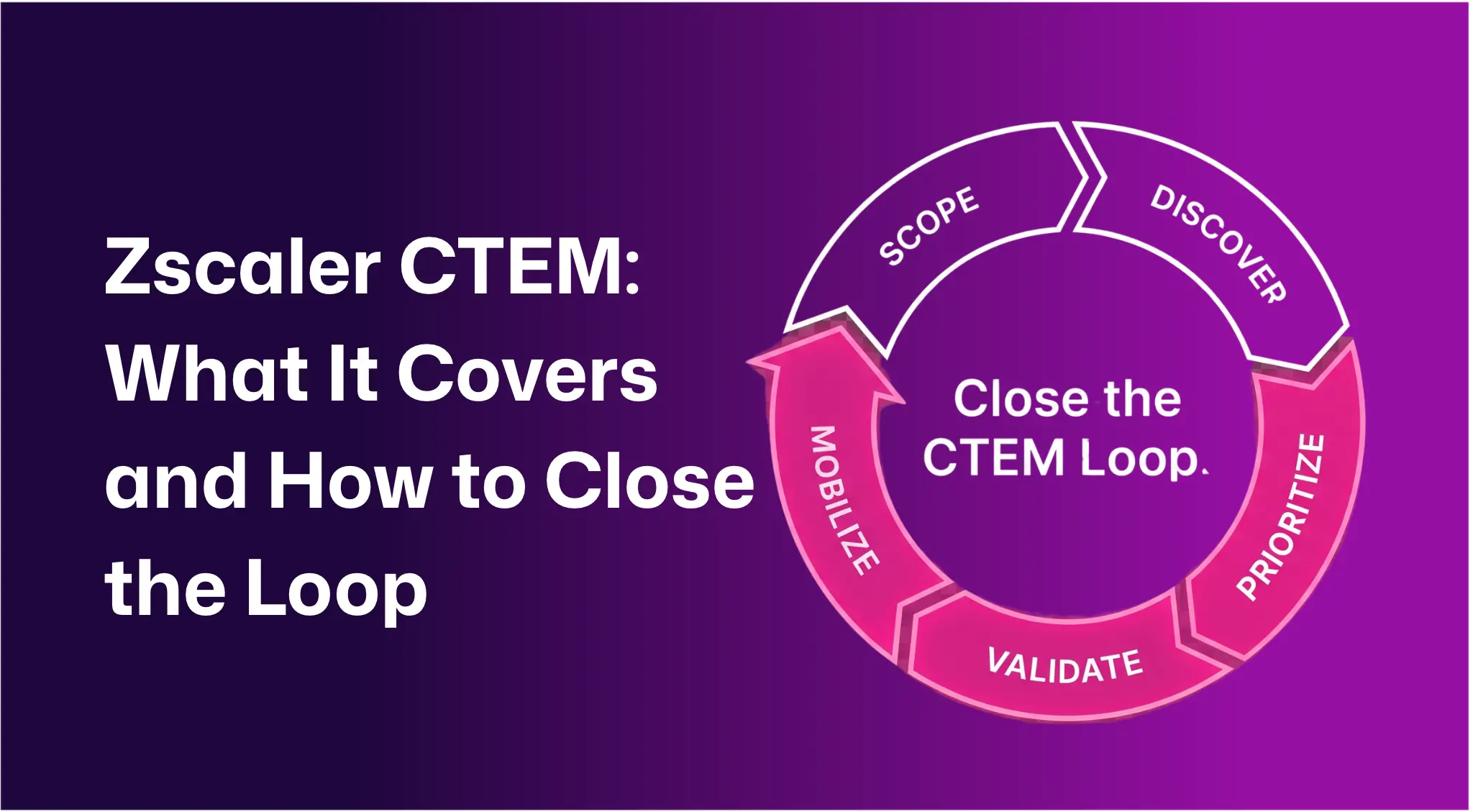
Continuous threat exposure management (CTEM) is Gartner’s framework for moving from periodic vulnerability scanning to an ongoing cycle of understanding and reducing exposure. It has five stages, and no single product has to own all of them. The practical question for any team is which stages a given platform covers well, and where the program still needs help.
This guide explains what Zscaler CTEM includes, how it maps to the CTEM framework, why many programs stall in the final stages, and how Seemplicity helps teams close the loop from exposure to resolution.
What Is Zscaler CTEM?
Zscaler CTEM is a set of exposure management solutions powered by the Zscaler Data Fabric for Security, technology that came from Zscaler’s acquisition of Avalor. The data fabric ingests findings and context from more than 150 security tools and business systems, then harmonizes, deduplicates, correlates, and enriches that data into a unified view of risk.
Several applications sit on top of that foundation:
- Asset Exposure Management, Zscaler’s cyber asset attack surface management (CAASM) offering, builds a consolidated asset inventory, identifies coverage gaps such as missing security controls, and can update the CMDB.
- Unified Vulnerability Management (UVM) prioritizes vulnerabilities using customizable risk factors and mitigating controls, with workflows that provide remediation details and rationale.
- Risk360 quantifies cyber risk, including financial loss estimates, and produces board-ready reporting on top risk drivers.
- Additional capabilities cover external attack surface management, cloud data security, SaaS posture, and identity risk.
For Zscaler customers, a distinctive advantage is the connection to the Zscaler Zero Trust Exchange. Exposure insights can inform policy recommendations, such as restricting access for users associated with risky assets, which creates a feedback loop between exposure data and access control.
A Quick Refresher on the 5 Stages of CTEM
To evaluate any CTEM platform, it helps to map it against Gartner’s five stages:
Scoping: Define which parts of the business and attack surface the program covers.
Discovery: Find assets and the exposures on them, including vulnerabilities, misconfigurations, and identity issues.
Prioritization: Rank exposures by real risk, using threat intelligence, business context, and mitigating controls.
Validation: Confirm whether an exposure is actually exploitable and whether existing defenses would stop an attack.
Mobilization: Get the right people to act, remove friction from remediation, and track exposures to closure.
Where Zscaler CTEM Is Strongest
Zscaler CTEM’s center of gravity is the front half of the cycle. The data fabric and Asset Exposure Management give teams a broad foundation for scoping and discovery. UVM and Risk360 bring prioritization and quantification, so security leaders can explain risk in business and financial terms.
The Zero Trust Exchange connection also gives Zscaler a unique mitigation lever: when exposure data reveals a risky asset or user, teams can adjust Zscaler access policies to reduce risk while longer-term fixes happen. For organizations standardized on Zscaler, that’s a real strength.
Why CTEM Programs Stall at Validation and Mobilization
Many exposure management programs build excellent visibility and prioritization, then find that the backlog barely moves. The challenge used to be detecting threats fast. Today it’s fixing them fast, and the final two CTEM stages are where that happens.
Scores don’t prove exploitability
CVSS and “exploit available” flags mean less than they used to, because AI has made exploits cheap and fast to build. Teams need evidence about whether a specific finding is exploitable on a specific asset, given its configuration, reachability, and exploit prerequisites.
Mitigating controls need to be checked, not assumed
An exposure might already be blocked by endpoint protection, or it might not. A simple yes-or-no coverage badge rarely tells the whole story, and assumptions in either direction waste effort or leave gaps.
Coordination slows everything down
Even a well-prioritized list becomes a bottleneck when every item needs someone to find the owner, open a ticket, explain the fix, and chase the status. Mobilization is where manual work piles up fastest.
Patching isn’t the only answer
Some fixes require change windows and testing. Without safe interim options, high-risk exposures stay open far longer than they should.
4 Questions Every CTEM Platform Should Answer
A practical way to test whether your CTEM stack covers validation and mobilization is to follow a single finding through four questions. If your current tools can’t answer all four, that’s the gap to close.
| Question | Why it matters | How Seemplicity answers |
|---|---|---|
| What’s going on? | Teams need fast answers about findings, owners, and SLAs without digging through dashboards. | Seema, an AI assistant, answers plain-language questions from live findings, scopes, queues, and SLAs. |
| Is it real? | Only exploitable exposures deserve urgent attention. | AI Analysts check exploitability on the asset itself, including live configuration, code and dependency reachability, and exploit prerequisites. |
| Is it already blocked? | Existing defenses may already neutralize the risk. | EDR Compensating Controls Awareness reads live policy from CrowdStrike or Microsoft Defender and shows whether the attack technique is already blocked. |
| How do we close it? | The fastest safe path isn’t always a patch. | Response Options present Fix, Mitigate, or Neutralize choices, with one recommended, reasoning attached, and a safety rating for each. |
How Seemplicity Completes the CTEM Loop
Seemplicity is the only technology that fuses exposure management with autonomous response in one system, rather than leaving teams to stitch two separate tools together. Here’s how a finding moves through the platform:
- Integrate. Seemplicity connects to the scanners and security tools you already run, such as Tenable, Qualys, Rapid7, Wiz, and Snyk, and pulls every finding into one place.
- Deduplicate, aggregate, and enrich. Findings are enriched with EDR coverage, threat intelligence, and KEV data, and grouped by fix: ten findings closed by the same patch become one remediation item, not ten tickets.
- Route to owners. Findings flow into remediation queues for the teams that own them. Each team can set its own priority rules, and role-based access control ensures they see only their own work.
- Sync with ticketing. Bi-directional Jira and ServiceNow integrations keep status, comments, and SLA tracking in sync, so teams can work from either side.
- Validate with AI Analysts. Instead of handing teams a raw list of critical findings, the AI Analysts assess exploitability, network reachability, and EDR coverage. A “P0” whose exploit prerequisites aren’t met can be reprioritized to a P3.
- Choose the right response. Response Options lay out Fix, Mitigate, or Neutralize with a clear recommendation, so risk comes down even before a permanent fix is deployed.
The result is a CTEM program that doesn’t stop at knowing what matters. It moves at the speed attacks now demand, fixing exposures before they become incidents.
Zscaler CTEM or Seemplicity: How to Decide
The right choice depends on your environment and where your program is weakest.
Zscaler CTEM may fit best if your organization is deeply invested in the Zscaler Zero Trust Exchange, values policy-based mitigation within Zscaler, and wants cyber risk quantification and board reporting from the same vendor.
Seemplicity may fit best if your top priority is validating and closing exposures across a multi-vendor security stack, with exploitability confirmed, compensating controls checked, and remediation routed automatically to the right teams.
Evaluating both? Map each platform to the five CTEM stages, test the four questions on your own data, and confirm integration options directly with each vendor.
See Seemplicity in Action
Whatever platforms power the front half of your CTEM program, the outcome that matters is exposures closed before attackers can use them. Request a demo to see Seemplicity in action for yourself.

Frequently asked questions
Zscaler CTEM is Zscaler’s continuous threat exposure management offering. Built on the Zscaler Data Fabric for Security, it includes Asset Exposure Management, Unified Vulnerability Management, and Risk360 to consolidate findings, inventory assets, prioritize exposures, and quantify cyber risk.
No. Zscaler Unified Vulnerability Management is one component of Zscaler’s broader CTEM offering. It focuses on risk-based vulnerability prioritization and remediation workflows, while other applications handle asset inventory and risk quantification.
Gartner’s CTEM framework includes scoping, discovery, prioritization, validation, and mobilization. The cycle repeats continuously as the environment and threat landscape change.
Mobilization is the stage where exposures are actually addressed. It covers communicating findings, assigning owners, removing obstacles to remediation, and tracking fixes to completion. It’s often the hardest stage because it depends on coordination across many teams.
Stay updated on Seemplicity blog
Subscribe today to stay informed and get regular updates from Seemplicity.