
Application Security in Cyber Security: Where AppSec Fits in the Bigger Picture

/what is application security in cyber security?
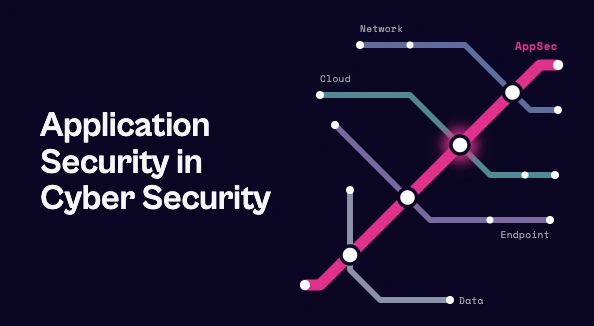
Application security (AppSec) is the area of cyber security that protects software, including its code, open-source dependencies, APIs, and the running application, from threats across its lifecycle. It differs from network, cloud, and endpoint security in two main ways: fixes usually fall to developers, and findings arrive continuously as code changes. In cloud-native environments, though, the lines between domains blur, and real attack paths often cross them. That’s why AppSec works best when its findings sit alongside the rest of your security data and are prioritized by real exposure and business context.
Where does application security sit in relation to network, cloud, and endpoint security, and where does each team’s responsibility start and stop? This post covers what application security means in cyber security, how it differs from other security domains, where those domains overlap, and why AppSec works best when it’s connected to everything else.
What Application Security Means in Cyber Security
Application security (AppSec) is the practice of protecting software from threats across its lifecycle. That covers design and code, open-source dependencies, APIs, and the running application.
Other security domains protect the systems applications run on: networks, cloud infrastructure, and devices. AppSec protects the software itself, including its logic, its inputs, its authentication flows, and the components it’s built from.
That makes AppSec one layer among several in a security program, but often the most exposed one. Applications are frequently public-facing, handle sensitive data, and change constantly. That puts them at the front of the attack surface. The most common application security threats include injection, broken access control, and vulnerable third-party components. The OWASP Top 10 serves as the industry’s baseline reference for them.
How AppSec Differs From Other Security Domains
| Domain | What it protects | Typical tools | Who usually owns the fix |
|---|---|---|---|
| Application security | Code, dependencies, APIs, application logic | SAST, DAST, SCA, IAST, RASP | Developers |
| Network security | Traffic, perimeter, segmentation | Firewalls, IDS/IPS, network scanners | Network and IT operations |
| Cloud security | Cloud configurations, identities, workloads | CSPM, CNAPP, CIEM | Cloud and platform teams |
| Endpoint security | Laptops, servers, devices | EDR, patch management | IT operations |
| Data security | Sensitive data at rest and in transit | DLP, encryption, access controls | Security and data owners |
Two differences set AppSec apart.
Ownership. Most AppSec fixes require a code change, so they land with developers, not the security team. Developers have their own priorities, tools, and sprint cycles. Security can find an issue, but rarely fixes it directly.
Pace. Infrastructure tends to change on scheduled cycles, but application code changes daily. AppSec findings arrive continuously, so point-in-time scans go stale quickly. That’s the reason for DevSecOps: building security checks into the development pipeline instead of bolting them on afterwards.
Where the Lines Blur
Cloud-native architecture has made the boundaries between domains much less clear.
- Container images bundle application code with operating system packages.
- Infrastructure-as-code templates are code that defines cloud infrastructure.
- APIs are both application components and network-exposed entry points.
Attackers don’t care which team owns which layer. A typical attack path might chain three findings. A vulnerable open-source library is an AppSec finding. It runs in a service on an internet-facing workload, which is a cloud and network finding. And that workload has over-permissive identity rights, which is a cloud finding. Each one might look like a medium risk on its own. Together, they form a critical path.
Different tools flag each piece of that path in their own format and on their own severity scale. Sometimes two tools flag the same underlying issue separately. Unless someone connects the findings, the path stays invisible.
Core Components of AppSec Within a Security Program
Most mature organizations combine several of these components:
- Security testing: SAST for source code, DAST for running applications, SCA for open-source dependencies, and IAST for instrumented testing.
- Runtime protection: web application firewalls (WAFs) and runtime application self-protection (RASP) to detect and block attacks in production.
- Secure development practices: threat modeling, secure coding standards, and code review.
- Posture management: ASPM aggregates findings across testing tools to give a unified view of application risk.
How these fit together depends on your application security program, your stack, and how your teams ship software.
Why AppSec Can’t Operate as a Silo
When AppSec runs separately from the rest of security, each domain ends up with its own backlog, its own scoring scale, and its own definition of “critical.” The organization then has no consistent way to decide whether an application vulnerability matters more than a cloud misconfiguration, or which one to fix first.
AppSec findings also need infrastructure context to reflect real risk. A severity score alone can’t answer questions like these:
- Is the affected service internet-facing?
- Is it running in production?
- Does it touch sensitive data?
Answering those questions is the core of effective vulnerability prioritization, and the answers usually live outside AppSec tools.
Leadership also needs a single view of risk across the whole environment, not a separate report for each domain. That’s why more organizations are taking an exposure management approach, treating findings from every domain as one pool of risk.
How Seemplicity Fits
Seemplicity doesn’t replace your AppSec tools. It connects what they find to the rest of your security data.
Seemplicity aggregates findings from AppSec tools alongside cloud, infrastructure, and other security tools, then normalizes and deduplicates them into a single view. It prioritizes each finding based on exploitability, exposure, and business context, then identifies the right owner and routes the fix into the tools developers already use. Every fix is tracked through to closure.
The result is application risk that’s managed as part of your overall exposure, not in a separate silo.
Making AppSec Part of Your Whole Security Strategy
Application security is a distinct discipline in cyber security, with its own tools, owners, and pace. But applications don’t run in isolation, and neither do attacks. The strongest programs give AppSec the specialist focus it needs and connect its findings to the rest of the environment. That way, every team works from the same picture of risk.
Stay updated on Seemplicity blog
Subscribe today to stay informed and get regular updates from Seemplicity.