

/What do attack surface management tools do?
Attack surface management tools continuously discover, inventory, and monitor the assets attackers could target, including unknown and unmanaged ones. EASM tools map your internet-facing footprint, while CAASM tools unify internal asset data. When choosing one, look for continuous discovery, accurate classification, risk-based prioritization, and strong integrations. Just as important is what happens after discovery: findings only reduce risk once they’re prioritized, assigned, and fixed.
Most organizations have more internet-facing assets than they think. Cloud workloads spin up and down daily, teams adopt SaaS apps without telling security, and acquisitions bring entire networks nobody has fully mapped. Every one of those assets is a potential entry point.
The problem is simple: you can’t secure what you don’t know exists. Attack surfaces change faster than any manual process can track, which is why attack surface management tools have become a core part of the modern security stack. They give security teams a continuous, attacker’s-eye view of what’s exposed, so gaps get found before someone else finds them.
What Are Attack Surface Management Tools?
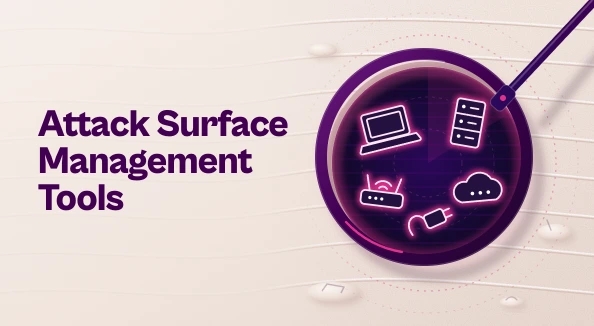
Attack surface management (ASM) tools continuously discover, inventory, and monitor the assets an attacker could target. That includes domains, IP addresses, cloud instances, exposed services, APIs, and forgotten or unmanaged systems.
What sets them apart is perspective. Traditional vulnerability scans only check the assets you already know about and point them at. ASM tools work from the outside in, looking for anything connected to your organization, whether or not it’s on an official list. That’s the foundation of continuous attack surface management: finding the unknowns, not just rechecking the knowns.
Types of Attack Surface Management Tools
ASM is a broad category, and tools tend to fall into one of two camps:
- External attack surface management (EASM): Maps your internet-facing footprint the way an attacker would, including domains, subdomains, certificates, open ports, and exposed services. EASM is especially good at surfacing shadow IT and assets left behind after projects end.
- Cyber asset attack surface management (CAASM): Focuses on internal visibility. Instead of scanning from outside, CAASM tools pull data via API from the tools you already run, such as EDR, CMDB, cloud, and identity platforms, to build a unified view of every asset.
Some platforms combine both approaches, but coverage varies a lot between vendors. It’s worth being clear on which problem you’re solving first.
Key Capabilities to Look For
The best attack surface management tools share a core set of features:
- Automated, continuous discovery: Assets should be found as they appear, not in a quarterly sweep. This includes unknown and unmanaged assets.
- Accurate asset inventory and classification: Every asset tagged with an owner, business context, and criticality, so findings mean something.
- Exposure detection: Vulnerabilities, misconfigurations, expired certificates, and exposed credentials or services.
- Risk-based prioritization: Context on exploitability and business impact, not just a raw list of findings.
- Integrations: Connections to ticketing, SIEM, and the rest of your security stack, so findings flow into existing workflows.
- Change tracking and reporting: A clear view of how your attack surface shifts over time.
How to Choose the Right ASM Tool
Feature lists only get you so far. When evaluating options, focus on fit:
- Map it to your environment. A cloud-native company needs different coverage than a hybrid enterprise with subsidiaries and frequent acquisitions.
- Test discovery accuracy. Run a proof of concept and check how many real assets it finds, and how many false positives it generates along the way.
- Check workflow fit. A tool that doesn’t integrate with how your teams already work will create a new silo instead of closing gaps.
- Plan for scale. Your attack surface will grow. Make sure pricing and performance hold up as it does.
- Ask what happens after discovery. Finding exposures is step one. The real question is how those findings get prioritized, assigned, and fixed.
Common Limitations of ASM Tools
ASM tools are very good at what they’re built for: visibility. Where teams run into trouble is everything that comes after.
- More findings than capacity. Better discovery means more exposures surfaced, often far more than security and IT teams can work through.
- Siloed results. ASM findings typically sit alongside data from vulnerability scanners, cloud security tools, and AppSec tools, each with its own format and severity scale.
- Unclear ownership. An exposed asset is only fixed when someone owns it. ASM tools can find the asset, but often can’t tell you who’s responsible for it.
- Visibility isn’t risk reduction. A complete map of your exposures is valuable, but it doesn’t close a single one on its own.
Where Seemplicity Fits In
Seemplicity isn’t an ASM tool. It works alongside them, picking up where discovery leaves off.
Seemplicity’s Agentic Exposure Action Platform pulls in findings from your attack surface management tools along with the rest of your security stack. It handles deduplication and normalization so the same exposure isn’t counted five times, applies business context to vulnerability prioritization, and routes each fix to the team that owns it. The result is a direct line from “we found it” to “it’s fixed,” which is exactly what a continuous threat exposure management program depends on.
Turning Attack Surface Visibility Into Action
Attack surface management tools are foundational. Without them, you’re defending an environment you can only partly see. But visibility is the starting point, not the finish line.
The teams that get the most value from ASM pair discovery with strong prioritization, clear ownership, and a repeatable path to remediation. That’s how a growing list of exposures becomes a shrinking one.
Want to see how Seemplicity turns ASM findings into fixes? Book a demo.

Stay updated on Seemplicity blog
Subscribe today to stay informed and get regular updates from Seemplicity.